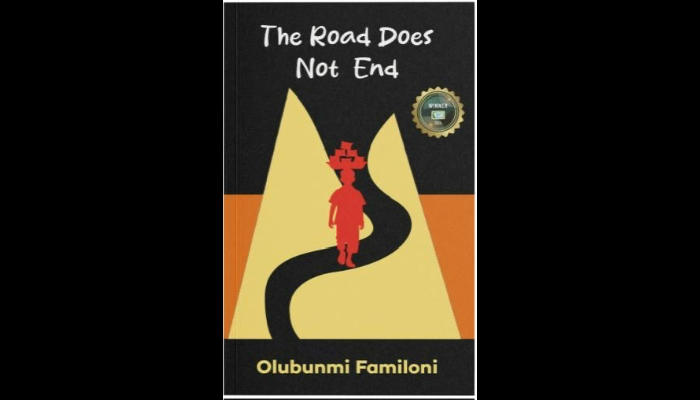
Book: The Road Does Not End
Author: Olubunmi Familoni
Year: 2024
Publisher: Noirledge Publishing
ISBN: 978-978-60194-9-9
Pages: 147pp
Reviewer: Nia Ihuoma Alexxis
There is something almost deceptive about The Road Does Not End by Olubunmi Familoni. It reads simply. Too simply, at first. The language doesn’t strain. The story doesn’t announce itself as “important.” It just starts. A boy. A home. And then suddenly, no home at all.
Rilwan’s life doesn’t fall apart in a dramatic, cinematic way. It simply… disappears beneath him. One moment, he’s a child with stability, and the next, he’s being handed over to an aunt who treats him less like family and more like free labour. No warning. Just a quiet transition into survival mode. And that quietness is precisely what makes it unsettling. Because it feels too real. Like a fate that could befall anyone, without warning.
What Familoni excels at is refusing to romanticise suffering. There’s no poetic softening of what it means to be a child hawking on the streets, exhausted, invisible, and entirely at the mercy of adults who should know better.
Rilwan is not “resilient” in the Pinterest-quote sense of the word. He is tired. He is confused. Sometimes he is hopeful in small, stubborn ways that don’t even seem like hope until you step back and recognise that’s exactly what it is.
And then there’s the world around him. It’s messy, unpredictable, occasionally kind, and mostly indifferent. His friendship with Moshood doesn’t come wrapped in speeches about loyalty. It just exists. Two boys are figuring out how to stay afloat without drowning each other in the process.
But the book doesn’t remain in that darkness forever, and that’s when it becomes something more than just a story about hardship. When Saka Pepper enters, it would have been easy for him to feel like a convenient saviour. He doesn’t.
He feels like what he truly is: proof that one decent adult can break a cycle that seemed inevitable, long enough for something else to develop.
And that “something else” is where the book quietly shifts pace. Rilwan is finding his way back to school. Holding on to music like it’s the last piece of himself that hasn’t been taken.
Beginning, slowly, awkwardly, to imagine a future again.
This is also precisely why this book won the Nigeria Prize for Literature. Not because it shouts the loudest, but because it sees clearly. It confronts a reality that many prefer to ignore, especially those not experiencing it firsthand, and compels you to face it without looking away.
It balances craft and purpose without becoming preachy, which—coming from a writer—is more challenging than it seems.
One thing I really appreciated is that it doesn’t talk down to its readers. It doesn’t over-explain, dumb down, or spoon-feed emotions in the way many Nigerian children’s books tend to. It trusts that the reader can keep up, read between the lines without needing everything broken down for them. And honestly, this is the kind of book Nigerian children should be reading. Not because it’s “educational” in that stiff, curriculum-approved way, but because it respects them. It doesn’t pretend the world is softer than it is. It gives them a character who feels things they might not yet have the words for: fear, displacement, quiet anger, that strange mix of hope and doubt that comes when life doesn’t go the way it was supposed to.
More importantly, it expands their understanding of others. A child reading this who has never considered street life will start to see those children differently. And a child who has experienced even a fraction of Rilwan’s reality might finally feel recognised in a way that isn’t pitying or exploitative.
That said, there were a few moments where I wished it had delved a bit deeper emotionally.
The writing is very simple and easy to follow, which works, but sometimes it feels like it pulls back just when you want to fully sit with what Rilwan is feeling. You understand his situation, but you don’t always feel completely inside his head.
Also, some parts wrap up a bit more neatly than I expected. Not in a bad way, just slightly convenient compared to the rest of the story, which feels raw. Some characters fall into place a bit too smoothly at times. It doesn’t ruin anything, but it does take a tiny bit away from how real everything else feels.
By the time you finish the book, nothing is perfectly resolved. His parents are still gone. The past hasn’t been neatly tied up. But Rilwan is moving forward, and that’s the point: The road doesn’t end. It just keeps going, whether you’re ready or not.
And somehow, that feels more honest than a happy ending.

Join BusinessDay whatsapp Channel, to stay up to date
Open In Whatsapp