Until the gubernatorial election scheduled for August 9 in Osun State is over, various interest groups will continue to discuss the reason(s) why the incumbent administration in the state should return or otherwise.
While those who would want to take over from the current administration are selling their manifestoes, the Aregbesola government and those who strongly believe that there has been a positive change in governance insists that it does not make sense to change a winning team.
Recently, a group of professionals under the umbrella of People’s Welfare League (PWL), organised a two-day economic summit in Osogbo, capital of the state, where indigenes were given the opportunity to critique the performance of the incumbent administration.
Some of those who spoke were of the opinion that Aregbesola was toeing the path of the late Obafemi Awolowo, first premier of the Western Region, in the prudent management of available resources and provision of dividends of democracy for the people.
In his paper, ‘Revamping Awolowo’s economic masterplan: The way of Osun’, Mojeed Olujinmi Alabi, professor of Political Science and Adjunct Professor of Public Law, University of Ilorin, and former speaker, Osun State House of Assembly, observed that the Aregbesola administration was emulating the worthy leadership style of Awolowo in meeting the needs of the people.
Recalling the achievements of Awolowo, he said they included “reform of the Local Government system of the Western Region, improved and Nigerianised Civil Service, a good judge of men’s qualities, put together an efficient team of ministers; recorded, within five years, a string of “Firsts” in the history of Africa; introduced and successfully implemented Free Primary Education programme in Africa; introduced and successfully managed Free Medical Service programme in Nigeria – for children up to the age of 18, established the first Television Station in Africa, built the Liberty Stadium, the first of such modem sports facility; introduced and successfully implemented minimum wage policy in Nigeria.”
He also noted that the level of poverty in Osun before the coming of the incumbent administration was occasioned by “dwindling national resources, aggravated by immense corruption in high public which resulted in little resources in the service of the people. It has remained a civil service state, and there were missed opportunities and failure of the past.”
Alabi pointed out that a six-point integral action plan, which formed the policy thrust of the current state government had been responsible for the quantum of verifiable deliverables all over the place.
According to him, the cardinal focus of the government is to “Banish hunger, banish poverty, banish unemployment, promote healthy living, promote functional education and promote communal peace and progress.”
The former lawmaker also noted that the Aregbesola administration has created a “new image of ‘Omoluabi’which has not only endeared our people to the right-thinking elements of the wider society but has also created a sense of self-realisation and consciousness that makes an average Osun indigene an epitome of virtue; emancipation of the teeming youths from the scourge of poverty through the O’Yes; regular recruitment into government services devoid of the ‘man know man’ syndrome of the past; massive road construction and economic potentials of a state accessible through good network of roads, regular train services and air transportation, and good network of roads with sustainable drainage that makes commuting within our towns and cities a pleasure rather than a headache. The ‘Ona-Baba-Ona’ that links the farthest part of the state with the capital city, the East bypass, Iwo-Osogbo road, the extended dualisation of the Freedom Way and the triple As (AbdulKareem Adebisi Akande) Trumpet Interchange Bridge, as well as the various road projects in all the LGAs in the state are works that could ordinarily have been unimaginable given the impression created before that Osun was poor.”
He also noted that there is “improved health and medical facilities, including the provision of free glasses (Diigi Omoluabi) and surgery for the needy; welfare packages for the elderly (Agba Osun); prompt attention to traffic and medical emergencies (O’Ambulance); improved security in towns and cities evidenced by low crime rates; rapid transformation of Osogbo and other key urban centres, in contradistinction to the hitherto pitiable state of a state capital, notwithstanding its status as a federal industrial zone, and the Nelson Mandela Freedom Square that is a friendly homecoming attraction for indigenes and passers-by, including the free riders who enjoy the largesse of free mass transport during the festive seasons.”
Alabi said the deliverables were in spite of the fact that Osun “remains among the least paid from the Federation Account, heavy salary bills, low IGR, low industrial base, and unsustainable consumption pattern.”
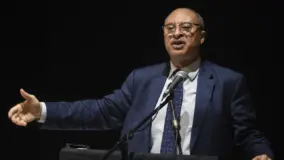
Speaking on ‘The role of prudence and strategic focus in institutional economic management’Lekan Sote, a resource person and policy analyst, said that a prudent government is necessary for successful management of any economy.
Tracing various attempts by different regimes in the country to rein in the problem of hunger and poverty, and enshrine prosperity in Nigeria, Sote noted that the numerous agenda of successive administrations have not helped matters.
The analyst noted that there must be a strategic planning for any meaningful success to be recorded in any enterprise.
“An individual or an organisation must define its strategy, and make choices or decisions on how to allocate its time and resources, to achieve a desired goal. In fact, the desired goal must, in itself, be a result of strategic planning,” he said, adding: “A strategy describes how the ends or goals will be achieved by the means or resources available.”
On the overall theme of the summit: ‘Crux of Economic Developmental Masterplan: Analysing a radical paradigm shift’, Sote quoted Thomas Kuhn (1962) as saying that paradigm shift or revolutionary science is a change in the basic assumptions within the ruling theory of science.
According to him, “When Rauf Aregbesola was confronted with how to get kids to come to school, he came up with the strategy of ‘O’ Meals. The strategy is to entice a poor peasant, who can hardly afford good food for his children, to allow his kids to go to school, to, at least, take one nourishing meal for the day, while also acquiring the knowledge that will stand him in good stead in future.”
The social commentator explained that the administration in Osun had made best choices, hence, the string of successes it has recorded. “So if you manage your economy through prudence and strategic focusing and also by installing certain institutional platforms, you should get the desired result. Institutional economic management must include setting up, and diligently operating according to, certain accepted rules, procedures and processes,” he said.
Sote also recalled: “Someone has postulated that good government should mean: a legitimate and representative government following democratic elections; an accountable administration and a responsive government, characterised by free-flowing information, separation of powers, effective internal and external auditing, low levels of corruption and nepotism, competent officials, realistic policies and low defense expenditure; and respect for human rights, as indicated by freedom of religion and movement, impartial and accessible criminal justice, and the absence of arbitrary government power.
“If you add Section 14 (2) (b) of Nigeria’s 1999 Constitution, which says: ‘Security and welfare of the people shall be the purpose of government,’ you get the entire gamut of governance.”
“It is against this backdrop that one can determine how well the Rauf Aregbesola’s administration has performed in almost four years at the helm of affairs in The State of Osun.”
Noting some of the laudable programmes that Aregbesola adminstration has put in place to transform the state into a self-sufficient state within the Nigerian Republic, Sote said: “Osun Rural Enterprise and Agricultural Programme (OREAP) plans to make the State of Osun the food basket of the South West, and to supply at least 10 per cent of the food requirements of Lagos State that has a population estimated at 20 million.
“School Computer Tablet (‘Opon Imo’), with the slogan, ‘Empowering Minds, Enriching Lives,’ is a plan to democratise the use of ICT among Osun youths and make them competitive in the global work place.
“Osun School Infrastructure Revamp (O-SCHOOLS). This is an ambitious plan to revamp and upgrade educational infrastructure in The State of Osun, in order to increase and improve the human capital of the state and indeed of Nigeria.
“OYES: This scheme takes idle youths off the streets, by engaging their minds and their hands.
“O-Meals: This is the most interesting of all the programmes. In addition to providing nutritional food for kids who come to school, it comes with a positive side effect of good health for the well nourished children, and keeping the doctor away. It keeps the agriculture industry busy, and so positively energise the economy of the state, with the potential of increasing internally generated revenue to fund government projects for the benefit of the people.”
Zebulon Agomuo

Join BusinessDay whatsapp Channel, to stay up to date
Open In Whatsapp