…Chieftains blame ruling party for woes
… ‘You’re architect of your own misfortune’
With less than two years to Nigeria’s next general election, uncertainty continues to trail the country’s major opposition parties as deep-seated internal crises threaten their preparedness for the 2027 contest.
While leaders of the opposition insist, they remain formidable and capable of dislodging the ruling All Progressives Congress (APC), ongoing factional battles, leadership disputes and unresolved litigations have cast doubts over their cohesion and electoral prospects.
Political observers say the opposition’s inability to resolve internal wrangling may weaken its bargaining power ahead of a crucial election cycle that is already witnessing early alignments, defections and strategic repositioning across party lines among political actors in Nigeria.
Lingering crisis in PDP
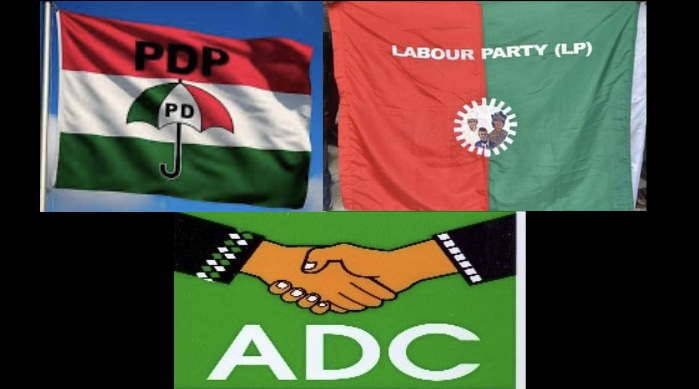
The current crisis rocking the People’s Democratic Party (PDP) remains one of the most pronounced within the opposition fold. Since the presidential primary in 2022, the once ruling party has struggled to regain its footing.
The crisis, which began after the 2023 primary, created deep divisions that contributed to the PDP’s loss in the presidential election. Since then, the party has grappled with recurring disputes over zoning, national leadership and control of state structures.
In the last two years, the fallout from the G-5 governors’ rebellion, unresolved grievances among key stakeholders and fresh disagreements over the party’s national convention have continued to widen cracks within the PDP.
In some states, parallel executives and factional congresses have further complicated reconciliation efforts.
While some chieftains argue that external interference from the ruling party is fueling the divisions, others within the PDP admit that poor internal conflict management and the judiciary have also played destabilising roles.
Read also: Baba-Ahmed says Tinubu risks ‘worst president’ tag if re-elected in 2027
“You would say the problem in PDP did not start today. Some of the issues were resolvable, but the current administration has fuelled it through Nyesom Wike,” a top PDP member who did not want his name in print told BusinessDay.
“Knowing the kind of politicians, we have, they lack integrity, especially when money is involved. They are working together with him to destroy the party.”
The source pointed to the recent failed attempt by the Seyi Makinde faction to hold a national convention, stressing that the judiciary has also been used to destabilise the party.
“Look at the judgments coming from the courts against those who want to make peace in the PDP. They annulled the Ibadan convention and Wike’s faction has been recognised by INEC because some people have influence.”
Temitope Musowo, a political analyst, argued that despite the defections and internal crisis that have grounded the PDP, he does not believe the party would go into oblivion.
“It is a phase. I believe this crisis will not ground the PDP finally. You and I know the crisis is fuelled by external factors, but these people cannot remain in power for life,” he said.
Labour Party’s leadership tussle
Just like in the PDP, the situation is not different in the Labour Party (LP), which rose to national prominence in the 2023 general election.
Since the election, the party has been entangled in leadership disputes and court cases over the legitimacy of its national executive.
In the last two years, many prominent politicians including the party’s presidential candidate in the 2023 poll, Peter Obi have defected from the LP as a result of the internal dispute.
Factional claims to the party’s leadership have created confusion at both national and state levels, with rival groups holding separate meetings and issuing conflicting directives.
Recently, the Nenadi Usman-led national caretaker committee of the Labour Party formally assumed control of the party’s national secretariat in Utako, Abuja, signalling a fresh phase of rebuilding and expansion following a Supreme Court judgment affirming her leadership.
Speaking to party faithful, stakeholders and journalists after taking office, Usman described the handover as both symbolic and pivotal for the party’s future, noting it was the first official activity at the secretariat since the April 4 Supreme Court ruling that ended a prolonged leadership crisis.
However, many party members have refused to accept her leadership and are continuing the fight.
Political analysts warn that unless the LP resolves its structural instability, it may struggle to sustain the momentum it built among urban voters and young Nigerians in 2027.
Some LP stakeholders allege that the crisis is being sponsored by external forces threatened by the party’s rising influence.
Critics, however, counter that the party’s weak institutional framework and lack of internal cohesion are largely responsible for its troubles.
“The momentum the LP had in the last election obviously is a threat, and they are working hard to kill the party.
Most of these men fighting the party, using their proxies, are prominent figures in the country,” a source in the LP said.
The source added that although much damage had been done to the party’s membership structure across Nigeria since 2023, the recent court ruling favouring the Usman faction had given the party a new beginning.
“The LP will bounce back. It may not be as strong as we had in 2023, but it will be an alternative platform,” Musowo argued.
Read also: Transmission ‘Wahala’: As lawmakers tinker, trust in 2027 election wanes
Allegations against the ruling party
Across opposition platforms, there is a recurring narrative that the APC is deliberately exploiting internal weaknesses to destabilise rival parties ahead of 2027.
Opposition chieftains accuse the ruling party of encouraging defections, sponsoring parallel executives and using state institutions to tilt the political landscape in its favour.
An opposition politician who spoke on condition of anonymity noted that there is a systematic attempt to weaken alternative voices before 2027.
“People are being coerced to join the APC with promises of automatic tickets and money. They may not tell you, but that is what is happening,” the politician said.
However, leaders of the APC have dismissed such claims, arguing that the opposition’s woes are self-inflicted.
“They cannot blame us for their inability to manage their internal affairs. If people are defecting, it is because they see direction and stability here,” Sunday Oloko, an APC chieftain, said.
2027: Coalition or fragmentation?
Although the opposition formed a coalition that fused into the African Democratic Congress (ADC), questions still arise about the strength of the party to challenge the ruling party in the 2027 polls.
Many stakeholders believe that only a broad-based alliance can challenge the APC’s national spread and incumbency advantage.
They argue that the current ADC does not appear united nor possess the national spread required to defeat the APC.
There are also concerns that the quest for the party’s presidential ticket among key political figures Atiku Abubakar, former vice president; Peter Obi, former presidential candidate; and Rotimi Amaechi, former Rivers State governor could lead to division and disagreements that may scuttle its chances in 2027.
Kunle Okunade, a political analyst, said that after the formation of the coalition which fused into the ADC, building the party’s grassroots presence across Nigeria should have been the next priority of its leaders.
He expressed fear that the ADC may not be ready for 2027, because its leaders are not doing enough to sell the party amid the growing dominance of the ruling party.
According to him, personal ambitions of key political figures could further complicate the party’s quest to mount a formidable challenge in 2027.
Whether the opposition can overcome its internal crises and present a united front remains uncertain.
What is clear, however, is that time is ticking. Without genuine reconciliation and strategic clarity, the opposition risks entering 2027 fragmented.
For many Nigerians, the unfolding drama raises broader concerns about the health of the country’s democracy.
With major political parties in one form of crisis or another, many citizens fear the country may be sliding toward a one-party state, with no viable alternative to rival the APC in 2027.
With economic hardship, insecurity and governance issues dominating public discourse, citizens are increasingly demanding credible alternatives and issue-based campaigns rather than internal party squabbles.
Whether the opposition can overcome its internal crises and present a united front remains uncertain.

Join BusinessDay whatsapp Channel, to stay up to date
Open In Whatsapp