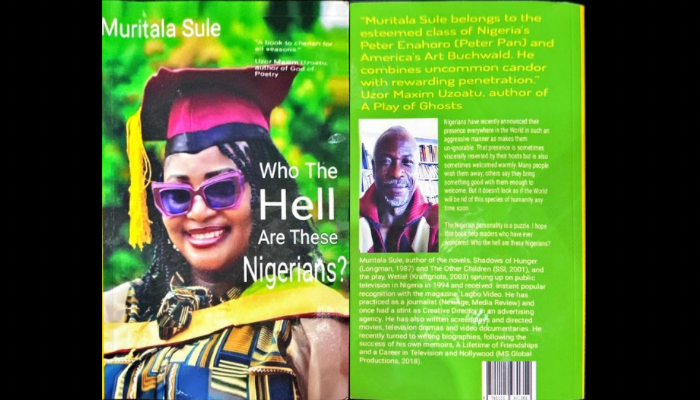
Book: Who The Hell Are These Nigerians?
Author: Muritala Sule | Year: 2025 | Publisher: MS Productions Limited
ISBN: 978-1-105-93135-2
Review by Chido Nwakanma
In Who The Hell Are These Nigerians? Journalist and filmmaker Muritala Sule offers a multifaceted analysis of the Nigerian character, aiming to answer his provocative title through the paradoxes, struggles, and triumphs that shape his compatriots. Combining personal anecdote, historical references, social media analysis, and journalistic research, Sule argues that the traits often associated with Nigerians—aggression, overconfidence, hard work, and resilience—are not innate but developed through failed governance.
Structured across ten chapters, the book develops this case methodically. The opening preamble and first chapter shape global perceptions of Nigerians, anchored by a viral video that displays international ambivalence: admiration for Nigerian confidence and success, and disdain for perceived aggression and links to fraud. Sule’s central answer to the question “What makes Nigerians so different?” is typically blunt: “No Government! That’s what.”
Chapters two and three argue that Nigeria functions as if it has no effective government. While institutions exist, Sule claims they are lacking individuals of integrity to uphold them, resulting in a widespread “morality deficit.”
Without basic state services—power, water, security, education—citizens become “governments unto themselves,” pushed into a relentless hustle that fosters the aggressive, hyper-vigilant Nigerian identity.
Chapters four and five situate this thesis within Sule’s own experiences of “scrambling for life.”
Vivid, frustrating accounts of dealing with bribery at the Seme border, chaos at airports, and the daily struggle for basic services demonstrate the impact of systemic dysfunction.
Comparing these with the relative order and civility in neighbouring Togo and Burkina Faso, Sule illustrates how working systems encourage more relaxed, trusting populations.
Chapter six shifts to resistance. Sule argues that the same survival instinct that drives the hustle also fuels fierce opposition to injustice. His participation in the “Ali Must Go” protests and personal battles with greedy bus drivers and corrupt bank officials exemplify a deep-seated refusal to be cheated.
Chapter seven balances the portrait with warmth, sharing stories of spontaneous communal empathy—strangers helping retrieve scattered manuscript pages, his daughter’s innate kindness abroad. Here, Sule highlights communal values, family bonds, and generosity as the backbone of Nigerian society, standing in stark contrast to a government that, as Fela Anikulapo-Kuti sang, “brings out the beast in us.”
Chapters eight and nine examine the “Japa” (immigration) syndrome, highlighting the desperation to leave due to limited opportunities, a fractured education system, and daily struggles for survival. However, they also include stark warnings from Nigerians abroad about loneliness, high costs, and new hardships—serving as reminders that the grass is not always greener.
The final chapters bring resolution. Sule highlights individuals like Dr Julius Oni, who reversed their Japa to return and contribute, and honours everyday heroes such as Immigration Officer Ugochukwu Orji and Cleaner Faiza Abdulkadir, whose integrity reflects the “soul of Nigeria” worth fighting for.
Analysis
Strengths
The book’s central thesis—that Nigerian character results from state failure—is both convincing and fundamental. Sule effectively connects macro-level governance collapse to micro-level psychology, portraying traits like aggression and hyper-industriousness as logical survival strategies. His engaging first-person narrative is the work’s greatest strength; encounters with border officials, bank managers, and bus conductors serve as vivid ethnographic examples, immersing the reader in Nigeria’s chaotic reality. Sule avoids one-dimensional portrayals, recognising negative stereotypes while highlighting intelligence, work ethic, family values, and community warmth. His use of contemporary references—viral TikToks, tweets, Afrobeats, the Japa movement—anchors the analysis in the present, lending the book urgency. Importantly, it fulfils its stated aim: to help those who engage with Nigerians understand that behaviour is often a response to environment, not an inherent flaw.
Weaknesses
The abundance of personal anecdotes occasionally overwhelms the analytical structure, resulting in meandering passages and thematic repetition that tighter editing could have addressed. The book is primarily driven by personal experience; a more in-depth engagement with political economy—such as mechanisms of oil wealth mismanagement and structural adjustment programmes—would have strengthened the “no government” diagnosis.
Sule’s fond memories of 1960s Lagos sometimes slip into romanticised nostalgia, glossing over the era’s complexities and inequalities. Finally, while he recognises Nigeria’s diversity, he does not thoroughly examine how the Nigerian character varies across ethnicity or class, often treating “the Nigerian” as a somewhat monolithic figure.
Themes and Significance
• The “No Government” State: The book’s most significant contribution is its exploration of life in a practically stateless society, showing how the absence of a formal state compels citizens to build parallel systems of survival, justice, and support. Sule rejects the notion that Nigeria lacks strong institutions, pointing instead to a deficit of character within existing structures.
• Duality and Paradox: Sule returns constantly to contradiction—Nigerians as both “dead serious” and “unserious,” hated and loved, corrupt and deeply generous—suggesting this duality is not a flaw but survival-born superpower.
• Agency and Resistance: Despite the bleakness of state failure, the book focuses on human agency. Nigerians are depicted not as passive victims but as active agents who resist, adapt, and innovate. Their success abroad becomes an extension of skills developed while surviving at home.
• A Love Letter to Nigeria: Beneath the critique of government lies a heartfelt tribute to the Nigerian people. Sule’s admiration for their resilience, intelligence, and warmth is unmistakable, and he concludes with a powerful affirmation that, despite its flaws, Nigeria is where he and many feel “most alive.”
Who The Hell Are These Nigerians? is a vital contribution to understanding modern Nigeria—part memoir, part social commentary, part cultural defence. While it may not satisfy readers seeking purely academic analysis, its strength lies in its raw, deeply felt portrayal of a people forged in the crucible of a failed state. It answers its own question by demonstrating that to be Nigerian is to be a complex, resilient, and irrepressible product of an environment that demands everything.
Situating the Book in Nigerian Literature
Sule’s work belongs to a rich tradition of Nigerian non-fiction that combines personal memoir, social commentary, and political critique to explain the country’s realities for domestic and international audiences.
It resonates with essay collections like Of This Our Country (2021 anthology edited by Adeyemi Akande), which explore identity through a personal lens, although Sule’s perspective is distinctly grounded in a lifetime of experiencing dysfunctional systems firsthand. It examines themes central to contemporary literature—particularly the Japa phenomenon and diasporic identity discussed in novels such as Chimamanda Ngozi Adichie’s Americanah and Buchi Emecheta’s Second Class Citizen—highlighting how the “hustle” mentality cultivated at home becomes vital abroad. By arguing that Nigerian character stems from “no government,” Sule offers an accessible voice to academic analyses of political disfunction, such as Nimi Wariboko’s Ethics and Society in Nigeria.
The book also continues the tradition established by Peter Enahoro’s How to Be A Nigerian, a satirical guide from the 1960s that uses humour to analyse national character. Their main arguments differ in revealing ways.
Enahoro depicted the Nigerian as “the player”—a social actor performing roles within a complex, informal system, criticising the individual’s role in perpetuating chaos. Sule, by contrast, views today’s Nigerian as “the hustler”—a survivor shaped by hardship, whose traits, though sometimes irritating, are practical and commendable.
While Enahoro identified symptoms, Sule investigates causes. Together, they offer a fuller picture: Enahoro invites us to laugh at ourselves; Sule encourages us to understand ourselves by recognising who has let us down. Enahoro’s work remains a timeless satire of human nature in a Nigerian context; Sule’s is a pressing, contemporary critique of the Nigerian state.

Join BusinessDay whatsapp Channel, to stay up to date
Open In Whatsapp