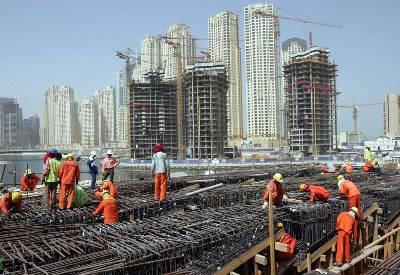
Economic challenges in Nigeria have cut construction activities in the country, forcing companies to work below 30 percent capacity, amid clients’ inability to meet contractual obligations in a timely manner, experts say.
They add that economic lull in 2015 led to suspension of works at sites by construction firms and staff retrenchment by companies that could not stand the pressure within the year.
But George Marks, managing director of Julius Berger Nigeria plc, expects that economic stimulus programmes in the form of budget, reconstruction programme for the North-East, implementation of the National Integrated Infrastructure Master Plan and the National Industrial Revolution Plan (NIRP) could stimulate the construction industry and revive the Nigerian economy.
Speaking at an investor forum held in Lagos on Tuesday, Marks said the improvement in the international reputation of Africa’s biggest economy was a positive for the country, but cautioned that there was the need to facilitate the ease of doing business.
Julius Berger boss said reforms could steer the Nigerian economy, even though it could take a minimum of two years to bear fruits, as the business trajectory of the construction firm was good and workable.
Julius Berger made a profit of N133.8 billion in the financial year ending 2015, a 32 percent decline from 2014. This shows low oil prices, revenue and external reserves, foreign exchange scarcity and interest rates impacted the firm negatively in 2015.
Marks said the Federation of Construction Industry (FOCI) now sought a bailout programme for the sector, as struggling FOCI member-companies now work below 30 percent capacity.
“We continue to believe in the resilience of Nigerian economy and encourage research and development, transferring new technological and technical know-how to staff and domestic contractors for ever improving human capital development,” Marks said.
According to the management, the company has efficiently and effectively managed available resources to generate profits and maintain a solid liquidity position while still distributing dividends.
Wolfgang Kollermann, financial director of the company, said Julius Berger’s profitability was sustained within the period because the management proactively and rationally developed stringently targeted and efficient measures to alleviate the effects of the economic downturn and mitigate potential adverse consequences.
Kollermann announced a dividend of N1.50k per ordinary share against N2.70k obtained in 2014, adding, “we have decided to keep the culture of Julius Berger and protect the interest of the shareholders.”
This situation equally affects the related cash-strapped steel firms, who complain of lower demand amid product glut and high indebtedness.
“Utilisation is low because the demand is low at the moment. It has been low for a year and it is likely to change once the infrastructure spend comes through the budget. Most of the construction companies have not been paid for the jobs they have done. Once the construction companies are paid, they pay our dues which are outstanding and place new orders,” Raj Gupta, chairman, African Industries Group, a consortium of 12 companies, including six steel plants told BusinessDay.

Join BusinessDay whatsapp Channel, to stay up to date
Open In Whatsapp