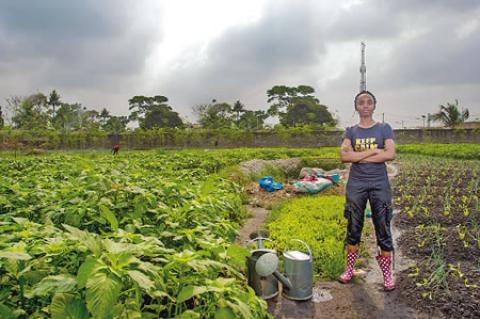
 ADERONKE ADERINOYE; Founder, Agrihub Nigeria
Biography
Aderonke is a farmer with over 6 years’ experience in agriculture, a graduate of Biochemistry from the University of Lagos. She holds a PGD in Community Relations from the Pan Atlantic University (PAU) and a certificate in Market and Social Research conducted by PAU in collaboration with GFK, Verin Germany.
An Alumni of the prestigious US consulate International Visitors Leadership Programme – Farm to Table 2013. She is also an Alumni of the Tony Elumelu Entrepreneurship Programme 2015. Winner WIMBIZ impacts investment award 2015 and a finalist at British Council Enterprise Challenge 2016.
She holds a certificate in Agriculture, Economics and Nature from the University of Western Australia with over four years’ of experience in various roles ranging from business development, marketing, electronic banking and customer support in the Nigerian Banking sector.
She is the founder of Agrihub Nigeria. She has embarked on an ambitious project to change the farming system for small holder farmers in Nigeria and indeed Africa with Ivory Green City (IGC) agricultural estate scheme, which is a go-to place for new generation small scale farmers providing them with space to grow crops, store, process their produce and acquire relevant training on site for improving productivity and generating sustainable profit-making business. IGC is much more than a farm and business point, it is an incubator, a training environment and a social network platform targeted at youths.
For the love of Agriculture
I discovered my love for agric in a geography class in SS2, or I would say, I received the call to Agriculture then, I tried to study agriculture in university, but was discouraged from studying it because my agric teacher then told me to see the President, Olusegun Obasanjo, he was a successful farmer that did not study agriculture, he advised I studied something else as this did not stop me from having a farm in future if that was my overall objective.
So I can say I have been a student of Agriculture since then, mopping up information speaking to people in the agricultural space, meeting farmers and so on. I picked up again when I went to serve, I served in Borno state, I would visit farms, research station for IITA and so on. I started working on my first farm in Epe immediately after service year, growing and processing cassava and oil palm but couldn’t stay there for too long because there was no funding for the farm.
I turned to fashion business to raise money but one of my major deals went bad and I became bankrupt, I got a job in the bank around that time and I proceeded to work in the bank for close to five years, while at the bank, I tried several agricultural ventures and lost quite a lot of money while at it, I realized to run a successful agric venture you need to do it full time.
I won the Tony Elumelu Entrepreneurship program 2015 and used the seed capital to start afresh. I kept at it seeing failures as lessons learnt and a part of the journey to success and I have been at it till now.
Nigeria needs to invest in Agriculture
We need to begin to understand in Nigeria that improvement of the agricultural sector is not in the hands of government alone and is not limited to farming or primary production alone. There is a whole value chain that needs to be developed asides from farming within the agricultural space, as a photographer, lawyer, accountant, engineer, all your skills are needed to develop the agricultural sector.
Everyone needs to begin to look inwards and take responsibility for the development of Nigeria, I always tell people, from my experience while serving in Borno state, Boko Haram was born out of poverty, hunger and starvation. We need to ensure there is no food crisis in Nigeria in the future and ensure we don’t leave a legacy of hunger for our children.
Agrihub
At Agrihub, we have designed agricultural estate, an upgrade of the farm settlement, a unique one-stop Agricultural estate with our pilot seating on 150acres in Ogun state. This is a go-to place for new generation small-scale farmers. It provides farmers the space to grow crops, process their agricultural produce and more so, acquire relevant training on site for improving productivity and generating a sustainable profit-making business.
It is so much more than a farm and business point, but also a social networking and training environment. It promises to deliver on secondary needs of a young farmer by providing necessary accommodation, facilities and tools that support the farming while allowing the farmer concentrate on his primary function.
Our vision is to transform the Nigerian economy and indeed Africa through agriculture, that Africa begins to feed itself and indeed the world. To have replicated the hub in 36 states of the federation as well as other African countries and successfully raise a new generation of youth farmers that utilize technology to improve the efficiency of the agricultural sector, developing indigenous and innovative solutions that solve problems peculiar to the African continent.
Challenges
The challenges are numerous, from government policies, land acquisition issues (omo oniles, community heads and so on) lack of infrastructure, lack of extension services, funding, processing and storage facilities, market linkage, the challenges are numerous.
Advice to the government
- Improved access to training and capacity development for youths. This can be done in collaboration with development agencies.
- Improved and easier access to resources such as land, capital and farm inputs like seeds, tractors and so on.
- Providing targeted marketing opportunities for primary and value-added agricultural products produced by young entrepreneurs
- Providing motivation and improving the image of agriculture.
 ADA OSAKWE; CEO, Agrolay Ventures
Biography
Ada Osakwe is a creative food entrepreneur and passionate agribusiness advocate. As the Founder and Chief Executive of Agrolay Ventures, an investment firm targeting early stage agribusiness and food-related companies and projects. The company has four investments namely The Nuli Juice Company, an innovative beverage brand that utilizes locally grown vegetables and fruits to make healthy juice products, Nuli Foods, a food manufacturer that makes ready-to-eat traditional African meals, Nature’s Bounty, a Nigerian dried fruit snack brand, and African Courier Express, a Nigerian technology-enabled logistics & services company.
From November 2012 to May 2015, Ada was seconded by the Tony Elumelu Foundation to serve as the Senior Investment Adviser to Akinwumi Adesina, Nigeria’s former Minister of Agriculture and Rural Development.
Prior to her role at the Ministry, Ada lived in New York and was a Vice President at Kuramo Capital Management, a private equity firm that manages the Kuramo Africa Opportunity Fund, a multi-asset class investment vehicle that invests in high-growth opportunities in sub-Saharan Africa. Ada also worked briefly with Actis, a multi-billion dollar Private Equity fund focused on emerging markets investing.
Ada was a Senior Investment Officer, Private Sector Infrastructure Finance at the African Development Bank Group (AfDB), based in Tunisia, where she led multi-disciplinary teams through the execution of debt financing and private equity investments worth over $1billion across the energy and transport sectors in Africa.
She is a 2016 Young Global Leader of the World Economic Forum and on the 2016 Choiseul 100 Africa list, a unique ranking of the African economic leaders of 40 years old and below. She received the ‘Achiever in Agriculture’ Award in 2015 and in 2014, was named one of Forbes 20 Youngest Power Women in Africa. She is also an Archbishop Desmond Tutu Leadership Fellow of the Africa Leadership Institute and a fellow of the African Leadership Network (ALN).
Funding opportunities in Agricultural sector
Financing agriculture remains a significant problem in Nigeria and the rest of Africa. The right kind of funding is not readily available because interest rates on loans are very high. And if a farmer (small scale or large scale) has to source equity, most investors do not understand agriculture and its need for patient, long-term returns on investment. The federal government has attempted to provide low-interest credit windows through banks, but unfortunately, most times, these funds do not get to the farmers who need them the most, There is much to do to ensure that businesses across each stage of the agricultural value chain have the right access to finance.
Nigeria beyond oil
There is no reason why the agriculture sector should not be the mainstay of Nigeria’s economy. Nigeria has abundant arable land, over 80 million hectares available, abundant water resources, a large labour force, and a huge consumer market, all ingredients for a thriving agriculture sector. Unfortunately, we are yet to harness the full opportunity of this because of our obsession with oil. Agriculture can create jobs, particularly as Nigeria develops a food processing sector that utilizes local agriculture produce, and also create wealth, given the immense financial returns from the sector. At the Federal government isn’t doing enough, there is still a great deal of talk and nice documents, but I personally do not feel enough action is being taken. Some state governments are moving in the right direction with progressing agriculture.
Serving as Senior Investment Adviser to Akinwumi Adesina
From November 2012 to May 2015, I was fortunate to be hired by the Tony Elumelu Foundation and seconded to serve as the Senior Investment Adviser to Akinwumi Adesina, Nigeria’s former Minister of Agriculture and Rural Development. In this role, I was at the helm of activities that attracted over $4billion of investments committed and deployed to Nigeria’s agriculture sector. I led the development and launch of the Fund for Agricultural Financing in Nigeria (FAFIN), an innovative private equity fund focused on investing in SME agribusiness companies in Nigeria. Today, FAFIN is fully operational and has made multiple investments across sectors such as dairy and edible oils.
Agriculture cannot
be sidelined
Without food, we cannot survive. Nigeria cannot continue to spend over $5billion annually importing food from other countries. Not only are we food dependent, we are making farmers in other countries richer, while ours become poorer. This does not make sense! Agriculture certainly cannot be sidelined, or else we will find ourselves in a dire state.
Encounter with Lagos state government
The Lagos state government has not dealt with this in a way that I expected.
It was more than an eviction, it was a demolition! My entire sweat and hard work, and investment of over N12 million was brought down in 5 minutes by the State Government, who claimed a number of things including that the owner of the property, our landlord, failed to make certain payments required as well as that the buildings on that row, including ours, were not beautiful and causing a menace to the area. The Government further stated that notice had been served to the landlord back in March 2016. I moved into that property in July 2016, and paid all the relevant Lagos State Government Signage fees (paid to LASAA), as well as the fees for food safety and environment. So they are effectively demonstrating that they issued permits to a structure that was marked for demolition without stating this at any point in time.
Ultimately, for a State that claims to be a beacon for entrepreneurship and innovation, their actions on September 1st demonstrated otherwise. Instead, job and wealth destruction is what occurred. I remain really sad and disappointed. But I continue to move on. I cannot lose hope in the system. Lagos really remains a hub for building wealth through enterprise in Nigeria, and I am determined to remain a part of this.

Join BusinessDay whatsapp Channel, to stay up to date
Open In Whatsapp