It was about 4:00 p.m. on a cloudy Saturday evening in 2024 when Martha Ejembi, a 52-year-old woman from Benue State, had just finished the day’s work on her peanut farm and was preparing to leave when she was suddenly bitten by a snake.

She was rushed to the nearest Primary Healthcare Centre (PHC) in her community, but help was not forthcoming. She was then referred to a General Hospital at the Okpokwu Local Government Area headquarters. Due to the late presentation and complications that had already developed, she was later referred to a hospital in Abuja. Unfortunately, she never made it.

“My mother’s condition worsened as we kept moving from one hospital to another. She died on our way to Abuja,” said Patience Ejembi, a registered nurse and Martha’s daughter.

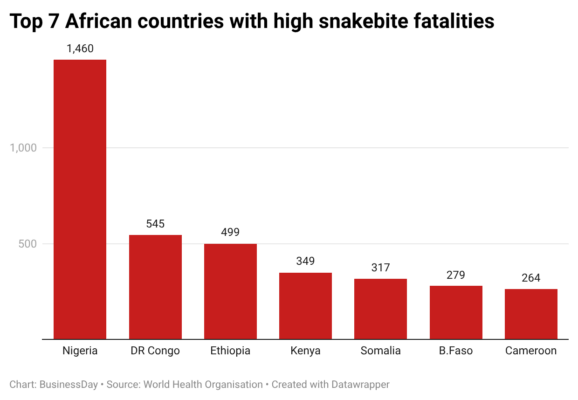
Every year, Nigeria records about 43,000 snakebite cases, with approximately 1,900 fatalities and about 2,000 amputations, according to reports from the Toxicological Society of Nigeria. These cases disproportionately affect people in rural communities, particularly farmers and individuals from lower socio-economic backgrounds, highlighting the need for PHCs to be adequately equipped to manage snakebite cases, experts say.

Read also: Snake anti-venom available in all Abuja public hospitals — FCTA 

“The people most affected by snakebites are from low socio-economic classes, particularly farmers, traders, and residents of rural communities who lack political representation,” stated Nicholas Amani, Medical Director at the Snakebite Treatment and Research Hospital in Kaltungo, Gombe State.
Helen Archibong emphasised the critical role PHCs play in snakebite care. “PHCs are the first point of contact for patient care in rural communities,” she noted.

About 50 percent of hospitals in rural Nigeria lack the capacity to manage snakebite cases, despite the country having 29 snake species, 41 percent of which are venomous, according to the global Strike Out Snakebite (SOS) initiative.

Antivenoms could cost Nigeria about N32 billion
The recent death of Ifunanya, a 26-year-old singer who was bitten by a snake at her Abuja residence and later laid to rest on February 14, 2026 has sparked nationwide concern over the availability of antivenoms in public hospitals. In response, the Federal Government, through the Senate, mandated the Federal Ministry of Health (FMoH) to equip every public hospital with antivenom. However, the challenge lies in the cost, as some cases require more than a single dose of antivenom.

“About 60 percent of the 2,500 patients we treat annually at our facility do well with just one dose, but complex cases may require up to five doses,” Amani noted.
A BusinessDay analysis shows that it would cost between N23.2 billion and N32.2 billion to equip 30,000 existing PHCs with antivenom, based on prices ranging from N180,000 to N250,000 per dose, assuming each patient receives an average of three doses.

Global antivenom shortage
Experts have highlighted that snake antivenoms are a scarce commodity globally, not just in Nigeria, due to the complexity and technical expertise required to harvest venom from venomous snakes. For instance, a gram of snake venom currently sells for $4,000 on the global market, according to Global Statistics, a business analysis platform. This high cost contributes to the expense of antivenoms, as venom is a key ingredient in the production of antivenom, experts say.

“Snake antivenom is scarce worldwide, and investment in its production is very minimal,” Amani noted.
Iskil Mustapha, a researcher and wildlife conservationist, recounted witnessing two snakebite cases at the University College Hospital (UCH), Ibadan, where the hospital did not have antivenom at the time.

“I recall how the families of two snakebite victims couldn’t get antivenom doses at UCH. They had to search through 12 pharmacies before finding one, and by the time they returned, one of the victims had died,” Mustapha said.
Other countries with a high burden of snakebites, such as Brazil, Kenya, India, and Indonesia, also face antivenom scarcity, with 50 percent of their health facilities lacking the doses and capacity to handle snakebite cases, according to SOS reports.

Way forward
Equipping public hospitals, particularly PHCs and health facilities in rural communities and areas with high snakebite cases, such as Gombe, which records about 10,000 cases annually, and other North-Eastern states, represents a major step toward reducing snakebite fatalities in Nigeria.
“It is important to equip public health facilities, especially in rural areas, with antivenom at a subsidised cost,” Mustapha noted.

Amani added that subsidised rates lead to better outcomes for patients in rural communities. “Our research found that when antivenoms are subsidised, patients recover faster, yielding significantly better outcomes compared to out-of-pocket payment,” he said.
The government has also made measurable efforts, such as supplying antivenoms to specialised centres and supporting research.
“FMoH, the Gombe State Government, and the North-Eastern Development Council have been very instrumental in antivenom supply and research funding,” Amani noted.

Experts also say that people in rural communities should maintain a clean environment, avoid walking bushy paths in the dark without torch and seek help from health professionals when necessary.

Dr. Faith Donatus is a climate change expert, a seasoned researcher with over 15 years of experience and a two-time award winner for contributing to research by the International Journal of Research and Scientific Innovation. With a PhD in Environmental Pollution and Control, Faith is passionate about transforming Nigeria's food and public health systems through deep research, data-driven analysis, deducing solution-based insights to challenges impacting Nigeria's food and health systems. At Businessday, she is a real sector correspondent, covering health and agricultural beats.

Join BusinessDay whatsapp Channel, to stay up to date

Open In Whatsapp