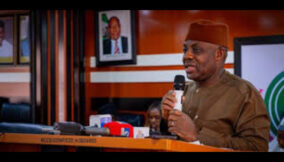
DIANE ABOTT, first black woman elected to the British Parliament and shadow Secretary of State for International Development has strong passion for the education of children of colour in the United Kingdom, she delivered the 2016 Oxbridge Club of Nigeria’s Spring Lecture. In this interview with STEPHEN ONYEKWELU she shares her thoughts on the value of education. Excerpts

Tell us a bit about yourself

am a member of the British parliament for Hackney-Newark in North-East London and I have one of the largest communities of Nigerians. I have been a member of parliament for 29 years and was first elected in 1987, the first black woman to be elected to the British Parliament. My family came to the United Kingdom from Jamaica in the 1950s. I was on local council until 1987 when I was elected to the parliament.

I have served in a number of committees including the Foreign Affairs Committee; I was the health spokesperson under one of our previous leaders. I am now the shadow secretary of state for international development.

You are the founder of London Schools and the Black Child initiative, what motivated you?

Well I realised that many black children or children of colour were not doing well in school and were involved in anti-social activities like substance abuse (drugs and alcohol). I thought I had to do something to stem the tide. We need some brilliant black children. We have many brilliant Nigerian children in the United Kingdom. Besides, I am a beneficiary of good education. From a low-income background I attended Cambridge University and this marked a turning point in my life. Every child deserves to have good foundational education.

What would be your message to government, regarding child education?

My message to government is that education is a basic need and global competitiveness hinges on education. If our children are not educated, they cannot compete globally and the jobs available within the country would be taken away from them by better educated children from other countries. This is applies to every country.

A country like Nigeria would only develop economically if it sent its young people to school, especially girls. Post-colonial countries like Singapore, India and even China owe their level of economic development today to education.

Over 80% of the universities in Nigeria are funded by government, Federal and State. Given dwindling revenue from crude sales, government subvention to these universities is waning, what advice would you offer, how are universities in the UK funded?

First of all, when I went to university perhaps less than 10 percent of British population went to the university at all, but now close to half of British children go on to higher education. Higher education is usually funded by the government. When I went to the university, higher education was completely free; my fees were paid for by the government.

However, we have introduced a system of loans. I think the young people that are better off should pay their own school fees. Those that are not so well off are assisted with loans that they have to pay off. But it is still the case that education in the UK is largely funded by government. Education is something that any government should make a priority.

At some point I was opposed to tuition fees because as a young person if had to pay tuition fees, my father wouldn’t have let me go to the university. He couldn’t have afforded it. He was a factory worker. Tuition fees, I thought would stop ordinary children from accessing education.

DIANE ABOTT
DIANE ABOTT

What would you consider core 21st Century skills?

Society is moving on and education should move on, too. It is important to have some core skills; literacy, numeracy and I say that because if you can’t read, and can’t do basic arithmetic then you can’t access anything. But technology is important. You must be able to understand new media. This should be a big part of education. We have to realise it is a very competitive world and education is the key.   

There is growing concern about how employable graduates of our education system are any thoughts in this regard?

There are two sides to this. On one hand, students acquire knowledge and skills that industry has little or no use for. On the other hand, the economy might not be growing, hence new jobs are not been created. If you don’t have growth, you don’t have jobs. Politicians have to look at job creation for both the highly skilled and the less skilled.

A country like Nigeria probably would have to look again at agriculture. Politicians have to build an economy which creates jobs and makes money. You want an economy that creates jobs for the majority, growing the middle-class in the process; not an economy that makes the few rich richer.

Which single quality if there is any, could you say accounts for your stellar success?

My parents came from a small village, on a hill in deep rural Jamaica. People from that little village or district believe you can leave it and conquer the world and this self-belief that I got from my ancestors, has carried me throughout.

STEPHEN ONYEKWELU

Nigeria's leading finance and market intelligence news report. Also home to expert opinion and commentary on politics, sports, lifestyle, and more

Join BusinessDay whatsapp Channel, to stay up to date

Open In Whatsapp