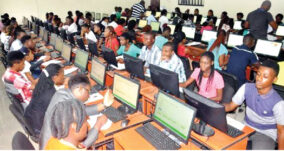
When we talk about social media, we usually think of time-wasting, loafing, distracted, plagiaristic young people that have lost control of their will to technology and the massive world of the internet.

We have trained ourselves that way – to concentrate on the ills of social media that we forget that the thing has its merits. And it is indeed a serious problem when we tend to see something or someone as only one thing, what Chimamanda Ngozi Adichie likes to call the danger of a single story. How can we learn to rewire our brains? Why (and perhaps, how) should today’s teachers adapt social media into learning in schools?

Global demography is evolving in interesting ways. We Are Social, a forward-thinking global agency that estimates the use of internet and social media in different parts of the world, puts the active users of social media globally at 2.31 billion in 2016.

In Nigeria, for instance, the figure stands at about 15 million in January 2016 (with a ten-percent growth since January 2015), and out of the 15 million social media users in Nigeria, sixty-one percent falls between the ages of 13 and 29, a testament to the fact that a great majority of social media users in Nigeria are teenagers and young adults – probably still in school or in the early years of their careers.

Social media has come to stay. It will become even more dynamic and complex in the coming years and future generations have to be able to live with (and through) it. It is important to point out at this point that social media is not totally evil – at least, not exactly the way most of us imagine it.

Maybe we can begin to talk more about the ability of social media to enhance collaboration and interaction among young people as well as the increase in the speed of research and accessibility of information for academic purposes.  Maybe we can begin to show that social media (and indeed the new media) is the new world and we need to adapt learning and thinking to this new world.

Research has shown that social media is a very important platform as it provides the forum for feedback, thoughtful reflection, open communication and strong relationship with peers. It could extend classroom discussions and works beyond the four walls of a classroom to a more interactive space and could provide a platform for users to develop and share newly developed ideas.

Indeed, social media can be built into learning if teachers realize that this new crop of generation – the Generation Y – is a product of technological advancement, and by extension, social media. A typical Generation Y student thinks in terms of the internet, social media, technology. His mind is in several places at the same time and his attention span is short. Instead of fighting this (something most Baby Boomers and Generation X parents and teachers are guilty of), we can learn to live with it and, in fact, build it into the learning process in our academic institutions.

Marshall McLuhan had predicted this in 1964 when he said that a time would come when technology would be the determining factor that shapes how people perceive the world. With the Technology Determinism Theory, it was as though McLuhan had envisioned the world we now live in, a world in which people live their lives in and through social media.

Exactly the reason why Gonzalez and Young (2015) argued in an article published on Tech Learning that social media should be incorporated in learning today. “Students who utilize social media alongside their course work demonstrate improved grades when compared with non-connected classmates,” they said. This is true on so many levels.

So, here is the proposition. First is that teachers need to build social media into the learning outcomes for students. This emanates from a clear recognition of the place of social media in learning today and modifying learning outcomes to reflect this. Teaching needs to be planned in such a way that it builds the acquisition of social media skills into intended learning outcomes.

Truly, the world is changing very fast and survivors of this generation will need to have sharp social media skills. Teaching that fails to recognize this and fails to plan it into the education system may not be preparing the students to fit into the dynamic workforce of the future. Think ten years from now. Think twenty years from now. Think futuristic.

Second, teachers should design lessons that enable students utilize social media as they work to complete projects, solve problems, and communicate their ideas. Social media encourages interactivity and participation, and designing lessons that allow students to use and cultivate good social media skills will lead to better student engagement as well as collaboration, well-rounded research and enthusiasm in the learning process.

In simple terms, teachers should encourage and create social media groups for the students – things like Facebook group page, blog, vlog, instagram account, Youtube, etc. This will extend learning outside the classroom and facilitate easy sharing of resources online.

Third and perhaps more importantly, teachers themselves need to become social media friendly. They have to be able to use these platforms because as the saying goes, ‘you cannot give what you do not have.’ How many teachers have social media accounts? How many are on Instagram, Twitter, Facebook, for instance? There is a certain level of open-mindedness that being a teacher requires and this involves being willing to learn new things, to acquire new knowledge in order to provide better learning experience for students. Let our teachers register accounts on Facebook. Let them harness the advantages of blogging and vlogging and rally their students around contents that they find particularly educating. This will hopefully reduce the unproductive time that students spend on social media platforms.

Acknowledging these benefits and harnessing them for the greater good may not take away the disadvantages of social media. The benefits may not come in leaps and bounds. But we will see, over time, that we are better prepared, more in control of the influence of social media in our lives and, perhaps, in the lives of generations to come.

Munachim Amah

Munachim Amah is a Master’s student at the School of Media and Communication, Pan-Atlantic University, Lagos. He worked as a research assistant at the Lagos Business School and has had his writings published on several platforms. He is an alumnus of the 2016 Farafina Trust Creative Writing Workshop organised by Chimamanda Ngozi Adichie.

Nigeria's leading finance and market intelligence news report. Also home to expert opinion and commentary on politics, sports, lifestyle, and more

Join BusinessDay whatsapp Channel, to stay up to date

Open In Whatsapp