Driving through Lagos any day drains you. These days the stress from meandering through traffic has been worsened by the rains. I’ve had to drive through pools of water praying there’s no gaping pothole underneath. I’ve seen my commute time quadruple because of broken down trucks trapped in craters.
Even when it’s not raining Lagos is saturated. Lagos is a wetland nestled along 180km of Nigeria’s coastline – a megacity of 21 million people built on peat, on land clawed back from the ocean and lagoon. Although it’s the smallest state, Lagos is the economic powerhouse of Nigeria.
Driving in Africa’s largest agglomeration is a tortuous negotiation of cars, buses and trucks crisscrossing bridges that connect the island and mainland. Lagos is jam-packed with cars, an average of 224 cars per km negotiate the city compared to the world average of 11 cars per km.
Lagos is significant, economically and environmentally. Wetlands are important for water purification, flood control and shoreline stability. This delta city serves as drain for two-thirds of southwestern Nigeria. Rivers Yewa, Ogun, Ogbere, Osun and Sunmoge empty into the lagoons and creeks of Lagos.
Dense market, diverse workforce, high productivity and income, increasing capital flow i.e. of ideas and money, economies of scale are some of the benefits of living and doing business in Lagos. Over 10,000 industrial and commercial businesses operate in Lagos (including 2,000 industrial complexes and 22 industrial estates); 70 percent of the cargo freight is conducted in Lagos’ three seaports. However, there are risks: congestion, go-slow and inadequate transportation and the effect of climate change.
Growing at 6 percent a year the population is projected to hit 25m by 2050. It’s no surprise Lagos serves as the corporate, commercial and industrial hub of Nigeria. The city is home to 45 percent of Nigeria’s skilled labour force providing jobs, taxes (70 percent of the state revenues are generated internally). Pace and energy, motion and action are routine. Lagos never sleeps – 50 percent of power generated in Nigeria is consumed in Lagos.
But Lagos isn’t being inundated by people only. Heavy rainfall and rising sea levels are flooding low-lying Lagos. Low-lying lands and wetlands occupy 78 percent of Lagos – 85 percent of inhabitants reside on just 37 percent of territorial land mass.
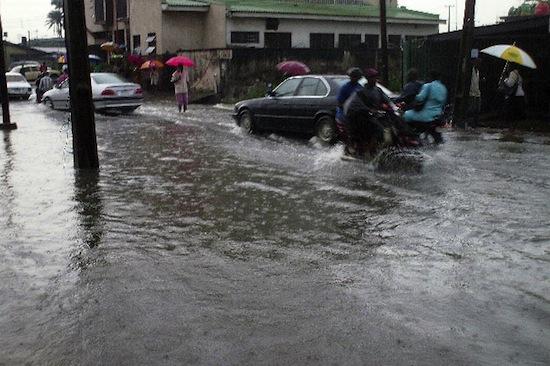
The pace of infrastructure development is far behind an ever expanding population, and coupled with scarcity of dry lands, illegal structures and slums are encroaching on its flood plains and wetlands. It’s a major problem to keep the water at bay.
In other words, Lagos can’t stand heavy rains. When it pours excessively or the coast and rivers overflow into clogged canals the city is flooded and, naturally, water finds its level, especially in a low-lying area.
Globally, coastal cities are at risk to climate change; agriculture, productivity and property prices are the most vulnerable. Fot imstance, hotel room rates in Lagos were the second highest in the world in 2012. Inbound business travel is rising and known brands are the preferred choice of business travellers. The limited number of international hotel chains means a premium is charged for the brand and location. The concentration of rooms in Ikoyi and Victoria Island, the locations prized by developers, is increasing as more high-end hotels set up store. A lot more has to be done to make Lagos resilient.
Tayo Fagbule

Join BusinessDay whatsapp Channel, to stay up to date
Open In Whatsapp