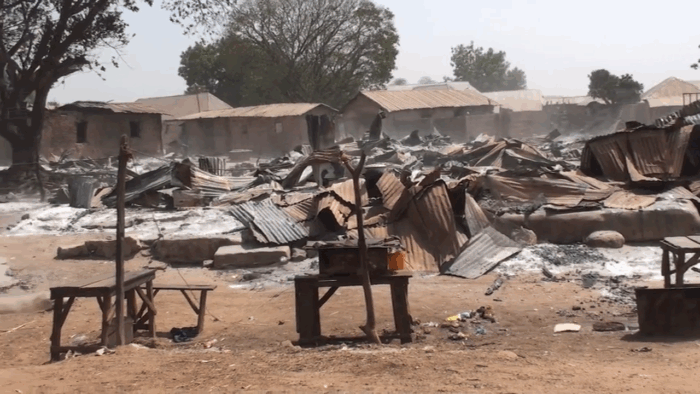
The story varies in detail, depending on the raconteur. But the essentials carry a unanimous thread. One evening recently, in rural Woro, in the Kaiama Local Government Area of Kwara State, a group of men appeared on motorcycles, riding in convoy. They were armed and menacing, and their intentions were clear from their demeanour.
One story has it that members of the group had come to the village before. They had gathered the villagers and exhorted them. The villagers were to accept their authority and immediately convert to the harsh, authoritarian brand of Islamic religion that they claimed to practise. The villagers, who were mostly Muslims already, did not see the sense in what they were saying and, despite the air of intimidation, did not give them a good reception. Many apparently thought them mad.
They were back now for revenge and to send a message to the world.
They feared nobody. If death came, they would be prepared for it, since they were going straight to heaven.
Lifting their guns, they began to fire randomly at the villagers. Men, women and children fell where they stood. A group of young men playing football in a field tried to melt into the bush. Some were struck and lay in the field, bleeding. Some quick-witted villagers with nimble feet climbed onto the top of nearby trees.
Not done, the attackers went into a nearby mosque and raised a muezzin’s call to prayer. Some villagers, who had no inkling what was going on, came out to pray. They were shot down in cold blood.
Different numbers have been given for the killed and injured. The only agreement is that they ran into hundreds.
The focus on this sad incident is not to paint the gory details of another irrational and callous attack on Nigerian citizens. It is not even to peek into the human angle stories of individuals and families caught up in the macabre atrocity.
The frequent reporting of people being killed or abducted on an industrial scale appears to have reduced the sense of shock and outrage that should normally attend such human tragedy. There is no other country in the world, which in not in active war with an identified enemy, where routine news reports are heard concerning massacres of hapless nationals by faceless, nameless killers, who are dignified with titles such as ‘bandits’, kidnappers, ‘terrorists’ and a variable mixture of other epithets.
Many years ago, when listening to the daily news was still an interesting pastime for you, India was, in your mind, the country most notorious for man-made and natural tragedy at scale. The Rajdani Express train would derail, and one hundred and fifty people would be dead, just like that. A pilgrimage to bathe with a holy man in River Ganges would result in a stampede, and one hundred people would drown.
The contemporary reality appears to be that Nigeria has taken over from India as the place where calamity lurks, not from ‘natural’ events but from the sick agenda of other people.
It is that sick agenda that is the subject of this discussion. What does a terrorist think? What does he want?
Very few human beings carry out murderous actions entirely without reason. The reason, of course, may be warped and reprehensible to every decent sensibility, as in the case of Woro. The rationalisation concerning ‘herders’ and ‘farmers’ has long since lost traction. There is a different, more sinister script at play.
One of the remarkable observations about the Psychology of ‘religious’ terrorists is their perfect certainty that they are right. They are so right that they are ready to die. That also means they have no compunction about killing anybody, and the numbers simply do not matter. Their end-target, such as it is, is for a heaven redolent with salacious pleasures that is the entitled reward for their actions. Some suicide bombers have been known to splash perfume and to wear protective guards around their genitals. That a heaven populated by such lower forms of life as themselves would not be an attractive place for most human beings to aspire to is not a worry that is known to trouble their hearts.
Which brings into focus the other big question – how does society deal with people who have placed themselves so far beyond the pale?
There is no evidence that expensive, time-consuming ‘deradicalisation’ programmes such as the one embarked upon by the British government to ‘cure’ its nationals who went into the field to become killers for Isis in Syria and Iraq have yielded any fruit to date, except to convince their enemies that they are ‘mush’, and to give terrorist sponsors like the famous erstwhile North London extremist preacher known as ‘The Hook’ a hearty laugh. ‘The Hook’ is now in an American high-security jail, from where there is not the slightest possibility that he will ever be freed.
Psychology, in the real world, is not based on political correctness, but on the hard fact that people who murder other people in cold blood, and for impersonal reasons, such as the killers of Woro, will do it again, and again, until they are stopped, permanently.
Many people are familiar with the story of the terrorists who came into town with guns recently, somewhere in the north, to buy mobile phones. Young people clustered around them admiringly, taking selfies. ‘Corrective Education’ may usefully be targeted at preventing such gullible youths from being sucked in by the lure of sick ideology. For the hard-boiled who have already tasted other people’s blood, it is often too little, too late, and is only promoted as a ‘solution’ by sponsors and sympathisers who believe other people are idiots.
May the souls of the murdered villagers of Woro rest in peace. And may the people of Nigeria learn the right lessons and take the right actions to end the scourge.

Join BusinessDay whatsapp Channel, to stay up to date
Open In Whatsapp