The German state of Rheinland-Pfalz has signalled a strategic pivot towards Nigeria as both a production base and renewable energy partner, as it seeks to expand bilateral trade beyond traditional export flows.
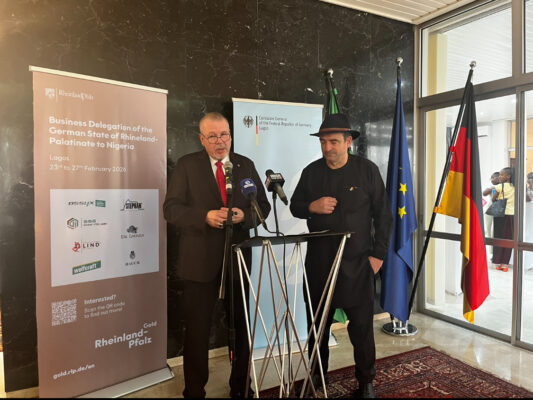
Joe Weingarten, head of department foreign trade, Ministry of Economic Affairs, Transport, Agriculture and Viniculture Rhineland-Palatinate, made this known late Tuesday at the German Consulate in Lagos.
Leading an eight-company delegation to Lagos, Weingarten said the visit marks Rheinland-Pfalz’s first formal economic engagement in West Africa and reflects growing German subnational interest in Nigeria’s industrial and energy transition landscape.
“The times where you could look from Germany to a state like Nigeria only as a marketplace are gone,” Weingarten told journalists. “International economic policy today is cooperation, production on both sides and trade for both sides. There must be positive results for both sides.”
Read also: Germany’s largest bank says reforms restoring confidence in Nigerian economy
Trade growth and regional expansion
Rheinland-Pfalz, one of Germany’s 16 federal states, has a population of about four million and a GDP of roughly €185 billion. It recorded more than €1.5 billion in trade with Nigeria, ranking the country as its fourth-largest African trading partner after Egypt, Algeria and South Africa.
While total trade between Germany and Nigeria stood at about €3 billion in 2024, officials said there remains significant scope to deepen engagement, particularly in industrial manufacturing, pharmaceuticals, chemicals, construction and renewable energy systems.
“Nigeria is a very interesting partner for us,” Weingarten said. “It is a big country with a growing population, and Lagos is clearly an economic centre. We are here to increase trade not only with Nigeria but with the whole region.”
The delegation includes firms across machinery, construction, wine production and technical equipment, reflecting the state’s diversified industrial base.
Rheinland-Pfalz hosts global players such as BASF, a key supplier to Nigeria’s oil and gas sector; Boehringer Ingelheim; and biotech firm BioNTech, known for its role in developing a COVID-19 vaccine.
Read also: Nigeria, Germany to collaborate on security, power
Renewable energy systems, not just hardware
A central pillar of the visit is renewable energy cooperation, particularly grid integration and decentralised systems, areas where Rheinland-Pfalz claims operational expertise.
About 60 percent of the state’s electricity production comes from renewable sources, according to Weingarten, giving it experience in managing intermittent energy supply within an industrial economy.
“It’s not only about building the energy structure,” he said. “You also have to bring decentralised renewable energies to customers. You need technical systems and economic systems to create a network that works reliably all year, all day.”
He stressed that reliability is critical to adoption. “Renewable energies are only accepted if they work around the clock.”
Bottom-up engagement model
Daniel Krull, German Consul General in Lagos, highlighted that the partnership model would be private sector-led rather than anchored initially on intergovernmental agreements.
“There’s always the question of memoranda of understanding between states,” a German official said. “We strongly believe in a bottom-up approach, building from business to business. If state involvement is needed, it comes as a topping up. But we don’t start from there.”
Read also: Siemens $2.3bn Nigeria power deal revived under Tinubu — Germany
Nigeria as production base
Responding to questions on whether German companies are considering local manufacturing or assembly operations in Nigeria, Weingarten indicated that production partnerships are firmly under consideration.
“Not only a marketplace, but also the idea of maybe production,” he said, pointing to historical examples of German brands previously assembled in Nigeria.
According to the delegate, plans are also underway to host Nigerian government representatives in Rheinland-Pfalz to deepen institutional ties, suggesting that political engagement may follow private-sector traction.
Join BusinessDay whatsapp Channel, to stay up to date
Open In Whatsapp