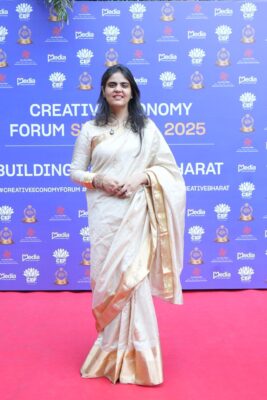
…How filmmaker and entrepreneur Supriya Suri is building the institutional scaffolding India’s creative economy has long been missing
There is a question that Supriya Suri has been asking, in one form or another, for the better part of a decade: why does a country of India’s creative abundance produce so few creative economies? The subcontinent has gifted the world with its cinema, its textiles, its music, its literature — and yet the business architecture that sustains creative careers in mature markets has remained conspicuously underdeveloped at home. It is this gap, as much as any artistic impulse, that has come to define her work.
Suri is a filmmaker, producer and entrepreneur based in New Delhi. She studied film direction under the Egide Scholarship at the Conservatoire Libre du Cinéma in Paris — an experience formative not merely in the craft it imparted, but in the worldview it cultivated. To train in Paris was to absorb cinema not as entertainment but as discourse: a language through which nations articulate their identities and argue about their futures. Suri brought this sensibility home.
From curation to ecosystem
Her early work was in audience development — persuading a sceptical public to care about difficult films. As a founding member of Cine Darbaar, an arts and film organisation, she helped cultivate serious engagement with world cinema through curated screenings, festivals and discussions. It was patient, systemic work: not just programming films, but building the communities that would receive them. Learning to think in institutions rather than individual projects would prove essential to everything that followed.
“Talent alone is not enough. Creativity must be supported by structure, strategy and a serious understanding of business.”
Her filmmaking has reflected a consistent preoccupation with cultural memory. Her feature documentary Aruna Vasudev: Mother of Asian Cinema chronicles the life of the pioneering critic, curator and NETPAC founder whose work shaped the global reception of Asian film. Suri’s decision to document Vasudev’s story speaks to a broader conviction: that creative ecosystems are built not only on talent, but on the less glamorous work of advocates and institution-builders. Through her production house, MaisonSu Entertainment, she continues to champion strong cinematic voices for a global audience.
Read Also: Google Gemini can now generate 30-second AI music
Building the forum
The Creative Economy Forum, which Suri founded in 2022, is the most visible expression of her institutional thinking. The premise was straightforward, if ambitious: India’s creative sectors — film, music, fashion, design, gaming, heritage, media — needed a dedicated national platform where creators, policymakers, investors and entrepreneurs could engage seriously with how creativity becomes an economy.
The forum has since grown considerably. Its second edition, held at the Dr. Ambedkar International Centre in New Delhi around the theme of Vikshit Bharat 2047, brought together senior government officials, a sitting Delhi High Court judge, fashion designers and publishing executives. The third drew support from four government ministries. By early 2026, CEF had launched a South edition in Visakhapatnam, embedding the conversation within India’s regional creative communities.
The forum operates on three pillars: policy, business and creativity. Of these, Suri argues consistently that business is the most in need of attention. Creative careers in India have historically depended on informal networks rather than the formal structures — funding mechanisms, legal frameworks, intellectual property regimes — that underpin creative industries in more mature markets. Sessions have addressed IP law with the participation of senior judges, explored film financing with producers, and recognised creative entrepreneurs through the Creative Global Voice of India Awards.
“India’s volume of content far exceeds its monetisation potential. We are yet to fully realise the true value of our intellectual property.”
The wider argument
Suri’s work has not gone unnoticed internationally. She was nominated by the United States Government for the International Visitor Leadership Programme to speak on Indian cinema, and has engaged with the British Council through the Creative Convergence initiative — a dialogue series exploring India-UK creative collaboration. She has also spoken at the Meta Cinema Forum in Dubai and served as a jury member at the Kolkata International Film Festival.
Beneath the carefully arranged panels and policy sessions, there is a quieter argument being made: that creativity is not a soft social good but an economic force capable of generating employment, projecting national identity and building intellectual property of lasting value. It will not achieve this by accident. It requires the same serious institutional attention India has directed towards technology or manufacturing. The creators who will shape India’s cultural future need to be entrepreneurs as much as artists.
Whether the Creative Economy Forum will achieve the structural transformation Suri envisions remains to be seen. What is already clear is that it has succeeded in making the conversation happen — bringing government officials, independent creators, lawyers and investors into the same room. These encounters are, in themselves, a form of institution-building. The architecture is under construction. And someone has to build it.

Join BusinessDay whatsapp Channel, to stay up to date
Open In Whatsapp