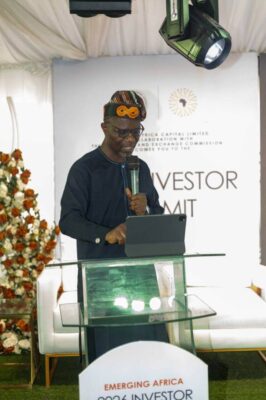
Stakeholders across Nigeria’s financial sector have called for stronger domestic capital mobilisation and long-term investment strategies amid shifting global economic conditions.
This formed the focus of the 2026 Emerging Africa Investor Summit, organised by Emerging Africa Capital Limited in collaboration with the Securities and Exchange Commission. The summit brought together regulators, investors, and industry leaders to discuss pathways for economic growth.
Opening the event, Oghogho Osula, Group Director, Emerging Africa Group, said the gathering was designed to address key issues shaping investment decisions across Nigeria and the continent.

“We are delighted to host you as we gather once again to engage and discuss matters that will influence the future of investments and economic transformation,” she said.
She noted that the global economy is undergoing changes that require “innovation, resilience and deliberate strategies” from investors and institutions. According to her, the summit reflects the firm’s commitment to “provide investment solutions that enable African businesses and governments to thrive”.
Nike Akande, Group Chairman and Independent Non-Executive Director, Emerging Africa Group, in her remarks, said recent global developments have shown that markets remain uncertain but continue to present opportunities.

“The world does not stand still. Markets shift, currencies fluctuate, policies evolve, and somewhere in that uncertainty, opportunity emerges,” she said.
She added that Africa is repositioning itself within the global system. “Africa is no longer asking for a seat at the table; we are building our own,” she stated.
Akande stressed that capital alone is not enough to drive growth. “Strategy matters, timing matters, partnership matters,” she said, noting that the summit provides a platform to shape future investment decisions and recognise contributions from partners.
Delivering the keynote address, Emomotimi Agama, Director-General, Securities and Exchange Commission, described the capital market as central to economic development. He said access to long-term funding remains critical for growth.
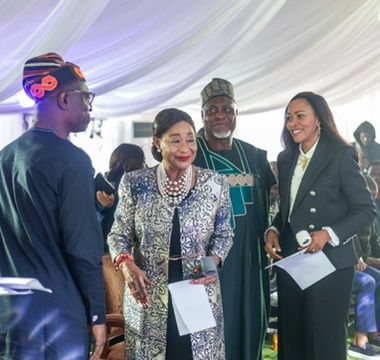
“Nigeria and indeed Africa is a construction site, and what it needs is long-term money, which can only come from the capital market,” he said.
Agama explained that global economic shifts, including geopolitical tensions and monetary tightening, have created both risks and opportunities for emerging markets. “The global economy is undergoing a structural reconfiguration,” he said, adding that Africa’s growth potential remains strong but requires “deliberate and strategic deployment of capital”.
He described the capital market as “the bridge between those who have capital and those who have ideas”, highlighting its role in job creation and economic expansion.
The SEC director general also urged increased participation in investment, particularly among young people. “You are learning early. It is about your future,” he said, encouraging long-term financial planning.
He cited growth in Nigeria’s collective investment schemes, which rose from about N3 trillion to over N8 trillion, as evidence of increasing market activity. He also called for stronger institutional frameworks and collaboration among market operators.
On the broader economy, speakers at the summit noted that Africa’s growth is projected to improve, supported by declining inflation and reforms across key sectors. However, they warned that foreign investment flows have declined, making domestic capital mobilisation more urgent.
A market outlook presentation at the event showed that development assistance to Africa fell by 10 per cent in 2025, while foreign direct investment dropped significantly. Participants agreed that reliance on external funding is no longer sustainable.
“External capital cannot be the primary driver of the African economy at this time,” one presenter said, urging investors to focus on local opportunities.
Nigeria’s economic outlook for 2026 was described as stable, with projected growth between 4.3 and 4.9 percent. Key sectors identified include oil, agriculture, construction, and services.

Speakers also highlighted strong performance in the Nigerian capital market, with significant gains recorded in equities and increased market capitalisation.
Closing the session, participants were encouraged to take advantage of emerging opportunities despite global uncertainty.
“This is the moment to deploy capital in Nigeria,” Agama said. “Africa is rising, and the capital market will be at the heart of that rise.”
Follow Emerging Africa Group on Instagram, Facebook, LinkedIn, and X, and visit our website at www.emergingafricagroup.com for financial updates.

Join BusinessDay whatsapp Channel, to stay up to date
Open In Whatsapp