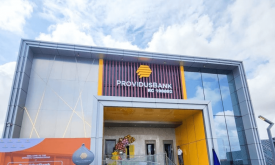
Unity Bank plc has won the Central Bank of Nigeria’s (CBN) 2018 sustainable banking award for ‘Sustainable Transaction of the Year in Agriculture.’
The bank won the award for its compliance with the Sustainable Banking Principles as it relates to the management of Environmental and Social Risk set out by the CBN for adoption by Nigerian banks, Discount Houses and Development Banks.
At the just concluded Bankers’ Committee held in Lagos, the CBN, while presenting the award, commended the effort of bank in promoting the Anchor Borrowers Programme (ABP), Rice Farmers Association of Nigeria (RIFAN) project, adding that the lender deserved the award because of the role it played in actualisation and management of this projects.

The active involvement of the bank in various financing schemes has resulted in creating huge social and economic impact on the income of households involving over 270,000 participating small holder farmers thereby boosting not only the gross domestic product but also helping to achieve self-sufficiency in food production.

Commenting on the development, Tomi Somefun, managing director/CEO of Unity Bank, dedicated the award to all farmers and businesses in agriculture value chain, saying: “We have successfully on-boarded over 90,000 hitherto financially excluded farmers and generated bank verification number for them to facilitate financial and banking transaction. Capacities of about 60 agro input suppliers were expanded through provision of facilities and financial advisory services.’’
The bank’s Environmental and social Management Programme covers comprehensive business operations that minimises adverse impact on the environment in the scope of its business activities.

According to Somefun, the bank’s environmental management policies and strategies comprehensively cover priority areas that encourage bio-diversity, green initiatives, recycling of waste, reduction of carbon emission geared towards promoting sustainability, conservation and environmental protection.

The bank is a niche player in agric financing in Nigeria, with active participation in most government intervention schemes and support for key policy initiatives. These are aimed at driving growth and transformation of Nigeria’s Agricultural economy.
The Code of Corporate Governance requires companies to act in an environmentally and socially responsible manner and Unity Bank has domesticated the principles in its commitment to save the environment from degradation or pollution.

Hope Moses-Ashike is an Associate Editor, Banking and Finance, with more than a decade of experience reporting on Nigeria’s financial system and broader economy. She closely tracks market movements, monetary policy decisions, company disclosures, regulatory actions, economic indicators, and global developments, and interprets what they mean for businesses, investors, policymakers, and households. Her reporting helps readers understand complex issues such as inflation trends, foreign exchange market dynamics, interest rate decisions, bank performance, and investment risks. She also covers major international events and periodically travels to Washington, D.C., to report on the World Bank/IMF Spring and Annual Meetings. Her dedication to financial journalism has earned her multiple recognitions and invitations to high-level professional development programmes. She is an alumna of the International Visitors Leadership Programme (IVLP) in the United States and holds an Advanced Financial Journalism Certificate from the Press Association Training in London, UK. Her other notable achievements include completing the Lagos Business School CMC Programme, the Bloomberg Media Africa Initiative Programme, and a Master Class in Journalism at Rhodes University in South Africa.

Join BusinessDay whatsapp Channel, to stay up to date

Open In Whatsapp