Nigeria’s top-tier banks delivered mixed half-year results in 2025, reflecting a challenging macroeconomic and regulatory environment marked by tight monetary policy, high inflation, and rising credit costs.
While interest income remained the bright spot across the sector, profit margins were squeezed by surging impairment charges, weaker trading gains, and the after-effects of the decline in the rate cuts this year.
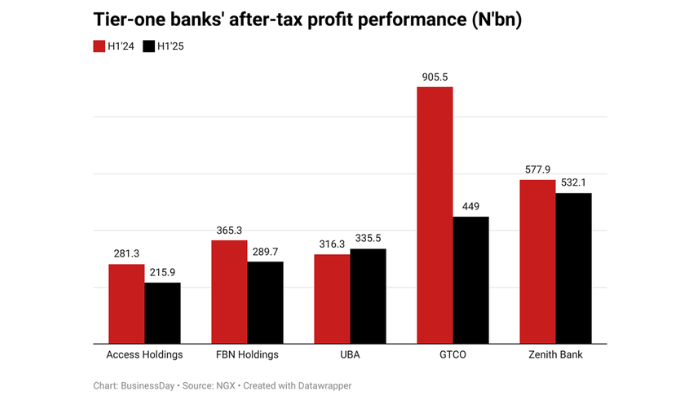
According to BusinessDay’s analysis of First HoldCo, UBA, GTCO, Access Holdings, and Zenith Bank interim financial results, their combined after-tax profit fell to N1.82 trillion in the first half of 2024, from N2.44 trillion in the same period of last year.
GTCO Plc, however, faced one of the steepest declines in profitability among the tier-one lenders, as after-tax profit fell 50.3 percent to N449 billion from N905.6 billion in H1 2024, followed by Access Holdings Plc, with after-tax profit dropping 23.3 percent; First HoldCo Plc, with 20.7 percent; and Zenith Bank Plc, with an 8 percent decline in its after-tax profit.
However, UBA Plc, Africa’s Global Bank, despite industry headwinds, grew its profit after tax by 6.1 percent to N335.5 billion from N316.4 billion a year earlier.
The drop signals that not all institutions have been equally shielded from the effects of monetary policy and other market variables.
This subdued growth marks a shift from the robust earnings environment experienced last year, driven largely by elevated interest rates that benefited banks’ interest income margins.
The Central Bank of Nigeria (CBN), at its 302nd meeting, lowered the benchmark interest rate to 27 percent, or 50 basis points, from 27.5 percent, signaling the beginning of a policy easing cycle aimed at supporting growth without sacrificing hard-won macroeconomic stability.
This decision followed the adoption of a rebased Consumer Price Index (CPI) by the National Bureau of Statistics. With the monetary policy rate (MPR) reduced, borrowing costs for banks and lending rates for consumers remain steady, narrowing the opportunity for banks to earn higher yields on loans and investment instruments.
“The flat interest rate environment is having a cooling effect on interest income for banks, even as they continue to adjust their strategies for non-interest revenue growth,” said Tunde Abidoye, analyst at FBNQuest Merchant Bank.
Read also: Investors flock to big banks as GTCO, Zenith lead in share price
He added, “The CBN has closed the loophole—they’ve taken banks’ net open position to zero, meaning they can’t hold dollar assets. I expect that the trend of declining profits will continue till H1, and non-interest income will fall, which will affect earnings.”
Additionally, the MPR’s accompanying asymmetric corridor used to manage liquidity by setting upper and lower bounds for CBN lending and deposit rates also reduced the Cash Reserve Requirement (CRR) for commercial banks to 45 percent, down from 50 percent, while retaining the CRR for merchant banks at 16 percent.
At the same time, however, it introduced a 75 percent CRR on non-Treasury Single Account (TSA) public sector deposits, a tightening tool aimed at mopping up excess liquidity from fiscal injections.
To further enhance monetary policy transmission, the Standing Facilities Corridor (SFC) was widened to ±250 basis points around the MPR. The liquidity ratio was held unchanged at 30 percent.
Interest income
Interest income remained the primary driver of earnings across the five lenders, buoyed by higher yields on loans and investment securities. Zenith Bank led with a 20 percent increase in gross earnings to N2.52 trillion, supported by a near-doubling of net interest income to N1.35 trillion. UBA followed with a 32.9 percent surge in interest income to N1.33 trillion, while Access Holdings posted a 38.9 percent rise to N2 trillion, reflecting its aggressive asset expansion and balance sheet diversification.
GTCO recorded a 29 percent improvement in net interest income to N632.2 billion, driven by increased lending and investment returns. Similarly, First HoldCo saw net interest income grow by 75.7 percent to N904.8 billion, following a 51.7 percent jump in interest income to N1.44 trillion.
However, these gains came at the cost of rising funding expenses. Interest expenses for GTCO soared 42 percent, while First HoldCo and Access also reported double-digit increases.
Non-Interest Income
Non-interest income, a key earnings diversifier for Nigerian banks, took a hit in the review period as foreign exchange revaluation and fair value gains normalized from 2024 highs. GTCO’s non-interest income dropped sharply to N70.9 billion from N630.3 billion a year earlier, when the bank benefited from outside FX and revaluation gains. Similarly, First HoldCo recorded a net loss of N53.7 billion on financial instruments, reversing a N432.2 billion gain last year, due to market volatility and exchange rate adjustments.
Zenith Bank’s non-interest income remained moderate at N128.1 billion in fees and commissions, up 17 percent, but trading income weakened as fair value gains were offset by higher impairment costs. UBA maintained stability in its fee-based income, reflecting its strong transaction banking franchise, while Access Holdings saw its fee and commission income rise 27 percent to N294.9 billion, supported by increased transaction volumes and digital penetration.
Read also: Big banks incur N442bn in AMCON expenses amid falling profit
Trading revenue
Trading income, which had boosted profitability in 2024, came under strain in H1 2025 as capital market fluctuations eroded fair value positions. GTCO’s trading revenue improved modestly to N37.9 billion, reflecting disciplined treasury operations despite softer yields. Zenith and Access also benefited from fixed-income trading, but their gains were dampened by higher mark-to-market losses.
For First HoldCo, volatility in financial markets weighed heavily on trading performance, dragging fair value gains and losses. Analysts at CSL Stockbrokers noted that the high-yield environment, while beneficial for interest income, simultaneously depressed bond valuations, resulting in fair value write-downs that offset core banking gains.
Impairment charges
Across the banking sector, impairment charges surged as lenders strengthened provisions against potential defaults. Zenith Bank’s loan-loss charges more than doubled to N760.8 billion from N415.3 billion, wiping out a large portion of its interest income gains. First HoldCo reported a similar trend, with impairment provisions rising to N185.4 billion, up from N93 billion a year earlier.
GTCO’s impairment expenses also climbed, reflecting cautious provisioning amid heightened credit risks, though it reported a small net impairment reversal on other assets. Access Holdings’ impairment contributed to its 23.3 percent drop in profit after tax to N215.9 billion.
Analysts attribute the spike in impairments to Nigeria’s tight monetary policy and elevated inflation, which have strained borrowers’ repayment capacity and weakened credit quality.

Join BusinessDay whatsapp Channel, to stay up to date
Open In Whatsapp