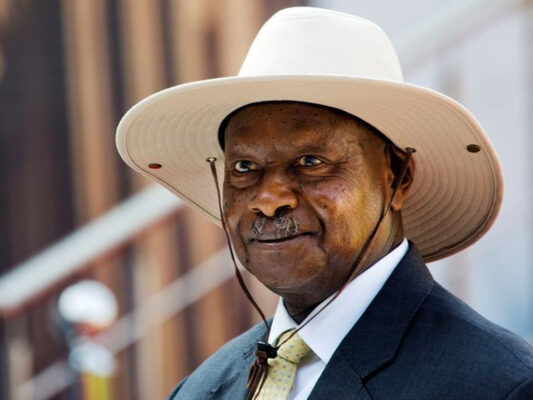
The election in Uganda last Thursday that returned Yoweri Museveni may have been held as a credible exercise, but the chief beneficiary knew he did not deal honourably. Is he running a monarchy?
Kaduna State is in the news for the wrong reasons. Not just that close to 200 people were kidnapped and remain in the kidnappers’ den, but also the denial of the incident has left many Nigerians perplexed.
Is Museveni running a monarchy?
Those who still believe that what is going on in Uganda is democracy may be believing a lie.
Although all the processes of a democratic election were followed in the last exercise in the country, what simply took place was inorganic voting that returned Yoweri Museveni for a fresh term of five years.
The election that was held last Thursday was simply organised by the government, of the government and for the sitting government.
Museveni empanelled the electoral body to do his bidding, even though it appeared that the voters gave him the winning votes. The votes simply came out of intimidation, coercion and a people’s resignation to fate.
The government created a false impression that something serious was happening in the East African country as it shut down the internet to prevent whatever the president thought was a possible threat.
If Museveni was as popular as he paraded himself to be, why was he jittery and suspicious that some people somewhere could manipulate the result by leveraging technology?
For 40 years, Museveni has held Uganda hostage in the name of governance. He believes he is the only good thing to happen to the landlocked country. He rose to power in 1986, and he has just won a fresh “mandate” that will take him to 2031.
He will be 86 years old at that time. But it is not about age. It is about competence. It is about bringing meaningful leadership to Uganda. It is about putting the interest of the people above his personal ambition to be a life president.
But let’s face it, at 81, President Museveni is too frail to address the day-to-day challenges of a country that is in dire need of economic revival.
He seems to have been bitten by the bug of “sit-tightism”, which he once condemned. When he seized power in 1986, he gleefully said, “The problem of Africa in general and Uganda in particular is not the people but leaders who want to overstay in power.”
Bobi Wine, the pop-star-turned-politician who challenged President Museveni, said he would not pursue his case in court because he had no confidence in the judiciary.
It’s common knowledge that the polls were marred by allegations of intimidation, restrictions on opposition campaigns, internet shutdowns and heavy security deployments.
Before the exercise, opposition parties had raised questions about fairness and transparency, yet official results were upheld by the electoral authorities.
It is high time world bodies began to advise leaders who have overstayed their welcome on the power stool to take the exit door.
It is saddening to read congratulatory messages from respected nations and international organisations to politicians who go against electoral processes or manipulate the processes to perpetuate themselves in power.
While the African Union (AU) condemns the coup d’état, it shuts its eyes to factors that catalyse the violent overthrow of the government in Africa.
AU has continued to maintain the “see nothing, say nothing” posture in the affairs of sovereign nations in Africa, preferring rather to endorse whatever the governments in those countries do.
While congratulating Museveni on his re-election for the seventh time, Mahmoud Ali Youssouf, AU Commission chairperson, said the group welcomed the conduct of the election.
By these endorsements, Museveni may be deceived into thinking that he is a saint.
It is this same faulty endorsement that the Economic Community of West African States (ECOWAS) is giving to some of the overstayed and incompetent leaders in its fold that may have resulted in some “reneges” in some countries under its fold to now say, “To your tents, O Israel.”
The Kaduna kidnapping is on my mind!
The Kaduna government and security chiefs in the state on Monday addressed the media, where they bluntly denied the report of the mass abduction of worshippers.
Muhammad Rabiu, Kaduna State Police commissioner, had described reports of the kidnapping of 177 worshippers in the Kajuru Local Government Area as false.
He warned against attempts to derail the prevailing peace in Kaduna State.
By the same token, Dauda Madaki, chairman of Kajuru LGA, mobilised the police and other security agencies to the Kurmin Wali community but found that no such attack had occurred.
“We visited the church where the so-called kidnapping took place. There was no evidence of any attack. I asked the village head, Mai Dan Zaria, and he said there was no such incident,” he said.
The council boss said he challenged anyone to name the people who were kidnapped. “I have been waiting for this list, and no one has come forward with a name,” he said.
On Tuesday, Benjamin Hundeyin, a chief superintendent of police of the Nigeria Police Force, said an “abduction” had indeed occurred on Sunday, and that the police had launched security operations “with a clear focus on locating and safely rescuing the victims and restoring calm to the area.”
With these discordant tunes and what seems like speaking with both sides of the mouth, how do you expect your people to trust you? How do you expect the international community to trust you? You came on a live camera and lied that nobody was kidnapped when close to 180 people were indeed kidnapped.
Do they need to go this ignoble way when they should have owned up to the incident but told the people that they were doing something about it? What the lying has done is to worsen the trust deficit against the government.
It is sad that lying seems to have become a culture in government. Yes, there is diplomacy. Yes, there are things that the government should not easily throw out in the open due to their sensitive nature, but not the issue of kidnapping that involved close to 180 people. Were they not thinking that the families of the victims could spill the beans? It is not compulsory for the highest echelon of the police to speak on a matter it is not sure of. There are occasions when silence should be more desirable than dishing out falsehood.
Why do we pretend that criminality is a native of Nigeria? They happen in other countries too. When they happen here, what matters is how we react to them. The reaction is what makes the difference. Tell the world the truth and what you are doing to mitigate it, but not to tell a “white lie” that will embarrass the entire nation in the long run.
What the security apparatchiks did by trying to deny the kidnapping was akin to what the Jewish leaders of old did when, in their desperation to cover up the resurrection of Christ, they sold a lie that Christ’s disciples came in the night to steal his corpse. That was the lie they pushed out. Of course, it did not stand as the truth emerged almost immediately to shame the purveyors of the lie.
The thinking that dishing out lies would save the face of the government is self-deluding and lowers the estimation of the government in the eyes of right-thinking citizens.
In recent times, Nigerians were told that there was no coup attempt even when there were clear indications to that effect. The truth later emerged that there was indeed an attempt to topple the government.
At various times, the government had said that it rescued kidnapped victims through non-kinetic methods and denied that ransom was involved. But after the denial, the truth emerged that money indeed changed hands.
Nigerians would prefer the government to be truthful at all times. In situations where the government believes it would not serve the interest of the people to go to town with any message, it should hold its peace, rather than dishing out half-truths or outright lies. Enough of these deceits, please!

Join BusinessDay whatsapp Channel, to stay up to date
Open In Whatsapp