


Life has never been easy for farmers in Yusufari Local Government Area, a fast-turning desert region in Yobe state.
For years, issues of terrorism, banditry and kidnapping have plagued communities in the local government and constantly put farmers and their investments in peril.
But today, the biggest concern for farmers in these communities is worsening desert encroachment they blame on climate change, that is drying up their crops and impacting yields per hectare.
“The droughts and desertification are a clear and present danger to our economic livelihood,” says Mustapha Mohammed, a farmer who grows mainly millet in Dangwaji village.
“The desert encroachment has swallowed half of our river we relied on for irrigation farming, and this is making it difficult to plant our millet,” he says.
“We are losing our livelihood every day owing to these climate change threats,” he notes.
Read also: Climate gets higher allocation as DMO plans N50bn green bond issue
For 29-year-old Muhammed Saleh, perhaps only a gun to his head would have persuaded him to leave the rustic splendour of Yusufari for the pastures of the south.
Dried grazing fields and the prospect of watching 17 heads of cattle, worth about N20.4 million, a year’s wage for a farmer, die off; Saleh didn’t need much persuasion to migrate to the south, where the fields are greener but the odds, higher.
“The sand in Yusufari is now dust, grasses can no longer grow on it,” Saleh says, in a voice shorn of hope.
“Now I am afraid to go south because they are attacking us. They say we are destroying their farmlands. I just want the animals to eat,” he says.
The violent conflicts between herders and farmers in Nigeria are largely a result of desertification, a consequence of climate change, as Saleh’s experience indicates.
Mohammed and Saleh’s situation is similar to what millions of smallholder farmers in Northern Nigeria, who account for most of what Nigeria eats, go through as the impacts of climate change became increasingly evident.
Climate change is challenging agriculture in Africa’s most populous country. With long dry spells and extreme heat, water bodies are drying and making it difficult for farmers to irrigate their crops.
For decades, climate change driven by fossil fuel emissions has slowly altered the landscape of Northern Nigeria, causing a large chunk of the region to be overtaken by desert.
Nigeria covers an area of 923,769 km² with 909,890 km² of landmass and 13,879 km² of water area. Currently, about 105,000 sq.km to 136,500 sq.km of landmass are lost to drought and desertification in the 11 frontline states, according to the National Agency for the Great Green Wall.
The 11 frontline states are Borno, Yobe, Adamawa, Bauchi, Gombe, Jigawa, Kano, Katsina, Zamfara, Sokoto and Kebbi states, which cut across the North East and North West regions of
Nigeria.
“Climate change has been curbing crop production in recent years, and its impact is intensifying, especially in the north,” Abiodun Olorundenro, operations manager at Aquashoots Limited, said in a response to questions.
“It is one of the major causes of production shortfall in most crops and surging food prices,” Olorundenro said.
Read also: Media tasked with promotion of climate-friendly technologies, environment
Declining productivity
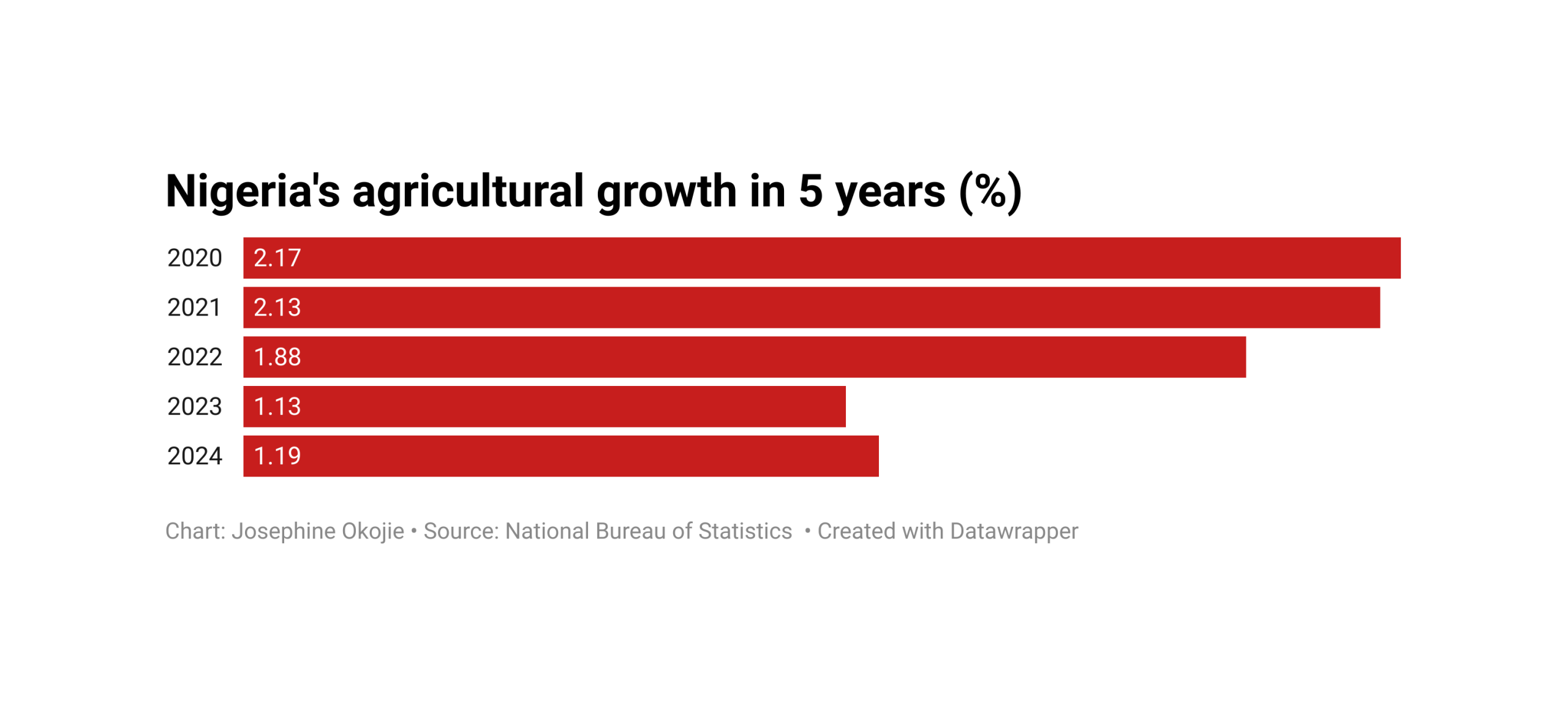
Despite successive government efforts to boost food production and diversify the economy through agriculture, Nigeria’s agricultural sector has not grown in the last four calendar years.
Data from the Bureau of Statistics (NBS) shows that growth in the sector has constantly declined between 2020 to 2023, before surging marginally in 2024.
The sector recorded 2.17 percent growth in 2020, which declined to 2.13 and 1.88 percent in 2021 and 2022, respectively.
In 2023, the growth in the sector recorded a further decline of 1.13 percent before increasing marginally to 1.19 percent in 2024.
Experts say that there is still no significant impact of increased focus and investments in the sector, as the country still has a huge demand-supply gap in most of its staple crops.
They attributed farmers’ continuous declining productivity to the worsening impacts of insecurity and climate change, which they say are hampering agricultural output.
“Climate change and insecurity are the two critical issues hampering farmers’ productivity in the country,” AfricanFarmer Mogaji, former group head of agribusiness, Lagos Chamber of Commerce and Industry (LCCI), said in a response to questions.
“The data is evidence that agricultural productivity is shrinking as the impacts of these two issues worsen,” Mogaji said.
Worsening impacts
Climate change has been altering and disrupting the farming cycle in the country for the past three years.
Erratic rainfall, flooding, droughts and longer dry spells have made farming more uncertain in Nigeria.
The situation has also led to the loss of billions of naira worth of investments in major staples, especially in the northern region, where the bulk of the country’s food crops are cultivated.
Owing to the worsening impacts of climate change, flooding and droughts have now become a yearly occurrence in Africa’s most populous country since 2018.
Read also: Why Nigeria needs a robust greenhouse gas inventory to tackle climate change
Data from the International Disaster Database shows that a total of 21.9 million people were severely affected by the country’s worst climate change impact in 2022, which caused 603 deaths and $4.2 million (N1.6 billion, using the 2022 average exchange rate) in total damage.
In 2024, Nigeria experienced flooding from heavy rain, which caused deaths and drove people from their homes. But there are no official data on the number of deaths and damage.
“Extreme weather events are occurring more frequently, and this is greatly impacting food production,” Jude Obi, president of the Association of Organic Agriculture Practitioners of Nigeria, says in a response to questions.
Currently, over 200 deaths are recorded with 700 persons missing as floods hit the Nigerian town of Mokwa – Niger State on May 29, 2025, according to data from the National Emergency Management Agency.
“The recent flood disaster in Mokwa is a stark reminder of how vulnerable our food systems are to climate-related shocks,” Sandra Victor-Gwafan, co-founder and chief executive officer, DeBranch Farmers, said in a recent media interview.

Rising food costs, worsening hunger
The climate challenge faced by farmers in the north, who account for almost 70 percent of what Nigeria eats, is affecting food prices and availability.
Food prices have surged by over 100 percent in Nigeria. With food prices climbing to record peaks, millions of Nigerians are already facing devastating hunger.
Buoyed by rising food costs, Nigeria’s inflation rate quickened to 34.8 percent in December 2024, the highest in three decades, before declining to 23.7 percent in April after the country rebased its inflation rate.
But despite inflation falling back to 24 percent, prices are still rising but at a slower pace. The rise in inflation has eroded households’ incomes and savings, amplifying the country’s worst cost of living crisis.
With staple crop yields plummeting and food prices skyrocketing, households are facing dire food shortages, leading to increased rates of hunger, stunting and wasting among children.
About 31 million people across the country have been projected to face acute hunger in the June-August 2025 lean season, according to a World Food Programme report.
Also, a November 2024 report by the NBS shows that two out of three Nigerian households are going hungry, with families skipping meals as they cannot afford enough food.
Read also: Influence of climate change on food security

Mitigation and adaptation
Nigeria must begin now to address climate change and rescue lands taken over by desertification for the cultivation of crops and as a lasting solution to the conflicts between farmers and herders.
“The government must empower communities to combat land degradation and build resilience to climate change using sustainable interventions,” Obi says.
Nigerian farmers must now actively adapt to climate change through various strategies to mitigate its negative impacts on crop yields and their livelihoods.

Join BusinessDay whatsapp Channel, to stay up to date
Open In Whatsapp


