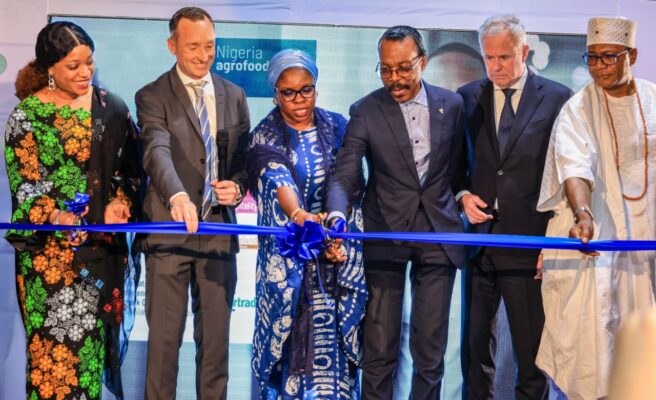
Nigeria lost an average of 35 million metric tons of food in 2025 due to poor storage and broken logistics, resulting in massive post-harvest losses, according to Babajide Sanwo-Olu, governor of Lagos State.
In his address, held on Tuesday in Lagos, the governor said the losses, however, present opportunities for investment, which in turn will curb the deficit suffered yearly.
The governor, represented by Abisola Olusanya, commissioner of Agriculture and Food Systems, stated that the state’s food economy has more than doubled in six years, from N6.5 trillion in 2019 to over N16 trillion now.
He explained that despite this growing food economy, Lagos still suffers from a high rate of post-harvest losses. “Last year alone, Nigeria lost between N3.5 trillion and N5 trillion — that is, 30 to 40 million metric tonnes of food,” Sanwo-Olu said.
“To post-harvest waste, mainly because of poor storage and broken logistics,” he added.
He noted that the state is open for business, urging exhibitors and investors to bring their best solutions, technology, expertise, and capital to address the issues plaguing the country’s food systems.
“Bring your best solutions, your expertise, and your capital. Come and co-create with us the systems that work for our roads, our climate, our farmers, and our consumers.” “The returns are real, the market is here, and the political will is unwavering.”
According to the governor, Nigeria’s food security can be achieved by cold rooms that stay powered, trucks that keep produce fresh from Kano to Lagos, processing plants that turn raw harvest into export-grade products, and market linkages that put money in the hands of farmers.
He noted that the state is already investing heavily in fixing the problem and creating an enabling environment for the private sector to tackle the problem as well and thrive.
He explained that the state has stopped managing the problem of postharvest losses and started fixing it at scale.
“We are building a modern food logistics backbone led by the Lagos Central Food Security and Logistics Hub in Epe — one of the most ambitious projects of its kind anywhere in Africa,” he noted.
Read also: FG targets 6m daily eggs in $900m poultry deal with China
“Around it, we are creating a network of agro-produce hubs and last-mile outlets so that food moves faster, stays fresher, and reaches our people with far less waste,” the governor added.
Freyja Detjen, exhibition director at Fairtrade Messe, organisers of the conference, said that Agrofood Nigeria, in its 11th edition, has provided a meeting point for innovation, partnerships, and new perspectives.
Detjen said that Nigeria is the largest importer of food and packaging technologies in West Africa, with imports hitting €265 million in 2024.
According to her, packaging technology accounts for €121 million. She noted that the country’s food market is projected to reach €222 billion by 2026
“These figures show the scale of opportunity in Nigeria, and this is exactly where AgroFood Nigeria contributes.”
Read also: National Food City will boost Benue’s economy – Alia
“137 exhibitors are presenting solutions designed to strengthen value chains, improve productivity, and support the continued development of Nigeria’s dynamic agrofood industries.”
Speaking also, Bismarck Rewane, managing director of Financial Derivatives Company Ltd, in his presentation said from 1970 to 2025, the country has shifted from an agriculture-dominated economy to an oil-driven one in terms of GDP and export structure.
He noted that agriculture’s share of GDP fell from 50 percent in the 70s to 23 percent in 2025.

Join BusinessDay whatsapp Channel, to stay up to date
Open In Whatsapp