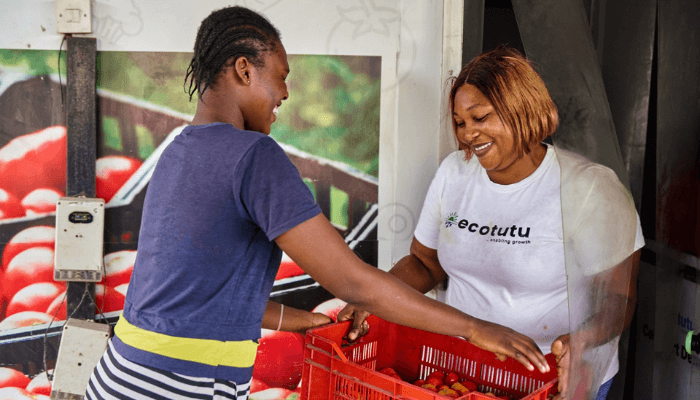
In Nigeria, where food waste is a pressing issue, Ecotutu’s cutting-edge cold storage solution is bringing hope to farmers and helping the country tackle its huge post-harvest losses.
By leveraging solar-powered cold storage facilities, Ecotutu – a cleantech agro business is enabling farmers to extend shelf life, increase income, and reduce Nigeria’s food waste, estimated at N3.5 trillion annual loss.
The agrofirm moved and stored about 18,000 tons of perishable produce across Nigeria, preventing roughly 13,000 tons of food loss in the process in 2025, according to its impact report.
The figures show how access to reliable cooling is reshaping the country’s agricultural sector.
“In 2025, we moved and stored approximately 18,000 tons of perishable produce,” Babajide Oluwase, chief executive officer at Ecotutu said in the report.
“We helped prevent roughly 13,000 tons of food loss. We also validated a critical truth about our market: women are the backbone of food security.”
For many farmers and traders, the absence of cold storage turns every harvest into a race against time. Without cooling, produce must be sold immediately, often at distress prices, or risk complete spoilage. Cold-chain access changes that equation.
“Before the cold room, I sold in a rush,” one of Ecotutu’s clients said in the report. “Now I sell with confidence,” reflecting a shift from survival-driven sales to market-led transactions.
The report showed that users of cold storage recorded an average income increase of 30 percent in 2025, largely because they could hold inventory longer, reduce waste and meet buyer quality standards consistently.
For processors, access to cold logistics reduced rejected raw materials by up to 45 percent, stabilising supply chains that are often disrupted by heat exposure and transport delays.
The impact is particularly visible in horticulture, where heat sensitivity makes fruits and vegetables highly vulnerable.
Farmers and aggregators using cold storage reported up to a 35 percent reduction in spoilage, helping preserve both food value and embedded resources such as water, land and labour.
Beyond storage, cold-chain logistics are also proving critical.
Case studies from the report show how temperature-controlled transport preserved mango pulp for Reel Fruit, a dried fruit agro company, that wanted to move from Ogun to Lagos, reduced spoilage for fresh produce distribution within Lagos, and protected pineapples transported across borders from the Benin Republic to Nigeria, routes where heat exposure previously wiped out value before goods reached the market.
Yet the report argues that cold chain is not merely a technical fix, but a systems intervention. “Cold chain is a system, not a product,” Ecotutu noted following its 2025 Cold Chain in Agriculture Roundtable, which brought together policymakers, financiers and agribusiness operators.
It noted that players in storage, logistics, and energy value chains must work together; if not, losses simply shift from one point in the value chain to another.
One key insight from the roundtable was that infrastructure is often deployed in the wrong places, clustered around urban markets rather than production and aggregation zones where losses actually occur.
Financing also remains misaligned, with high interest rates and weak collateral frameworks limiting cold-chain investment, despite clear demand.
“Knowledge and standards gaps lead to misuse, spoilage, and underperformance even where infrastructure exists,” the report notes.
Cold-chain expansion is also emerging as a climate intervention. By saving food that would otherwise rot, Ecotutu estimates it avoided about 39,000 tons of carbon dioxide equivalent emissions in 2025, while solar-powered systems displaced diesel generators commonly used for cooling.
Food waste is a major driver of methane emissions, making loss reduction one of the fastest routes to climate mitigation within food systems.
The report further revealed that its survey showed that women appear to be central beneficiaries. About 45 percent of Ecotutu’s users in 2025 were women, reflecting their dominant role in food trading and processing.
The report showed that women-led enterprises exhibited strong utilisation discipline, translating cold storage access into better cash flow and inventory management. The full report can be downloaded on the company’s website.
The report disclosed that Nigeria’s cold-chain gap remains wide. Investment gaps run into billions of dollars across fresh produce, meat, dairy and aquaculture. However, Ecotutu plans to deploy over 40 additional solar and hybrid cold rooms by 2026, targeting logistics hubs and underserved markets.

Join BusinessDay whatsapp Channel, to stay up to date
Open In Whatsapp