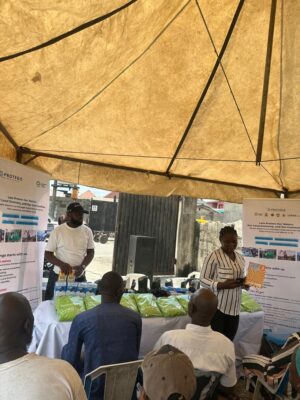
Circularity Africa, a sustainability firm, has scaled up its community-based recycling initiative in Lagos as part of efforts to curb plastic pollution and improve waste management in underserved areas, with activities marked on Global Recycling Day.
Speaking at an equipment distribution event on Wednesday, Seun Ogungbure, managing director of the company, said the organisation is deploying a model that combines environmental sustainability with income generation for low-income communities.
“Why should people prioritise waste management when they struggle to feed? Our model makes recycling economically beneficial while solving environmental challenges,” he said.
Read also: From waste to resource: Nigeria’s rPET plant brews a circular economy
Ogungbure said the initiative is designed to address both economic hardship and poor waste disposal practices, which often go hand in hand in underserved communities.
The firm distributed tools to 145 material recovery officers and is establishing 54 recycling collection clusters across Nigeria in partnership with local governments. The clusters will serve as aggregation points where trained community members carry out door-to-door waste collection, record volumes and earn commissions based on recyclable materials gathered.
The project is being implemented in collaboration with the Federal Ministry of Environment, Lagos State Ministry of Environment, Lagos Waste Management Authority (LAWMA), and the German government under a programme focused on preventing marine litter in the Gulf of Guinea.
Operations are currently concentrated in coastal communities such as Ajeromi in Lagos State and Calabar, where improperly managed waste frequently ends up in drainage systems and flows into the Atlantic Ocean.
According to Ogungbure, the intervention seeks to intercept waste at the community level before it reaches waterways. “What we are doing is building systems that stop waste before it gets into canals and ultimately into the ocean,” he said.
Nigeria generates more than 32 million tons of plastic waste annually, much of which is poorly managed due to weak infrastructure and limited access to formal waste collection services. Ogungbure noted that the absence of structured systems has historically driven indiscriminate dumping in many communities.
He added that Circularity Africa’s model is already changing behaviour in some areas, with residents beginning to properly containerise waste and engage with formal collection systems.
Read also: Lagos roll out circular economy project for grassroots impact
Beyond collection, the company is piloting the recycling of low-value and hard-to-process plastics into products such as benches and chairs for schools and offices, demonstrating the commercial potential of circular economy solutions.
Ogungbure called for stronger government collaboration and replication of proven grassroots models across the country, noting that enforcement alone is insufficient without functional systems.
“The key is not just policy or bans, but creating systems that work for the people. If the options are not available, there is little individuals can do,” he said.
He added that expanding such partnerships would be critical to addressing Nigeria’s growing waste crisis while unlocking economic opportunities within the circular economy.

Join BusinessDay whatsapp Channel, to stay up to date
Open In Whatsapp