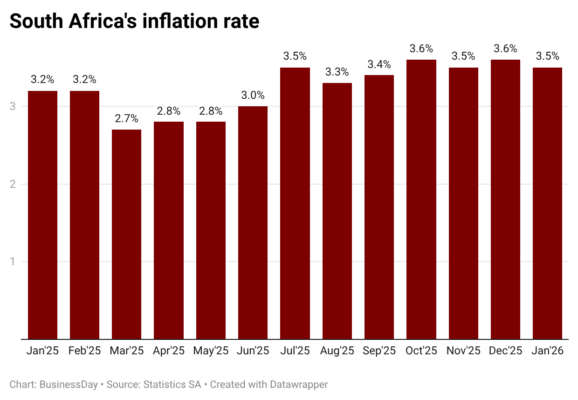
South Africa’s annual inflation rate eased in January 2026, returning to its November 2025 level, according to the latest Consumer Price Index (CPI) report from Statistics South Africa.
Data showed headline inflation in Africa’s most industrialised economy slowed to 3.5 percent in January from 3.6 percent in December, slightly above analysts’ expectations of 3.4 percent.
“Stable food inflation and lower fuel prices contributed to the softer headline rate. The monthly change in the CPI was 0.2 percent, unchanged from December,” the report said.
Last month, the South African Reserve Bank paused its easing cycle, holding the benchmark interest rate at 6.75 percent—the first pause since September 2025—amid an improved inflation outlook and firmer currency. The decision signalled a more cautious policy stance following cumulative rate cuts of 100 basis points over the past year, which lowered the policy rate from 7.75 percent.
Food trends mixed despite overall stability
Food inflation held steady at 4.4 percent for a third consecutive month, though key staples showed notable moderation. Annual inflation for cereal products slowed sharply to 0.6 percent in January from 2.1 percent in December.
White rice prices declined 11.0 percent year on year—marking an eleventh consecutive month of deflation—while maize meal inflation dropped significantly to 2.6 percent from 9.5 percent.
Oils and fats inflation eased to 4.0 percent from 4.6 percent, with olive oil 7.9 percent and butter 0.7 percent cheaper than a year earlier.
The milk, dairy products and eggs category remained in deflation at -0.5 percent, compared with -1.1 percent in December. Declines in fresh full-cream milk (-1.4 percent), low-fat milk (-1.6 percent) and eggs (-7.6 percent) drove the trend.
Meat prices, however, continued to strain household budgets. Annual meat inflation accelerated to 13.5 percent from 12.6 percent in December—the highest level since December 2017.
Fuel declines and services pressures
Fuel prices fell 3.7 percent over the 12 months to January, with monthly petrol and diesel prices dropping 3.1 percent and 5.4 percent, respectively.
At the same time, several banks raised annual fees in January, pushing the financial services index up 4.1 percent month on month and contributing to an annual rate of 4.9 percent.
Back-to-school costs and stationery relief
January’s back-to-school season also shaped price movements. School uniform items—added to the CPI basket in January 2025—recorded stronger inflation than the broader clothing and footwear category, which rose 1.2 percent.
School jersey prices increased 7.0 percent year on year, while skirts or dresses rose 3.2 percent and school shoes 4.1 percent.
By contrast, stationery prices declined sharply month on month: pens fell 9.8 percent, writing books 5.0 percent, and printing paper 3.5 percent. Textbook prices dropped 1.3 percent on the month, bringing annual textbook inflation to -3.3 percent.

Join BusinessDay whatsapp Channel, to stay up to date
Open In Whatsapp