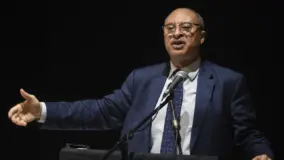
As the eloquent politician strode off we found ourselves studying each other’s faces, seeing in each sheepish countenance a mirror of our own discomfiture. Are we all, then, fools, dummies—or average, below average, above average at best? Does the earth belong only to bold, brash, brilliant rascals? Would we trade places with them if only we had sufficient courage? Can we beat them, or, if we can’t, join them?
The reporters broke into orations of their own.
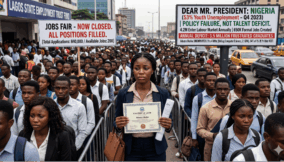
“Dissemblers they called themselves,” said the First Reporter. “Pretenders, fakers: deceit is the common coin of their currency. They play to the gallery of hapless masses who are so easy to fool, so ready to be led by the nose, so wretchedly poor in spirit they will accept any crumbs to keep body and soul together. For people so poor, their belly becomes their god. Even if their leaders were so magnanimous, which they are not, as to grant them the regulation-minimum wage of N18,000 a month, it would still be only $1,100 a year or $3 a day—while the leaders pocketed millions ($2.2 million a year or $6,000 a day) in public funds.”
“The masses in their wretched condition are unreasoning,” said the Second Reporter. “Obey before complaint is the motto drilled into them. After obeying, complaint is worthless: the damage is done, the victim is dead. It is the slogan of foot-soldiers, cannon-fodder for the ruling class, ever ready to fight and die without mutiny for cause. They do not ask if the cause is just—just that the master so commanded!”
“Fela was right when he called soldiers-in-uniform zombie,” said the Third Reporter. “But Fela didn’t see deep enough. Virtually the entire citizenry are zombie. The leaders know this, and cynically exploit that knowledge. They behave as they do because they know the citizens are helpless before them. There is no Enforcer to stop them, no Avenger to punish them. Only a discredited Army, a toothless and corrupt Judiciary. The citizens who see through their game are too few, too scattered, too weak. Too many of them, when they can’t beat them, will join them. And so an intolerable situation continues to be tolerated for decades.”
“It used to be,” said the Fourth Reporter, “that ultimate power issued from the tip of an arrow, the point of a spear, the blade of a sword. Nowadays it issues from the barrel of a gun. The people have no guns. No ready militias to guard and protect them. A gaggle of armed cattlemen will trample farm crops and massacre an entire village. A determined insurgent gang will out-gun the residual colonial army and carry off hundreds of young girls for their pleasure. If you don’t have a People’s Army, a right-minded fighting force in whom resides the authority and direction of the majority-citizenry, a force dedicated not to the predatory privileges of the minority upper class but to justice and well-being of the majority—if you don’t have a People’s Army driving the people’s interest, what you have is NOT democracy but some counterfeit bearing its name.”
“Did I hear somebody mention democracy?” An alien voice, wrapped in gold agbada. Clearly one of the leaders out for fresh air. “I will tell you about democracy. What we have is just the outward trappings and rituals, not the real thing. Look, I have M.Sc. in Political Science. But in practical politics, book knowledge is neither here nor there. I spent a small fortune before I could get my party’s nomination. The nomination form alone cost millions. Then I spent a large fortune to get elected. You know the election results are determined in advance . . . you didn’t know? . . . Ha-ha-ha . . . Since I got in, my only goal is to recover the money I invested and make a handsome profit. Politics is business, you know.”
“When you were campaigning, did you have thugs?” asked a reporter.
“Of course I did. What sort of question is that? Do you chase a runaway cow with empty hands?”
“Did you kill anybody?”
“Not me but . . . em . . . em . . . my thugs did. So unfortunate. But I didn’t tell them to kill anybody. My enemies were desperate to win, and I just wanted to be safe. My thugs fought their thugs all the time.”
“Did you have a godfather?”
“Yes I did. I had no money. He financed my entire election. Now he gets the lion’s share of whatever money I get. Plus contracts I arrange for him. I hope to become a Minister at the next cabinet reshuffle. My godfather is working on it. Then the real money will come. Dollar will fall down sha-sha like rain.”
“Why are you telling us all this?” asked a reporter, his voice tinged with embarrassment like a child who stumbled on something he was not meant to see.
“You asked me questions, didn’t you?”
“But aren’t you afraid we might expose you?”
“Expose me? Ha-ha-ha! You’re a very funny boy. You think you’re in oyiboland? . . . Anyway, I like journalists. They are serious people. They tell the truth—half the time. And they never name names. They protect their sources. I wanted to be a journalist—but there’s no money in it!” . . . .
•To be continued
Onwuchekwa Jemie
[email protected]/en
07039460162

Join BusinessDay whatsapp Channel, to stay up to date
Open In Whatsapp