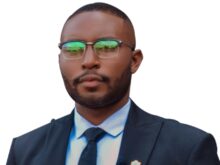
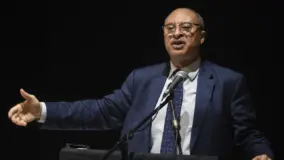
Clement Ofuani, a former commissioner in Delta State as well as a former Presidential aide was on a visit at the corporate head office of the BusinessDay Newspapers where he spoke with CHARLES IKE-OKOH (Editor, BDSUNDAY), TAYO FAGBULE (Chairman, Editorial Board), ZEBULON AGOMUO (Deputy Editor, BDSUNDAY) and PATRICK ATUANYA (Senior analyst) on the state of the nation. Excerpts:
Like in India and some other places where professionals are now going into politics and seeking elective positions, do you see that happening here in the country?
I think we are likely to see that. Whenever people are not satisfied with what they are getting, there’s always a tendency for seeking new solutions. New solutions will always come from those who have not been part of the crisis we have been going through, those who have the unique attributes that we think we need to make a change to the direction we want to be. So, the problem of Nigeria is the unwillingness of the political system to welcome such people into political arena, because the nature of our politics is still in such a way that the people are not given the opportunity to choose who govern them or to tell them what roles they should play in government. They are limited in the sense that it is the political party that determines who the candidate is; the people are not given opportunity. The outcome of general election becomes less than what you desire. The challenge for us is not to back away from political engagement simply because we think it is a closed shop. We must keep knocking at that door until it is open. It is a trend I think I see it happening in our country as it is happening in other countries.
Assuming you decide to run for the governorship in 2015, what value do you want to add to Delta State and the people?
Let me say that from my experience in the public service, I have found that there is too much concentration of attention on management, appropriation, contracts etc, so much that even the civil servants who should deliver services for the good of the nation have begun to forget what their job requirements are. In most cases, you’ll find out that the struggle is about where the cheque is being written, where the contract is being awarded from etc.
Some people are getting so much out of the system beyond what they are contributing; there’s no relationship between effort and reward. Of course, that changes incentives for the kind of behaviours you find around. I think there’s a need to change our society. We need to change the incentives, the reward system to make sure that people understand that those values that move society forward are the values that we ought and should promote and incentivize. Once we begin to do that, the aggregate change in behaviour will begin to occur. Economy will tend to be more efficient. For me, that’s the best order of business. The other one about how you build the roads, the bridges, hospitals and schools are matters of setting priorities. The real challenge is transferring the way society reacts, the way people behave, the way leaders are held accountable and reducing the undue focus on paraphernalia of office at the expense of the people they are supposed to serve. Once this change- the way we use our resources etc – that’s for me is the biggest contribution that anybody can make at this point in time for our political development.
How would you assess the administrations in Delta State since 1999?
You see, assessing administrations is not something that we can deal with on emotional point of view – this one did well and that one did not do well. There are many indices for assessment. It is not a question of assessing each administration, but understanding the era in which each has to operate and what it has to contend with and how well it managed those affairs. I can speak better about the James Ibori administration because I was involved in it; for the best part of the Uduaghan administration, I have not been in the state, so I do not have access to the kind of information that will enable me make informed judgment. I Joined the Ibori administration at the height of the crisis of the Niger Delta. Up until that time, Delta State was just about 8 years old. Again, the budget of the state in 1999 was N6.4 billion; that was total annual budget for both capital recurrent expenditures. We did a supplementary budget of about N1.8billion which brought the total budget that year to about N8.2billion. The following year, 2000, the budget was N18.2billion; it was only about April that the President acceded to the agitation from the Niger Delta states to give to them the 13 percent derivation provision of the Constitution; so there was a higher than normal inflow.
We had to do a supplementary budget to push the budget to N28 billion, even at that, because the spending capacity had not also been pushed up, the substantial funding was left in the treasury at the end of the year. It was carried over to 2001 budget. If you add or aggregate total budget available for that administration, from 1999 to 2007, it did not get to one year budget of a state today. Again, because of agitations from various ethnic groups within the state, the administration did everything to make the people realise they were not forgotten. At the end of the day, it tended to water down the impact of the expenditure because it was scattered, and couldn’t achieve much that could ‘wow’ anybody.
The way I look at it is that every administration that comes in should look at the problems that have not been solved; the one that has been solved is no longer your problem. That, for me, should be the focus. The questions should be: what are the new challenges? Where are the areas of new opportunities that we can take on, that can help us make the kind of progress we want to make?
What kind of economic policies would you have pursued?
Unfortunately, politics often determines the economic tempo, but if you look at it deep down, if you make good economic decisions, it yields political benefits. The focus, as difficult as it is, should be to make good economic judgment. It is difficult to make instant impact in the lives of people without thinking through. If you are sensible you’ll create the kind of new society we are looking for, and after some times people will begin to see political benefits from those difficult economic choices that had to be made.
If you look at private and public sector education- in our time, there was nothing like private schools- everybody went to public primary school and we got good education and then we moved on to the public secondary school, and we got good education and then public university, and got a quality education.
But overtime, the funding became insufficient. The issue is that if you insist it must be free education, you have not told us how it will be funded. Unless you are going to transfer more and more of crude oil revenues into education, you cannot continue to have that quality, the alternative is to find a better way of funding our education in such a way that we’ll continue to have the quality we want. But then, if we decide we’re not going to take part in the funding, then, you have invariably decided to get the half measure. This, to me is the real challenge.
What will be your priority on the scale of projects, assuming you become the state govenor?
If I take education, I will like to see where public schools can give quality education. The teachers must have the capacity to import the right knowledge; must be equipped with the needed materials to work, and they must be adequately motivated. These are the issues that will be addressed.
I’ll also like to see a situation where children will not be deprived of education because of the circumstances of their parents; therefore, we have to find a way of providing resources for every child to get quality education.
I also will insist that people take more responsibility because by so doing, they attach importance to what they do.
The other thing is that job creation remains a major focus because challenges of insecurity and growing inequality can only be addressed when people start earning good income from their job; farmers start getting good pay for their produce.
In Delta, we have five sea ports; we have about three trade zones. These trade zones have multiplier effects. The acute housing deficits in and around Asaba area, can be tackled. If you take time to build houses or create opportunities for people to build in and around that area, imagine the number of jobs it will create. Then, you’ll have new sets of industries spring up around there as a result.
When you look at Delta, you see a state that has oil resources, gas, proximity to Onitsha and the airport; when you talk about Nigeria broadly, you mention Lagos, Port Harcourt, Abuja, and Kano, even within the Niger Delta, it is about Port Harcourt, Uyo (Akwa Ibom State). So, it can be said that Delta is under performing its potentials; if you were to be elected governor in 2015, how do you intend to reposition Delta to be a go-through state so that when a foreign or local investor is thinking, the first state that comes to his mind is Delta?
Some of the opportunities you mentioned- the oil, gas etc, unfortunately, we don’t have much constitutional powers to take decision on them, so we really can’t do much there. But, there are opportunities- the free zones- are intended to create jobs (high technology jobs) that will support the oil and gas industry.
Lagos has grown as an economic hub so that people can live in Apapa or any other part of the state without being bothered about what is happening in Alausa. The only concern is if the road to your house or office is not good, that’s when you can ask question about governance or government. But a state that is far more rural, we haven’t got a formal economy to drive it yet. That is a challenge. Rivers was largely in the same footing with Delta but they benefitted somehow from the crisis of Niger Delta militancy. Port Harcourt benefitted immensely. Some also migrated to Abuja. These affected Delta so much. What we need to do is to address the insecurity challenges, and it requires political re-engineering for it to be achieved. And once we have that then we begin to deal with criminality.
Delta is home to different ethnic groups who make various demands from the state government. How do you handle such variegated demands so as to keep the peace?
I don’t think it is the job of one person. It is hoped that as we perfect the strategies of addressing such agitations, more and more people will come on board to contribute to the good of the state.
I have always said that PDP as a party has understood such sentiments and made a provision to address it in its constitution by way of power rotation, which gives each and every demographic group a form of confidence that at one point or the other, they’ll achieve.
If we are committed to implementing that constitutional provision, it will to a large extent increase the inter-ethnic harmony. Forget about the individual ambition that drives a few people to kick against the provision. Everybody who is right-thinking has come to understand that it is the way to go.
I also think there’s need for transparency, honesty in dealing with such issues. Once people can see there’s a programme that is transparent and they begin to see that what is due to them are given them, that’s what democracy is all about. The people will begin to believe and work with you.
Could the President have done anything differently on this issue of terrorism; how would you describe the INEC in the state?
On the INEC, it was supposed to be a copy of what the Americans operate, we didn’t quite copy it the way they operate so we tend to get a lot of things wrong. And it is not something that is peculiar to Delta State, so one should not be discussing it in isolation, but the fact that regular elections are not being held for local government is a big challenge because that’s in itself is a breach of the constitution which states that a democratically elected local government chairman is guaranteed under the constitution.
So, why are the elections not being held? Why do we continue to have ad-hoc local government chairmen? What we need to do is to show greater determination to do the right thing and provide the right and appropriate funding for the SIEC to organise a proper election. I think that’s the way to go.
As for the national crisis, it is excessive politics that is of great concern. Other nations that faced the challenge of terrorism come together; they unite to face a common enemy that endangers the society. It is unfortunate that the popular narrative is that the anger is not being channeled against the people who have abducted the young school children and prevented them writing their examinations and pursuing their education, the focus is on what the president has done or has not done.
And if you’re not careful it is almost an endorsement of the activities of the Boko Haram. So, we have to be very, very careful. Yes, I expect to see greater involvement between the President and the presidents of the surrounding nations because it is a regional crisis. If the President of Cameroon is providing sanctuary for these people to enter into Nigeria and wreak havoc, they should be able to reach a form of understanding not to allow that to happen. And they must understand the consequences that will follow if they must continue that way.
On whether I would have done something differently if I were the president or governor of Borno State, I cannot say that I have better knowledge than all the security experts that are around. The truth of the matter is that we need back those girls, we need them back unconstitutionally. This is not about Jonathan; it is about terrorism versus democracy. We should and must find a solution to it.

Join BusinessDay whatsapp Channel, to stay up to date
Open In Whatsapp