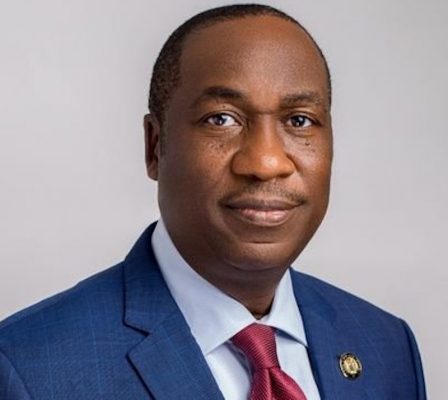
As conversations quietly intensify around who succeeds Babajide Sanwo-Olu, Lagos State governor, in 2027, one name has moved from the background to the centre of Lagos politics, Obafemi Hamzat.
A long-serving deputy governor with deep roots in the state’s political structure,
Hamzat is now widely seen within the ruling All Progressives Congress as a leading contender for the top job. His emergence reflects not just timing, but years of calculated positioning, loyalty to party hierarchy, and a technocratic profile that has shaped governance in Nigeria’s commercial capital.
Read also: Sanwo-Olu backs deputy Hamzat for Lagos top job
A technocrat shaped by legacy and learning
Born on September 19, 1964, in Lagos, Hamzat comes from a family steeped in public service. His father, Mufutau Olatunji Hamzat, combined politics with traditional authority, serving in the Lagos State House of Assembly and later as commissioner for transportation in the early 1980s.
That early exposure to governance would prove formative.
Hamzat’s academic path reflects a strong technical grounding. He studied agricultural engineering at the University of Ibadan, earning both undergraduate and master’s degrees, before completing a PhD in system process engineering at Cranfield University in 1992. He finished the programme in record time, a detail often cited by allies to underline his discipline and focus.
Before entering public office, he built a career across both academia and the private sector, with stints at Columbia University, Merrill Lynch, Morgan Stanley, and Oando Plc. Those experiences shaped his reputation as a technocrat with global exposure rather than a conventional politician
Entry into Lagos politics
Hamzat’s formal entry into politics came in 2005 under Bola Ahmed Tinubu, then Lagos State governor, who appointed him commissioner for science and technology.
In that role, he pushed the digitisation of government processes, introducing systems that improved record keeping and helped eliminate so-called ghost workers from the state payroll.
Read also: Sanwo-Olu, Hamzat sworn- in for second term
“When Babatunde Fashola became governor in 2007, he retained Hamzat,” a move seen at the time as a vote of confidence in his administrative competence.
Under Fashola, Hamzat later served as commissioner for works and infrastructure, overseeing major projects including the Lekki Ikoyi link bridge and the expansion of the Lekki Epe expressway.
These projects cemented his image as a results-driven, public official, more comfortable with systems and delivery than political theatrics
The long road Alausa
Hamzat’s ambition to become governor is not new.
He contested for the APC governorship ticket ahead of the 2015 election but lost to Akinwunmi Ambode. Four years later, he made another attempt, only to step down on the eve of the primary in favour of Sanwo Olu after consultations with party leaders.
“After due consultations with my numerous supporters… I have resolved to step down from the governorship race… and pool resources together with my brother and friend, Mr Babajide Sanwo Olu,” Hamzat said at the time.
Read also: Top 10 countries that spend the most on education per student in 2026
That decision would prove pivotal.
He went on to become deputy governor in 2019 and secured a second term in 2023, placing him in a historically strong position within Lagos politics.
A historic tenure and a political test
If he completes his current term, Hamzat will become one of the longest-serving deputy governors in Lagos since Nigeria’s return to democracy in 1999.
Yet, history presents a hurdle.
No deputy governor in Lagos has successfully succeeded their principal. Breaking that pattern will be Hamzat’s biggest political test.
Still, his supporters argue that his experience, loyalty, and visibility within government give him an edge.

Join BusinessDay whatsapp Channel, to stay up to date
Open In Whatsapp