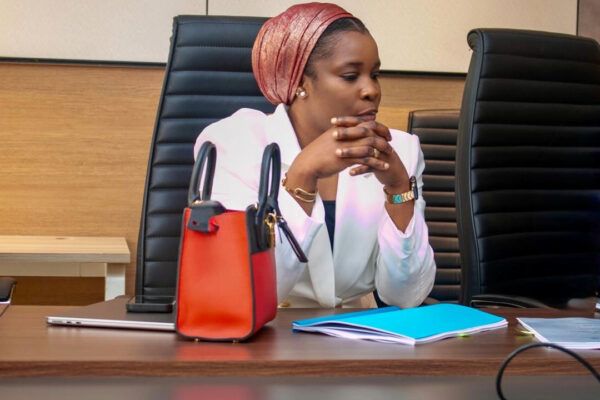
On a construction site in Kano State, solar panels rise from dry earth at a pace that would have seemed improbable just three years ago.
Behind the project is a woman who once spent her days inside university libraries, dissecting the architectural failures of Nigeria’s energy policy.
Dr Nabilah Sani Mohammed did not abandon academia for the private sector. She concluded that academia alone could not fix the problem.
“Understanding the problem was not enough,” she says. “I wanted to be part of delivering the solution.”
Mohammed, who holds a doctorate in Public Policy from Universiti Brunei Darussalam with a specialisation in renewable energy policy, is co-owner and Director of Corporate Services at Alfuttaim Nigeria Limited, an energy company focused on decentralised power solutions.

At a moment when Nigeria’s grid continues to haemorrhage investment and public trust in equal measure, her firm is doing something increasingly rare: actually building.
The numbers are striking. Through the World Bank-supported Distributed Access through Renewable Energy Scale-up programme, known as DARES and implemented by the Rural Electrification Agency, Alfuttaim Nigeria Limited secured a $6.4 million grant to develop solar mini-grids across ten underserved communities in Kano State, targeting approximately 1.2 megawatts of generation capacity.
The firm then mobilised an additional $4.6 million from Bank of Africa UK and Impacta Global, bringing the total project financing to $11 million. That is not a pilot. That is a portfolio.
“In addition to the grant, we mobilised further financing from Bank of Africa UK and Impacta Global,” Mohammed explains, “reinforcing investor confidence in our execution capability.”
What makes Mohammed’s story unusual is not just the scale of capital she has assembled, but the distance she has travelled to reach this point.
She began her career as a research assistant at Penn State University under Professor Catherine Rodgers, a scholar of international arbitration and professional ethics. She holds an LLM in Energy Law from Penn State and a certificate in justice from Harvard University.
Her academic pedigree is immaculate. Her sector of choice, however, offers few concessions for credentials alone.
Nigeria’s energy sector remains one of the most challenging operating environments on the continent.
Power generation consistently falls short of installed capacity. Financing for infrastructure projects is constrained by currency risk, regulatory uncertainty and shallow domestic capital markets.
For a woman without an engineering background entering an industry dominated by men with both, the barriers were structural, not merely cultural.
Mohammed is candid about what she encountered. There were rooms, she says, where her presence was questioned. Boardrooms where the credibility she had spent years building had to be re-established from scratch.
“Credibility in this industry is built through delivery,” she says. “Consistency, technical understanding, and strategic clarity became my strongest responses, not through assertion, but through execution.”
That disposition has produced results. The DARES grant, awarded through a highly competitive selection process administered by the Rural Electrification Agency, validated Alfuttaim Nigeria’s technical and financial proposal against dozens of competing developers. Winning it required more than policy fluency. It required a bankable project structure, demonstrated capacity and a credible team.
Deployment is now underway. Solar panel installations and distribution infrastructure are visible across multiple Kano State sites. Communities that have spent years relying on diesel generators or kerosene lamps are weeks or months from accessing reliable electricity for the first time.
For Mohammed, the stakes extend beyond the balance sheet. She has spent time on project sites and frames what she sees in terms that few developers bother to articulate publicly: electricity as a determinant of whether a healthcare clinic can refrigerate vaccines, whether a small business can extend its operating hours, whether a family’s economic trajectory changes at all.
“Energy is not an abstract policy goal,” she says. “It is a lived reality.”
She also carries this work into her role as Secretary General of the Baze University Alumni Association, where she has served since 2019, and her prior tenure as Assistant Registrar at Baze University, an institution that trained her and that she continues to invest in. The dual identity of operator and institution-builder is deliberate.
The mini-grids in Kano will not be the last thing she builds.
Nigeria’s electricity access deficit remains one of the largest in the world by population affected. Closing it will require private capital at scale, developers who understand both the policy landscape and the ground-level execution demands, and women who refuse the implicit instruction to wait their turn.
On that last point, Dr Nabilah Sani Mohammed stopped waiting some time ago.
Join BusinessDay whatsapp Channel, to stay up to date
Open In Whatsapp