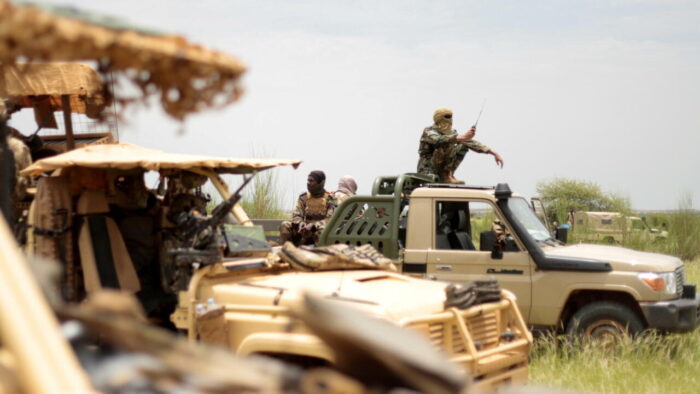
Mali’s military government is grappling with one of its most severe security crises in years after a wave of coordinated attacks by jihadist fighters and separatist rebels left the country’s defence minister dead and a strategic northern town reportedly under rebel control.
The offensive, launched at dawn on Saturday, was carried out by a coalition of Tuareg separatist groups under the Azawad Liberation Front (FLA), alongside the jihadist alliance, the Group for the Support of Islam and Muslims.
The attacks targeted multiple regions across the vast Sahelian nation, exposing deep vulnerabilities in the ruling junta’s security architecture.
Among the casualties was Sadio Camara, Mali’s defence minister, who died following a car bomb attack on his residence in Kati, a military stronghold just outside the capital, Bamako.
Family sources and officials confirmed that his second wife and two grandchildren were also killed in the blast.
In a statement released on Sunday, the government said Camara died of wounds sustained while fighting off attackers, adding that he had “neutralised some” of them before succumbing in hospital.
Authorities announced that he would be honoured with a national funeral.
Read Also: Mali defence minister Sadio Camara killed in major militant assault near Capital
His death marks a major blow to the administration of Assimi Goïta, the junta leader, who has not been publicly seen since the attacks began.
However, a security source indicated that Goïta remains in a secure location.
Clashes continued into Sunday in several parts of the country, including Kati, the northern cities of Kidal and Gao, and the central town of Sévaré.
Residents in affected areas reported sustained gunfire and explosions, underscoring the scale and coordination of the offensive.
Particularly significant was the reported collapse of Kidal, a long-contested northern stronghold.
Tuareg rebels claimed they had taken “total” control of the city after reaching an agreement that allowed Russian-backed forces to withdraw.
“We saw a military convoy leave, but don’t know the details. Fighters from armed movements have now taken over the streets,” a resident told reporters.
The Malian army had only recaptured Kidal in November 2023 with support from the Russian Wagner Group, ending more than a decade of separatist control.
The apparent loss of the city again highlights the fragility of recent military gains.
Read Also: Trump targeted in shooting at correspondents’ dinner as suspect opens fire on security agent
The withdrawal of Russian-backed troops, now operating under the Africa Corps following the reorganisation of the Wagner network, marks a significant development in the conflict.
The FLA coalition also claimed advances in parts of the Gao region, further stretching government forces already battling insurgencies across central and northern Mali.
In Bamako, tension remained high as troops sealed off military installations using makeshift barricades of tyres and concrete blocks.
Heavy fighting erupted on Saturday in Sénou, on the outskirts of the capital, forcing a temporary closure of the international airport, which reopened on Sunday.
“I still hear the blasts ringing in my ears. It’s traumatising,” one resident said, describing the intensity of the violence.
Opposition coalition, the Coalition of Forces for the Republic, warned that the country was “in danger”, accusing the junta of failing to deliver on its promises of stability and security.
“The authorities promised the return of the state. After this offensive, no one can seriously claim Mali is secure,” the group said.
António Guterres, United Nations Secretary-General, condemned the violence and called for coordinated global support to combat extremism and address urgent humanitarian needs in the Sahel.
The European Union also condemned the attacks, describing them as acts of terrorism.
Mali has been in conflict for more than a decade, battling jihadist insurgencies and separatist movements.
However, analysts say the scale and coordination of the latest attacks represent the most serious challenge to the junta since it seized power in 2020, and arguably since the 2012 insurgency that prompted French military intervention.
According to an AFP report, the country, rich in gold and other natural resources, has in recent years pivoted away from Western allies, including France, and strengthened ties with Russia, mirroring similar shifts in neighbouring Niger and Burkina Faso.

Join BusinessDay whatsapp Channel, to stay up to date
Open In Whatsapp