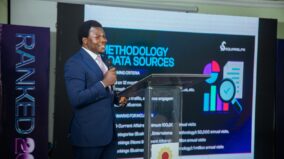
…From tax architecture to treasury command, a technocrat steps into the deep end
The elevation of Taiwo Oyedele to Nigeria’s finance leadership is less a political appointment than the culmination of a carefully built reform career, one defined by technical depth, institutional influence, and a consistent push to rethink how the country raises and manages revenue.
For over a decade, Oyedele operated at the highest levels of fiscal advisory as Africa Tax leader at PricewaterhouseCoopers, where he engaged governments, multilateral institutions, and corporations on the mechanics of public finance and economic transformation. His work straddled policy design and implementation, an uncommon blend that positioned him as both strategist and operator.
That duality would later define his transition into public service.
When he was tapped to chair the Presidential Fiscal Policy and Tax Reforms Committee in July 2023, expectations were modest at best. Nigeria’s tax system had long resisted structural change, hampered by complexity, inefficiency, and political resistance. Yet, under Oyedele’s leadership, the committee delivered one of the most ambitious overhauls of the country’s fiscal framework in decades.
The reforms, which came into effect on January 1, 2026, were not merely technical adjustments; they were a recalibration of Nigeria’s revenue philosophy. At their core was a clear objective: expand the tax base, simplify compliance, and improve efficiency without stifling economic activity.
Early projections underscore the scale of that ambition. Nigeria’s tax-to-GDP ratio, historically one of the lowest among peer economies, is expected to rise from about 9.5 percent to 10.2 percent in 2026, with a medium-term target of 12.5 percent by 2027. The broader ambition is to pushing that ratio toward 18 percent within three years.
In comparative terms, countries like Ghana, Kenya, and Senegal have consistently outperformed Nigeria in domestic revenue mobilisation, with ratios ranging from the mid-teens to about 20 percent, while South Africa stands above 20 percent. Closing that gap is not just a fiscal exercise, it is central to Nigeria’s development capacity.
For Oyedele, the reforms were a proving ground. They demonstrated his ability to navigate entrenched interests, manage opposition, and still deliver policy outcomes with measurable economic implications.
But his story is not confined to fiscal reform alone.
Beyond government, he has maintained a strong intellectual and institutional footprint, serving as a Professor of Practice at Babcock University and an adjunct faculty member at the University of Lagos. His contributions extend to global policy conversations, including input into the African Union’s Agenda 2063 and the World Bank Doing Business reports.
He has also held governance roles within the Association of Chartered Certified Accountants and Nigeria’s policy ecosystem, including the Nigerian Economic Summit Group, further cementing his position at the intersection of policy, practice, and advocacy.
Now, as he assumes full leadership of Nigeria’s finance ministry, after serving briefly as minister of State, the terrain shifts from reform design to fiscal management at scale.
And the challenges are immediate.
Nigeria’s fiscal space remains tight. Debt servicing continues to consume a significant share of government revenues, constraining capital expenditure and limiting the state’s ability to invest in infrastructure and social programmes. Recent complaints from ministries over funding gaps for capital projects underscore the severity of the constraint.
Budget financing, revenue volatility, and the sustainability of public debt now sit squarely on Oyedele’s desk.
The irony is not lost: the same system he helped redesign is now his to run.
Yet, this continuity may also be his greatest advantage. Unlike many before him, Oyedele enters the role with a working blueprint already in motion: a reform agenda he understands intimately, having shaped it himself.
His immediate task is execution: ensuring that projected gains in revenue materialise, while maintaining macroeconomic stability and investor confidence.
In a system often criticised for policy reversals and fragmented implementation, Oyedele represents something different, a technocrat with both the intellectual grounding and institutional memory to follow reforms through.
His journey from private sector strategist to public finance chief is not just a career progression; it is a convergence of expertise and responsibility at a moment Nigeria can ill afford missteps.
Whether that translates into lasting fiscal stability will depend not on the ambition of his ideas, but on the discipline of their execution.

Join BusinessDay whatsapp Channel, to stay up to date
Open In Whatsapp