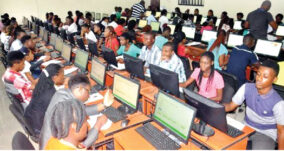
The morning air outside the exam centre in Lagos felt heavier than usual, not just because of the rainfall but with anticipation.
For 17-year-old Rebecca Ojo (not her real name), clutching her registration slip for the 2026 Unified Tertiary Matriculation Examination (UTME), she left Ikorodu by 5:30 am for her CBT centre at Badagry. She had supposed it would be a different scenario this year, with no stories of glitches and leaked questions, among others.
However, that was not to be as she was caught in traffic at Mile 2-Ajangbadi road, which held her till the exam started.
For Stella Nweke, she left Oke-Afa, Isolo to her centre at Igando by 4:30 am. Though she got to the centre before 7:00 am, she was so tired that she had to find a place to rest before the exam. Unfortunately, she dozed off and could not join others on time.
Jessica Osuere, chief executive officer at RubiesHub Educational Services, said, “JAMB was created to make university admission fair for everyone, but in reality, it has made the process more stressful.”
In the 2026 UTME, there were reports about tech glitches and security threats across the country, with some students reportedly kidnapped, while some others were barred from sitting the exam for wearing hijab.
Experts believe that the structure and governance of tertiary education admission systems are pivotal to national development goals, particularly in contexts characterised by institutional heterogeneity, demographic pressures, and educational inequality.
In Nigeria, the central mechanism for managing access to tertiary education is the JAMB, established in 1978 by Decree No. 2. This initiative emerged as a policy response to the inefficiencies of the decentralised admission system that prevailed in the immediate post-independence period.
However, JAMB as a body has been found to be embroiled in corruption, which even Is’haq Oloyede, the registrar, confirmed in a statement some years ago.
In March 15, 2021, two staff members of JAMB were arrested and paraded for defrauding some candidates seeking admission into universities. One of the staff members arrested explained that he collected N500,000 from four candidates’ parents, out of which he paid N180,000 to a colleague to help facilitate their admission.
The disturbing fact here is that these atrocities are done at the expense of the innocent, hardworking and intelligent students. In 2025, JAMB acknowledged receiving an unusual volume of complaints concerning inconsistencies in the system.
Recall that in 2025, some candidates were affected by technical glitches. The JAMB registrar disclosed then that 379,997 candidates were affected, with 206,610 across 65 centres in Lagos and 173,387 in 92 centres in the south-eastern states.
There were also reported cases of candidates who could not access their centres, especially in the South-East, due to the abrupt rescheduling and confusion over logistics.
Many stakeholders thought the board would adequately address the issue of posting, but the experiences of Rebecca and many other candidates across Nigeria say it all.
There was a case of some candidates in Oron, Akwa Ibom State, posted to Aba, in Abia State, and the eight passengers out of the 14 kidnapped on April 15 in Benue State, were said to be JAMB candidates travelling from Otukpo to Makurdi, that is about 100 kilometres, and two hours journey away from their homes.
Nubi Achebo, director of academic planning at Nigerian University of Technology and Management (NUTM), emphasized that JAMB has improved on many of its duties, but on candidate experience, he said, “The board still push for “exam integrity, and comfort” 7am slots during insecurity, centres without chairs, and silent glitches erode public trust even when the exam is technically fair.”
The conduct of the 2026 UTME by JAMB sparks renewed debate over the integrity and efficiency of the board, with attention focused on security, technical performance, and irregularities.
The UTME is not just another test; it is an experiment in trust. After years of criticism and controversy, JAMB promised reforms, but for candidates such as Rebecca and many others, the real issue is not what officials announced at press briefings, but what is done.
Imaenyin Usoro, a professional realtor with BRG Billionaires Realtors Group, argues that, going by the reports on glitches during the exam, JAMB has not justified the huge amount committed to the board by the federal government.
“The issue of glitches is a national embarrassment by an agency handling a very sensitive task, such as UTME, considering the enormous funds that have been pumped into the system by the government.
“I thought after last year’s massive glitches that the necessary infrastructures should have been put in place to forestall future occurrences,” he said.
Besides, he emphasised it is inconsiderate on the part of JAMB to give 7 am accreditation time considering the fragile security situations in Nigeria, which is exposing candidates to kidnappers and robbers.
Nevertheless, the board has achieved some commendable feats, such as curbing examination malpractice and releasing results quickly. In the 2026 UTME, results were released within 48 hours of the exam.
JAMB has seen significant improvements in revenue generation and remittance to the federal government in recent years, largely driven by technology adoption, reduced financial leakages, and higher registration numbers.
The board, which was set up in 1978, remitted only N50 million to the federal government coffers, but in 2017 and 2018, under a new management, the board remitted N15.6 billion to the federal purse.
Oloyede, in May 2018, described the huge difference between the revenue generated by the board in 2017 and that of his predecessors as a reflection of chronic corruption in the system.
“Nigeria is dominated by thieves at the helm of affairs, I mean certified thieves; let me talk about JAMB for instance, since over forty years that JAMB has been established, the total money generated before we came in is N52 million.
“After we finished our examinations for 2017, we generated N9 billion, in which I returned the total sum of N7.8 million to the federal government,” Oloyede said.
Looking ahead, the true test for JAMB is consistency. Incremental fixes, whether in logistics, technology, or communication, must evolve into a stable, predictable system that candidates can trust without hesitation.

Join BusinessDay whatsapp Channel, to stay up to date
Open In Whatsapp