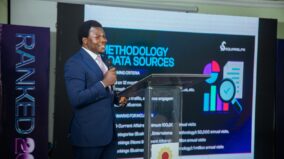
The German government, through the Deutsche Gesellschaft für Internationale Zusammenarbeit (GIZ), in collaboration with the Small and Medium Enterprises Development Agency of Nigeria (SMEDAN), has launched the Inspire, Create, Start and Scale (ICSS) initiative. The program aims to support entrepreneurs through capacity building and ecosystem linkages to foster sustainable enterprise growth.
Speaking at the event in Abuja on Tuesday, Markus Wagner, Country Director for GIZ Nigeria, noted that Micro, Small, and medium-sized Enterprises (MSMEs) represent the backbone of Nigeria’s economy, as they drive innovation, create employment, and contribute significantly to economic resilience.
He however acknowledged that despite the critical role MSMEs play, many entrepreneurs still face barriers in accessing structured support, practical business development services, and market opportunities, adding that this is precisely why the ICSS framework was developed.
“At GIZ, supporting sustainable economic development and job creation remains a central priority. In Nigeria, this means working closely with public institutions, ecosystem organizations, and the private sector to build practical systems that allow entrepreneurs and small businesses to grow.
“In collaboration with partners such as SMEDAN and Kaduna Business School, alongside many ecosystem stakeholders, the ICSS framework provides a structured pathway for entrepreneurs, from the earliest stages of ideation through business development and ultimately to scaling.
“Today’s convening marks an important milestone. It provides an opportunity to officially launch the Inspire, Create, Start and Scale (ICSS) framework as a structured approach to entrepreneurship development in Nigeria,” he said.
Wagner explained that through the ICSS framework, over 42,250 people have already been reached across six states in Nigeria, providing aspiring and growing entrepreneurs with access to structured development support, while approximately 17,967 jobs have been created.
“At the same time, more than 380 ICSS Trainers, Facilitators, and Coaches, as well as about 100 ICSS Master Trainers, have been trained through over 40 partner organizations and institutions, thereby creating a growing network of professionals who can deliver entrepreneurship training and mentoring sustainably across the country.
“These achievements are important not only because of the numbers involved, but because they represent capacity that now exists within Nigeria’s entrepreneurship ecosystem. The ICSS framework is therefore more than a training program; it represents a practical system that connects entrepreneurs with the knowledge, mentorship, and networks needed to transform ideas into viable businesses,” he added.
In his remarks, Charles Odii, the Director General of SMEDAN, explained that the ICSS initiative marks a significant moment in Nigeria’s MSME development story, as it supports entrepreneurs throughout their entire journey—from the initial ideation phase to scaling and market entry—by providing them with the essential technical, managerial, and financial expertise required to succeed within the formal economy.
Odii emphasized that the initiative aims to equip entrepreneurs with the skills to document, plan, and pitch their businesses using terminology that resonates with banks and investors. He argues that this specific focus is precisely what distinguishes a standard training program from a true economic intervention.
“We are gathered today to showcase a framework that has taken root, demonstrated results, and earned the right to be institutionalized as a permanent feature of how this country supports its entrepreneurs.
“Nigeria’s MSME sector defines the economic reality of the average Nigerian household. Nearly 97 percent of all businesses in this country are nano, micro, small, or medium enterprises, accounting for almost 90 percent of employment and nearly half of our GDP. When this sector struggles, the country feels it. When it thrives, the country feels that too. The attention, the investment, and the policy architecture we direct toward MSMEs is therefore among the most consequential work any government institution can do.
“And yet for decades, we have failed to give this sector the foundational support it deserves. Access to finance is the barrier most commonly cited by small business owners, but financing is a symptom. The deeper problem has been the absence of standardization in how we train and prepare entrepreneurs for the formal economy.
“Every program ran its own curriculum. Every intervention produced its own certificate. Banks and financial institutions had no reliable common reference point when an MSME applicant walked through their door. They could not confidently assess the risk, so they did not lend. Entrepreneurs, many of them talented and hardworking, were told they were unbankable without anyone taking responsibility for giving them the tools to become bankable. ICSS was built to solve that problem from the ground up,” he said.

Join BusinessDay whatsapp Channel, to stay up to date
Open In Whatsapp