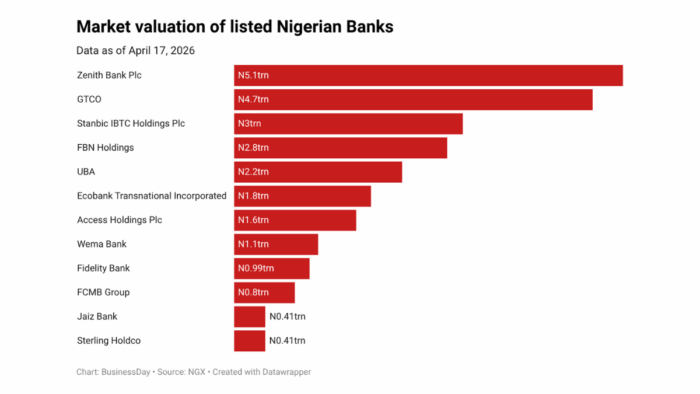
Nigeria’s banking sector has recorded a significant surge in valuation, with the combined market capitalisation of listed lenders on the Nigerian Exchange Limited (NGX) rising to N25 trillion, following the conclusion of the recapitalisation exercise.
BusinessDay analysis of twelve (12) listed banks on the NGX as of April 17, shows that tier-one lenders continue to dominate market valuation, while mid-tier banks are also gaining traction as balance sheets strengthen and capital buffers improve.
Topping the list is Zenith Bank Plc, which leads with a market capitalisation of N5.1 trillion, closely followed by Guaranty Trust Holding Company (GTCO) at N4.7 trillion. Stanbic IBTC Holdings Plc ranks third with N3 trillion, while FBN Holdings Plc and United Bank for Africa (UBA) posted valuations of N2.8 trillion and N2.2 trillion, respectively.
Other significant contributors include Access Holdings Plc at N1.6 trillion and Ecobank Transnational Incorporated at N1.8 trillion, reflecting the growing scale of pan-African banking franchises.
Among mid-tier players, Wema Bank Plc recorded a market value of N1.1 trillion, while Fidelity Bank Plc stood at N994 billion and FCMB Group Plc at N798 billion.
Smaller lenders such as Jaiz Bank Plc and Sterling Financial Holdings Company Plc posted market capitalisations of N414 billion and N411 billion, respectively.
The surge in market value reflects a combination of factors, including stronger capital bases following recapitalisation, improved earnings performance, and sustained high interest rates that have boosted margins across the industry.
The Central Bank of Nigeria (CBN) said the country’s banking sector has emerged stronger following the conclusion of a 24-month recapitalisation programme that saw lenders raise a combined N4.65 trillion in new capital.
The exercise, which began in March 2024, drew participation from both domestic and international investors, with 72.55 percent of the capital sourced locally and 27.45 percent from foreign markets, underscoring sustained confidence in Nigeria’s banking system.
Olayemi Cardoso, governor of the CBN, said the programme has significantly strengthened the capital base of Nigerian banks, positioning them to better support economic growth and withstand both domestic and external shocks.
The apex bank confirmed that 33 banks have met the revised minimum capital requirements set under the programme, while a limited number of institutions remain subject to ongoing regulatory and judicial processes being handled within existing supervisory and legal frameworks.
The CBN said the recapitalisation has improved capital adequacy ratios across the sector, with banks maintaining levels above international Basel benchmarks. Minimum capital adequacy thresholds remain at 10 percent for regional and national banks and 15 percent for banks with international licences.
The programme was implemented alongside an orderly exit from regulatory forbearance, a move the Central Bank said has enhanced asset quality, strengthened balance sheet transparency, and reinforced overall financial system stability.
Similarly, the International Monetary Fund (IMF) has described Nigeria’s recently concluded bank recapitalisation exercise as a critical buffer against rising global financial risks, noting that stronger capital positions will help the banking system withstand external shocks.
The International Monetary Fund (IMF) has described Nigeria’s recently concluded bank recapitalisation exercise as a critical buffer against rising global financial risks, noting that stronger capital positions will help the banking system withstand external shocks.
Tobias Adrian, financial counsellor and director of the Monetary and Capital Markets Department at the IMF said Nigeria’s recapitalisation exercise has come at a crucial time when global markets are facing heightened volatility driven by geopolitical tensions, tighter financial conditions, and shifting investor sentiment.
“Yes, bank recapitalisations are very welcome and are paying off, particularly under times of stress,” Adrian added.
The IMF highlighted that although global financial markets have remained relatively orderly despite ongoing conflicts and energy market disruptions, underlying vulnerabilities persist, especially in emerging markets and developing economies.
Adrian pointed out that Sub-Saharan Africa has experienced significant swings in capital flows since the onset of recent global shocks, even though asset prices have remained relatively stable.
“When we look at capital flows to Sub-Saharan Africa, we see a sizeable reaction in terms of volumes, even larger than what we observed during the early phase of the Ukraine war. However, price movements have remained fairly contained, reflecting still-healthy global risk appetite,” he said.
He warned, however, that such conditions could change quickly if global risk sentiment deteriorates, potentially exposing countries with weaker buffers.
Join BusinessDay whatsapp Channel, to stay up to date
Open In Whatsapp