Sub-Saharan Africa’s economy is projected to grow by 4.3 percent in 2026, according to the latest Regional Economic Outlook by the International Monetary Fund (IMF), but the expansion will be far from uniform.
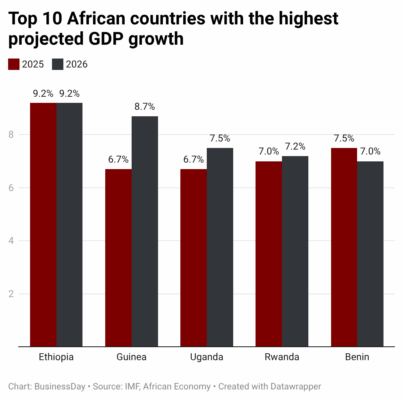
A handful of frontier economies—Ethiopia, Guinea, and Uganda—are expected to drive the continent’s growth, outpacing larger peers such as Nigeria and South Africa, which continue to grapple with structural constraints.
Ethiopia is forecast to lead with a 9.2 percent expansion, maintaining its 2025 pace and positioning itself as one of the fastest-growing economies globally. Guinea follows with 8.7 percent, while Uganda is projected to grow by 7.5 percent, supported by a combination of resource-driven investments, infrastructure build-out, and policy reforms.
But Nigeria is expected to grow at 4.1 percent, while South Africa lags at 1.0 percent, underscoring a widening divergence in Africa’s growth landscape. The IMF attributes this gap to differences in reform momentum, investment flows, and exposure to global shocks, particularly the ongoing Middle East conflict, which is expected to hit oil-importing economies harder while benefiting exporters.
Ethiopia: Infrastructure and reforms drive momentum
Ethiopia’s strong growth outlook is anchored on sustained infrastructure expansion and structural reforms aimed at opening up key sectors.
The completion and scaling of the Grand Ethiopian Renaissance Dam (GERD) is expected to deliver reliable and low-cost electricity, providing a critical boost to manufacturing and industrialisation. This has supported the expansion of industrial parks and export-oriented production.
At the same time, the liberalisation of the telecommunications and financial sectors since 2024—including the launch of the Ethiopian Securities Exchange—has improved investor sentiment and attracted foreign capital.
According to UN Trade and Development, foreign direct investment inflows rose to $3.98 billion in 2024, up from $3.27 billion in 2023, reflecting growing investor confidence.
The gradual shift in Africa’s second most populous nation from agriculture-led growth toward manufacturing and agro-processing is also strengthening export capacity and reducing vulnerability to commodity shocks.
Guinea: Mining boom reshapes growth outlook
Guinea’s projected growth is largely underpinned by its vast mineral resources, particularly the development of the Simandou iron ore project—one of the largest untapped deposits globally.
The commencement of production and exports from Simandou is expected to significantly boost GDP and government revenues, marking a structural shift in the country’s economic base.
Beyond extraction, associated infrastructure investments—especially rail links connecting inland mines to coastal ports—are improving logistics and unlocking broader economic activity.
While bauxite has historically dominated the West African nation’s export profile, the rise of iron ore and potential diversification into other minerals position the country for sustained medium-term growth.
Uganda: Oil production set to lift output
Uganda’s growth outlook is being reshaped by the anticipated start of oil production, which is expected to transform the economy into a significant crude exporter.
The development of petroleum infrastructure, including the East African Crude Oil Pipeline, has attracted substantial foreign investment and is creating spillover effects across construction, services, and logistics.
In parallel, the government is prioritising commercial agriculture, value addition, and regional trade within the East African Community (EAC), helping to broaden the country’s growth base beyond oil.
Diverging growth paths
The strong performance of Ethiopia, Guinea, and Uganda highlights a broader shift in Africa’s growth dynamics, where reform-driven and resource-backed economies are pulling ahead.
However, the outlook remains sensitive to global developments. Rising energy prices, geopolitical tensions, and domestic fiscal pressures could reshape growth trajectories across the continent.
For now, the continent’s 2026 growth story will be defined not by its largest economies, but by a new set of high-growth frontrunners.

Join BusinessDay whatsapp Channel, to stay up to date
Open In Whatsapp