The steel derrick has not moved in decades. It stands at the edge of this mangrove-fringed village in Bayelsa State, a corroded landmark from 1956, when Shell geologists struck Nigeria’s first commercial crude and set in motion one of Africa’s most consequential economic stories.
What followed was staggering in scale. More than a trillion dollars in petroleum revenues flowed out of the Niger Delta over the next seven decades, threading through pipelines that crisscrossed fishing communities and farmland.
Gas flares burned so bright they lit the night sky for miles. And yet Oloibiri, the community that started it all, spent 15 years without electricity after the oil boom moved elsewhere, left with little more than environmental damage and a long list of unfulfilled government promises.
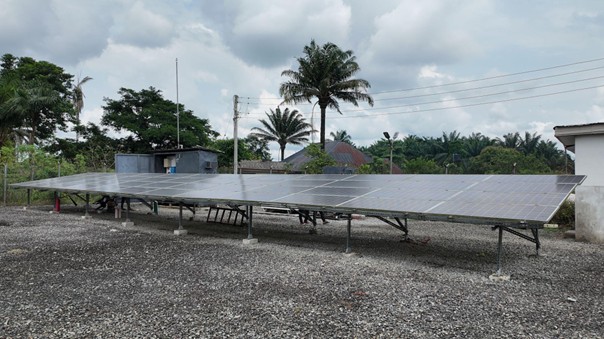
Today, the village runs on sunlight.
In 2020, Renewvia Energy Corporation, an Atlanta-based renewable energy developer, commissioned a solar-and-battery microgrid that now serves roughly 160 households, businesses, schools, and churches. The system replaced a communal diesel generator that had provided erratic power — 12 hours on a good night, nothing on others, to those who could afford the monthly fee. It marked the end of fuel queues, noisy engines, and the anxiety of not knowing whether the lights would come on.
The shift is felt most sharply in the town’s small economy. Asa, a 34-year-old welder who sold his personal diesel generator in 2021, now recharges his prepaid meter for as little as 300 naira. His welding torch stays lit through the workday. His customer base has grown. “I have more customers now thanks to solar,” he said, sparks falling around him as he bent over a motorcycle frame. His only complaint — one that would have sounded unthinkable a few years ago — is that power currently cuts off around 10 p.m. He wants 24-hour service and says he would willingly pay for it.
That complaint signals something important. Across the Niger Delta, the conversation around energy is no longer about whether power exists, but how much of it people can access and afford. That is a different kind of problem, and a more hopeful one.
Anthonia Deezua, 42, runs a provision store that sells cold drinks. Before the microgrid arrived, she ran a generator only when she could justify the fuel cost. The noise was constant. The expense was unpredictable. Now her refrigerators run through the day, cold beverages stay chilled, and workers and students stop in regularly. She calls this the most rewarding period of her business life.
Financing for the project came partly through Nigeria’s federal electrification initiative, backed by $350 million from the World Bank and $200 million from the African Development Bank, which directed performance-based grants to private developers serving underserved communities. Renewvia navigated a four-stage application process before receiving its allocation for Oloibiri, with a target of connecting 364 households.
Beyond commerce, the microgrid powers a medical center established under the Oloibiri Health Program, a partnership between Shell’s Nigerian subsidiary and the Bayelsa State government. Randy Okrikpa, the facility’s medical director, describes reliable electricity as the baseline requirement for any functioning clinic — lighting, diagnostic equipment, vaccine cold-chain storage. When Nigeria removed fuel subsidies after the 2023 elections, diesel prices surged and health facilities that relied on generators faced nighttime outages. Oloibiri’s clinic, backed by solar power, was insulated from that shock.
A third thread runs through the village: a training lab for young people between the ages of 10 and 17, where students learn typing, graphic design, and introductory artificial intelligence skills — all on computers powered by the same microgrid. The initiative, run in partnership with a blockchain-based NGO called Synota, has recorded a 90 percent success rate in training students to repair their own electricity meters. For the operator, that means lower maintenance costs. For the community, it means growing technical self-sufficiency.
Oloibiri’s transformation is small by any national measure. But in the village where Nigeria’s oil age was born — and where the derrick still stands rusting — the terms of energy and development are quietly, stubbornly being rewritten from the ground up.
Join BusinessDay whatsapp Channel, to stay up to date
Open In Whatsapp