The race to build Africa’s next great innovation hub is intensifying, and universities are fast becoming the launch pads for that transformation.

At the centre of this shift is the collaboration between the United Nations Development Programme (UNDP) and the TETFUND innovation pod initiative, an ambitious effort reshaping how talent, technology, and enterprise intersect within Nigeria’s academic ecosystem.

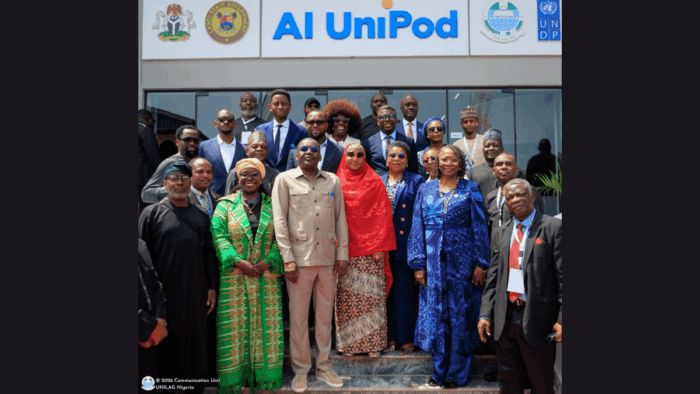
At the University of Lagos (UNILAG), UNIPOD is not just another campus programme; it is laying the groundwork for a thriving innovation economy, positioning the institution as a serious contender in the quest to create Africa’s own Silicon Valley.

Folasade Ogunsola, vice-chancellor at UNILAG, speaking about the innovation hub, said, “Nigeria is a nation of over 226 million people, with an average age of 19 years and a population set to be 400 million by 2050. We cannot afford not to embrace AI.

“It gives us the tools to shape that future to our benefit. To develop the right minds for that future, to ensure that this youthful population is an asset and not a liability.

“This is the seed time, and we are sowing good seeds that we must now water, nurture, prune and support so we get the bountiful harvest of which we can all be proud.”

Ogunsola emphasised the crucial place of artificial intelligence in economic development when she said that AI is a pivotal force reshaping the world.

“Its potential to augment human capabilities, accelerate scientific discovery, and solve complex global challenges is immense,” she said.

According to her, “This hub, therefore, represents our unwavering commitment to harnessing this transformative power for the betterment of humanity.”

Sunday Adebisi, a professor of entrepreneurship, innovation, and strategic management, emphasised that entrepreneurship was essential to developing the country’s economy and to preparing young people with an innovative mindset.

“Entrepreneurship is people being able to identify the problem in society and solve those problems, by creating an enterprise out of those problems and solving them profitably,” he said.

Adebisi noted that the University of Lagos has what it takes to become Africa’s first Silicon Valley, with six hubs inside this university, including even the design studio.

“We’re all in the same cluster for our students to be able to realise their entrepreneurship orientation and their entrepreneurship journey,” he noted.

He explained that infrastructure was key to achieving the Silicon Valley goal, which he said was the relationship between Stanford University and Silicon Valley in the USA.

According to him, when you look at Stanford, it was a professor who created Silicon Valley.

“It was a professor who gave $6,000 to Oleg Pakhad and his friend and said, ‘ Look, this thing you want to do, if you do it within the university, the university system will disturb it a little,” he said.

He highlighted how Frederick Terman, a professor at Stanford University, encouraged graduates such as David Packard and William Hewlett to stay in the area, creating a self-sustaining ecosystem of innovation.

Adebisi explained that with the sum of $6,000, the graduates were able to go outside the campus to offer solutions to societal problems with their enterprise in that place.

In the University of Lagos, there are 99 offices for entrepreneurial hubs, besides the AI innovation hub unveiled recently, and the institution has not less than 67,000 students.

Akintunde Opawole, a data-AI product expert, describes UNILAG’s AI innovation hub as a catalyst that can bridge the skills gap ravaging the country’s employment space.
“What the UNIPOD hub will do at UNILAG is to bring learning closer to the real-world ecosystem.

“For a long time, one of our biggest gaps in Nigeria has been that disconnect between what students learn in school and what the industry actually needs,” he said.

Opawole emphasised that with this kind of hub, students would not just be sitting in classrooms; they would be developing, experimenting, and solving real problems, which he said was exactly how ecosystems such as Silicon Valley evolved.

Besides, he reiterated that innovation does not happen in isolation, stressing that what the UNDP is enabling at UNILAG is a space where students, founders, and industry players can actually interact.

“That mix is powerful because it creates both opportunity and exposure. If UNILAG can sustain this and keep the focus on real output products, startups, and talent, it will definitely move them closer to becoming a true innovation hub, not just in Nigeria, but across Africa,” he emphasised.

Speaking about how the hub will improve youth employability and skills development, the tech expert said the biggest gain was the exposure it gives to students.

“We have a lot of smart young people in Nigeria, but many of them don’t get the chance to work on real problems early enough. That’s why you see graduates struggling to transition into the workforce.
“With a hub like this, students can start building relevant skills while they’re still in school, things like product thinking, collaboration, and even entrepreneurship. Those are the skills employers are actually looking for today,” he stated.

Moreover, he sees the hubs inculcating a paradigm shift in Nigerian youngsters while still on campus.

It also changes the mindset; instead of waiting to get a job, more young people start thinking about how to create value, whether that’s within a company or by building something themselves.
“Besides, there’s the network effect; when you bring in mentors, companies, and ecosystem players, you naturally create pathways to internships, jobs, and even funding,” he said.

The AI innovation hub is a great step, but the real impact will come from consistency. Nigeria will develop talents that can compete globally, and experience a shift, not just in employability, but in how it participates in the global tech ecosystem.

Charles Ogwo is a proactive journalist, driving education, and business innovations for over 10 years. He leads initiatives leveraging tech to enhance storytelling and build topnotch performing team. Charles is passionate about harnessing technology to inform, engage and empower communities.

Join BusinessDay whatsapp Channel, to stay up to date

Open In Whatsapp