Introduction
Watching birds on a farm is something timeless. In open fields, in orchards, hedges, ponds, and fence lines, birds transform the common country scenes into the play of life, movement, and sound. Farms provide a distinct environment to birdwatchers since it is always different depending on the season.
With the growth of crops which are harvested and the emergence and disappearance of insects, and with the increase and decrease of temperature, the activity of the birds varies directly with these changes. Birdwatching on farms is more like a story in motion that is being followed, unlike birdwatching in a fixed setting.
Each season brings new species, new habits, and new possibilities to see interesting behaviors. There are those birds who come to nest, those who come to rest on migration, and those who stay all through the coldest months, and are adapted to suit whatever the landscape will supply them. To both farmers and nature lovers, the outcome is an all-year-round relationship with wildlife that is satisfying and convenient.
Spring Awakening: Nesting, Singing, and New Life
The most interesting season for watching birds in farms is usually spring. With the increasing length and warmth of the days, migratory birds start visiting farmlands again after spending the winter in warmer areas. Fields and lines of trees suddenly start moving and singing birds, something that was not there just a few weeks ago.
It is nesting time, and the farms provide numerous attractive nesting places to breeding birds. Orchard trees, shrubs along field borders, barns, and fence posts are all useful nesting places. During spring, nest-building, territorial displays, and courtship rituals can often be observed by the birdwatchers. Male birds become more vocal and more aggressive around this period, and they use the calls to attract their mates and maintain space.
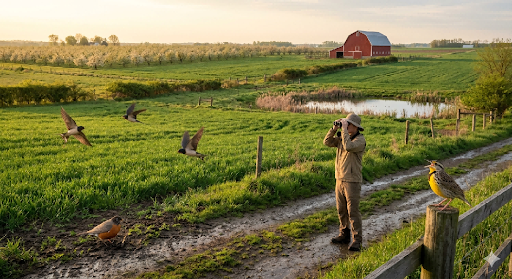
Examples of common spring visitors to farms would be swallows dashing low over fields, robins pecking at the wet soil, meadowlarks singing on posts, and finches moving in between hedges and gardens. Pollinator activity is also enhanced in regions with orchards or flowering crops, which attract birds that flourish in a vibrant, insect-abundant environment.
Summer Buzz: Feeding Frenzies and Family Life
By summer, the farm is in full blast, and birds are in the midst of it. It is family time. Eggs are hatching, chicks are developing at a high rate, and parent birds are always in search of food. It is among the pleasures of summer birdwatching to see adults repeatedly come and go, with insects, seeds, or other morsels, to their young.
Farmlands are particularly appealing to insect-eating birds due to the large number of insects during summer. Swallows, flycatchers, warblers, and wrens can be seen more frequently when they are hunting over crops, around water sources, or around barns. They can also be helpful to the farmers, as a lot of them contribute to the pest population reduction naturally.
The best time to watch the summer birds is usually in the cooler part of the day. It is best in the early morning when the birds are busy feeding, and the temperatures are not too hot. Afternoon is also a fruitful time, particularly around shaded places, ponds, or hedges where the birds congregate to drink and forage.
Autumn Transition: Migration Magic on the Move
Autumn transforms the farm once again. Fields turn color, harvests transform the landscape, and birds start to prepare to migrate. This is, to most birdwatchers, one of the most magical periods of the year as it involves movement on a grand scale. Flocks flock, the feeding becomes more pressing, and even passing species may come to a short, yet memorable visit.
Open fields, wetlands, and recently plowed areas may be congregating sites of migrating birds. Others will pull up to have a meal, others to join up, and then proceed further south. Bird diets also tend to vary during this season when there are changes in the natural food sources. Seeds, grains, berries, and old material of crops might appeal to other species not observed in summer.
Autumn is a perfect season to observe some unexpected or unusual visitors. In some areas, some birds may not be typical of the farm but may visit the countryside as a way of migrating. This uncertainty renders each adventure a treasure hunt.
Winter Calm: Quiet Fields, Special Sightings
Winter may seem like the least active season on the farm, but it has its own distinct beauty. While there may be fewer species overall, the birds that remain or arrive in winter often stand out more clearly against bare branches, frosted fields, or open skies. This simplicity can make winter birdwatching feel peaceful and focused.
Some hardy birds adapt well to colder temperatures by changing their feeding habits, flocking together, or seeking shelter in dense shrubs, barns, and evergreens. Winter visitors may include sparrows, woodpeckers, jays, hawks, and other species that are easier to notice when foliage is sparse. Raptors can be especially striking in winter, as open fields make hunting behavior more visible.
Feeders and sheltered areas become particularly important during this season. On farms, placing food and water sources in strategic locations can support birds when natural resources are limited.
Smart Birdwatching Year-Round: Enhance Your View with Technology
The conventional birdwatching will never lose its charm, yet the latest technology may enrich the experience, particularly on a farm where birds can show up at any time of the day or night. Smart tools help birdwatchers capture moments they might otherwise miss, identify species more easily, and build a better record of bird activity throughout the year.
Birdfy Smart Bird Feeder with Camera is one of the useful options. In the case of farms, it will provide an extra convenience where the bird lovers can view the feeding behavior of the birds at a closer distance without disrupting the birds. Users are no longer limited to just making luck when attempting to see the species that visit their property, since they can have a better and more reliable picture of the species.
This smart feeder also helps you record rare sightings, monitor seasonal changes, and improve identification in real time. This is especially helpful during migration periods, when unexpected visitors may only stop briefly. With careful placement near hedges, orchards, water sources, or sheltered corners of the farm, the setup can attract both resident birds and seasonal guests.
Smart tools simply extend those experiences. Products from Birdfy can make it easier to turn everyday bird visits into a more engaging, documented, and interactive hobby.
Conclusion: A Year of Discovery
Birdwatching on farms is never the same from one month to the next, and that is exactly what makes it so rewarding. Spring brings nesting and song, summer bursts with family activity, autumn offers migration drama, and winter reveals quieter but equally meaningful moments.
Each season tells a different story, shaped by weather, crops, habitat, and the remarkable adaptability of birds. For farmers, birdwatching adds another layer of appreciation for the land. For nature lovers, it offers a reason to return again and again, knowing there will always be something new to see.
On a farm, every season brings a fresh chapter, and every bird sighting adds to the experience. Watch every season come alive on your farm. Start birdwatching smarter today.

Join BusinessDay whatsapp Channel, to stay up to date
Open In Whatsapp