
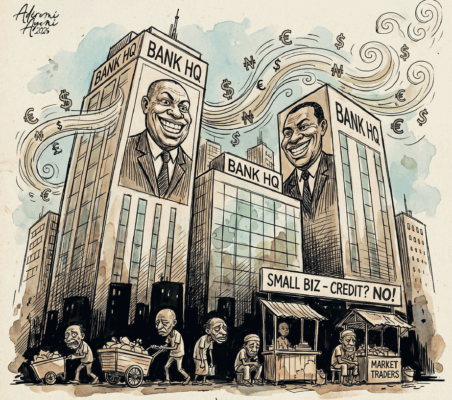
Nigeria’s banking sector has emerged from its latest recapitalisation exercise larger, stronger, and more structured. In total, about N4.65 trillion (about $3.3bn) was raised, strengthening capital buffers and reinforcing balance sheets across the industry. A new tiered framework, anchored by a mezzanine layer, now defines how banks position themselves within the system. However, these gains in scale and structure do not automatically translate into effective credit to the real economy.
This disconnect is most visible in the structure of credit itself. Small and medium-scale enterprises (SMEs), which account for roughly 70% of employment in Nigeria, receive only about 1% of total bank credit to the private sector. For most businesses, access to finance has historically depended less on bank size than on risk perception, incentive structures, and institutional constraints. Recapitalisation expands capacity, but it does not, on its own, change lending behaviour.
The introduction of a mezzanine layer within the capital framework is intended to address part of this structural gap. By establishing a tiered system of international, national, regional, and non-interest banks, the reform seeks to align financial institutions with specific segments of the economy. In theory, this segmentation should improve credit allocation by matching bank scale and risk appetite to borrower needs. In practice, structure alone cannot overcome entrenched lending patterns.
At the top of the hierarchy are international banks. With the largest capital bases, they are positioned to finance large corporates, infrastructure, and cross-border transactions. Their systemic role is clear, particularly in absorbing macroeconomic shocks and supporting capital-intensive sectors such as oil and gas, telecommunications, and infrastructure. However, their lending remains concentrated among a narrow pool of high-credit-quality borrowers, limiting their direct impact on broader economic participation.
National banks occupy the middle tier, serving domestic firms that require more capital than microfinance institutions can provide, but do not operate at a global scale. They have the potential to support industrial expansion and scale local enterprises. However, their lending behaviour remains shaped by the same macroeconomic uncertainties and risk constraints that affect the wider system.
At the lower tiers – regional and non-interest banks – the promise of inclusion is most pronounced. These institutions are expected to engage SMEs, local businesses, and underserved segments of the economy. Their proximity to local markets and specialised operational models positions them as potential drivers of bottom-up growth. However, proximity does not automatically translate into effective lending. Structural barriers remain significant.
The challenge is not simply identifying underserved sectors, but understanding why they remain excluded. For SMEs and small businesses, the issue lies in viability within existing lending frameworks. Limited collateral, weak or non-existent credit histories, and the prevalence of informal operations complicate risk assessment and encourage conservative lending decisions. Many businesses remain dependent on informal financing or high-cost alternatives.
Sector-specific dynamics further reinforce this constraint. In agriculture, production is exposed to weather variability, price volatility, weak storage systems, and limited insurance coverage. These factors increase uncertainty and make risks difficult to hedge within conventional banking models. Even well-capitalised banks remain reluctant to lend at scale without complementary mechanisms such as risk-sharing frameworks and viable agricultural insurance systems.
Manufacturing presents a different structural problem. The sector requires long-term financing for machinery, technology, and capacity expansion, yet Nigeria’s financial system remains predominantly short-term in orientation. With manufacturing contributing less than 10% to GDP, limited access to patient capital continues to constrain growth. Foreign exchange volatility, policy uncertainty, and infrastructure deficits further elevate lending risks, discouraging long-term commitments.
These sectoral constraints are reinforced by broader incentive structures within the financial system. In a volatile macroeconomic environment, banks are naturally drawn toward low-risk, high-yield instruments such as government securities and foreign exchange transactions. These options often provide more predictable returns than lending to the real sector. As a result, additional capital tends to flow toward familiar and secure assets rather than into productive but uncertain segments of the economy.
This dynamic explains why increases in banking scale do not automatically translate into broader credit distribution. Without deliberate policy intervention, recapitalisation risks reinforcing existing patterns with larger volumes of credit directed toward established borrowers, while sectors critical to employment and production remain underserved.
Addressing this requires more than regulatory restructuring. It demands policies that alter the underlying economics of lending. Credit guarantee schemes can mitigate perceived risk, while improved credit information systems can reduce information asymmetry. Legal reforms can strengthen contract enforcement and collateral recovery, and infrastructure investment can improve business viability. Together, these measures can shift incentives and expand lending beyond traditional comfort zones.
Within this context, the mezzanine layer should be understood as an enabling framework rather than a complete solution. It organises the banking system more effectively, but outcomes depend on how institutions within each tier respond to prevailing incentives and constraints.
Ultimately, the success of Nigeria’s recapitalisation will not be judged by the size of bank balance sheets or the strength of capital ratios. It will be measured by outcomes in the real economy, whether farmers can access seasonal financing, manufacturers can secure long-term capital, and small businesses can obtain credit to grow.
Nigeria’s banking system now has greater capacity. The unresolved challenge is ensuring that this capacity translates into access. Until structural barriers to credit allocation are addressed, the outcome will remain familiar: stronger banks alongside a real economy still constrained by limited financing.

Join BusinessDay whatsapp Channel, to stay up to date
Open In Whatsapp