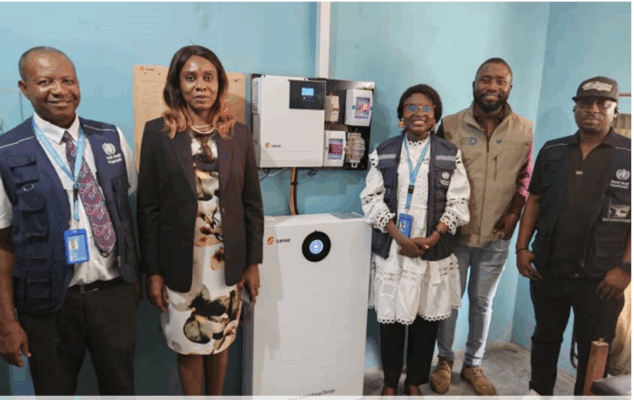
A midwife once delivered babies by the glow of a mobile phone. Today, the delivery room at Rumuigbo Primary Health Centre in Rivers State stays lit through the night.
A solar pilot program backed by the World Health Organisation has cut power outages at two Nigerian primary health facilities by more than 80 percent, according to results from a six-month implementation period ending June 2025.
The initiative, part of WHO’s HealthCREST program, equipped centres in Rivers State and Akwa Ibom State with 5-kilowatt solar photovoltaic systems and 10-kilowatt-hour lithium-ion battery storage.
The numbers land hard against a troubled backdrop. Roughly 40 percent to 50 percent of Nigeria’s primary health care facilities lack reliable electricity, according to WHO estimates, a chronic vulnerability that disrupts vaccine cold chains, delays emergency procedures and discourages patients from seeking nighttime care.
Measurable gains
Since the installations came online, night-time deliveries at Rumuigbo climbed from approximately 40 per month to more than 50. Monthly generator fuel costs dropped from roughly N250,000, about $182, to around N50,000.
The facilities now report 24-hour uninterrupted service covering immunisation, maternity care and minor emergencies. Carbon dioxide emissions fell by an estimated 231 kilograms daily, equivalent to over 84,000 kilograms annually, displacing diesel generator use.
For local health workers, the shift has been stark. Blessing Nangibo, Local Government Immunisation Officer at Rumuigbo, said vaccine storage temperatures now hold steady during grid outages, a problem that previously forced staff to rush doses to neighbouring facilities before spoilage.
The wider infrastructure gap
Nigeria’s electricity grid remains among the most unreliable in sub-Saharan Africa. Frequent nationwide outages push hospitals and clinics onto diesel generators, an expensive, carbon-intensive workaround that smaller facilities often cannot sustain. For primary health centres serving rural and low-income communities, the financial strain frequently means going without.
The pilot’s site selection factored in maternal and immunization service loads and documented exposure to outages. Implementation included training for health workers on basic system operation and maintenance, monitoring tools to track performance, and coordination with the Rural Electrification Agency and private renewable energy partners.
From pilot to policy
The program has already generated policy momentum. WHO and Nigeria’s Federal Ministry of Health co-convened the country’s first National Dialogue on Power in the Health Sector this year, resulting in a signed national Energy Compact to accelerate health facility electrification. Nigeria subsequently secured a $700,000 grant targeting solar deployment across facilities in the Federal Capital Territory, Niger State and Nasarawa State.
Climate considerations are also being embedded into the Basic Health Care Provision Fund 2.0 and Nigeria’s updated Nationally Determined Contributions, signaling an intent to formalize clean energy as a health security priority rather than a one-off intervention.
Zakari Mohammed, director of climate change and environmental health at the Federal Ministry of Health, called the results a scalable model. Communities, he said, are already seeing the benefits.
Scaling remains the challenge
Despite the gains, thousands of primary health centres across Nigeria still run on unreliable grid power or diesel backup. Replicating the pilot at national scale will require sustained funding, technical capacity and long-term maintenance commitments, none of which are guaranteed.
For facility head Angbara Roseline, the immediate priority is straightforward: more facilities, more states, and a health system where keeping the lights on is no longer the hardest part of the job.
Join BusinessDay whatsapp Channel, to stay up to date
Open In Whatsapp