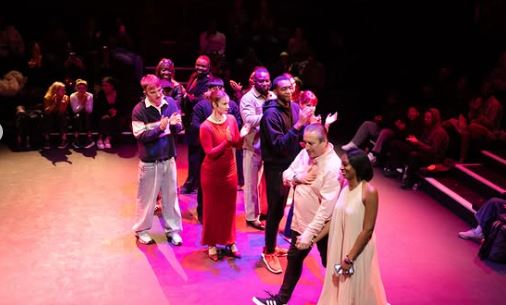
Nigerian filmmaker and theatre director Rolake Adesina has ignited the conversation around modern romance with her new production, ‘You Can’t Find Love in London, The Musical’. Premiering at London’s intimate Cockpit Theatre, this rap-musical fuses the raw lyrical power of hip-hop dialogue and rap battles with traditional musical theatre structure to offer a savage, funny autopsy of the dating wars in London.
The production fearlessly dissects what it means to seek connection in one of the world’s most unforgiving cities.
‘You Can’t Find Love in London, The Musical premiered from 22–23 March 2026. The one-hour-and-thirty-minute-long play was written and directed by Adesina and produced by her independent production company Scene-opsis.
Critics say the play is ambitious in form, intimate in scale, and timely in its social commentary, though its production values occasionally reveal the constraints of a small-venue debut.
At its core, the story follows a group of multicultural Londoners whose lives intersect in unexpected and emotionally charged ways. Characters such as Leticia (Kiesha Mwase), a fierce feminist confronting generational trauma; Yale (Joseph Terrell), whose fragile masculinity is challenged through explosive confrontations; Leon (Snatcha), a poetic yet emotionally guarded cynic; and Miss Catherine (Damilola Turner), a grounding voice of wisdom and healing, each embody different perspectives on love and vulnerability.
Tony Hyland is the executive producer of the play, which includes Nigerians such as Seyi Crown, the production manager; Jude Chibueze Meju, the stage manager; and Abasi-Ikpongke Asanga, the music producer.
Stage Design: Intimate, Movement-Driven, and London-Grimy
The Cockpit theatre, situated in Marylebone, London, is a compact, flexible black-box space, and the production design leans into that limitation rather than fighting it. The versatile set keeps the focus squarely on the seven performers and their rap battles. Post-show reflections describe the space as an empty theatre transformed into a living, breathing arena for “savage monologues” and “soulful rap battles,” with strategic lighting, urban projections, and simple props that double as battle arenas or a table-for-two confessionals.
The design prioritises choreography and spatial dynamics as performers circling each other in rap cyphers, or breaking the fourth wall to drag the audience into the dating war. Lighting likely shifts from harsh, interrogative whites during monologues to pulsing, clubby hues during the beats, underscoring emotional isolation amid urban chaos.
Soundtrack: Soulful Hip-Hop Rap battles with theatrical precision
Adesina explicitly brands this a rap-musical, and the soundtrack is pure hip-hop DNA injected into musical-theatre veins. The beats are contemporary yet theatrical: heavy, bass-forward trap/boom-bap hybrids laced with soulful melodic hooks, layered vocal samples, and live-percussion energy that lets the cast spit bars without losing melodic flow.
Beats serve the story rather than overshadow it; they underscore the “war” of dating with aggressive drops during confrontations and stripped-back, piano-or-synth-driven moments for the vulnerable monologues.
The Message: Love Is Dead… Or Are We?
You Can’t Find Love in London is a savage, funny, and ultimately hopeful autopsy of 21st-century romance in a global city. Seven Londoners—each carrying “seven wounds”—cycle through flings, ghosts, awkward “we dated?” revelations, and family-meet disasters.
The central question is posed raw: “Is it the city, the culture… or us?” London becomes both character and culprit; its fast pace, superficial networking, racial dynamics, and app-driven disposability conspire against connection. Yet the rap battles and monologues force the characters (and audience) to confront personal accountability.
In an era of endless swipes and performative vulnerability, Adesina’s musical insists that the real battle is internal and that hip-hop’s combative honesty might be the perfect weapon to fight it. The closing message feels quietly defiant: love isn’t missing from London; it’s hiding in the courage to stop treating dating like war and start treating it like healing.
Rolake Adesina is a Nigerian filmmaker and theatre director based in the United Kingdom with a Master’s degree in Film from the University of Kent. She has directed short films like The Cladder, inspired by the Grenfell Tower tragedy.
In 2021, she starred in the lead role of Osamede, a Benin mythology play at Muson Center Lagos, in 2025 the story was adapted into a cinematic release by Lilian Olubi, starring William Benson and Ivie Okujaye in the lead roles.
Adesina, in her social media post for her new play, wrote, “What started as an idea became a living, breathing experience shared with a sold-out audience who showed up, stayed present, and gave us a standing ovation I’ll never forget. This wasn’t just a performance; it was a statement.”
Join BusinessDay whatsapp Channel, to stay up to date
Open In Whatsapp