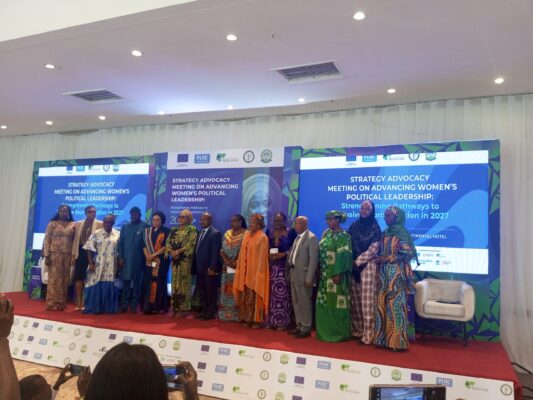
Fresh concerns over Nigeria’s persistently low female political representation have triggered renewed pressure on the National Assembly to pass the proposed Special Seats Bill, as stakeholders warn that failure could undermine the credibility of ongoing constitutional reforms ahead of the 2027 general elections.
They also urged political parties to initiate inclusive representation to ensure women’s participation in the 2027 elections.
These were the crux of discussions in Abuja on Tuesday at the Strategic Advocacy Meeting, with the theme ‘Advancing Women’s Political Leadership: Strengthening Pathways to Inclusive Representation in 2027, organized by the Policy and a legal Advocacy Center, PLAC, Nigerian Women Trust Fund, NWTF and the Nigerian Bar Association, NBA, Section on Public Interest and Development Law, SPIDEL with support from the European Union
Clement Nwankwo, executive director, PLAC, in his remarks, described the current state of women’s representation as “embarrassing” and unacceptable in a modern democracy.
He cited stark figures to illustrate the gap. Nigeria currently has only four female senators out of 109, while women occupy about 15 seats in the 360-member House of Representatives.
At the state level, he noted that nearly 15 states have no female lawmakers at all.
“This is a serious democratic deficit,” Nwankwo said, warning that the exclusion of women from decision-making weakens governance and national development.
He stressed that the Special Seats Bill, which seeks to create additional legislative seats for women, remains the most viable legislative pathway to correcting the imbalance.
According to him, failure to pass the bill would render the entire constitutional amendment process a “failure in the eyes of Nigerians and the international community.”
The advocacy meeting brought together lawmakers, civil society actors, and development partners to chart a path toward inclusive governance.
In her welcome address, Uju Agomoh, chair, NBA SPIDEL, said women’s underrepresentation is not just a gender issue but a governance challenge that undermines legitimacy and effectiveness.
“Women make up nearly half of the population yet remain largely excluded from leadership. This weakens the responsiveness of our democratic institutions,” she said.
Agomoh called for concrete reforms, including stronger legal frameworks, affirmative action measures, and institutional support systems to enable women’s participation in politics.
Also speaking, Brenda Anugwom, chief executive officer, NWTF, attributed the imbalance to entrenched structural barriers within political parties and the broader socio-political system.
She said while women remain active as voters and mobilisers, their presence in decision-making spaces is “far too limited.”
Anugwom noted that although the Special Seats Bill offers a historic opportunity, it may not be implemented before the 2027 elections due to tight legislative timelines.
She urged stakeholders to sustain momentum toward securing its passage for future electoral cycles.
At the legislative level, Kafilat Ogbara, chair of the House Committee on Women Affairs, acknowledged growing support for the bill within the National Assembly but warned that significant hurdles remain, particularly at the state level.
“We have moved from the sidelines to the headlines, but we are not there yet,” she said, adding that public awareness and cultural acceptance will be critical to securing nationwide backing.
Ogbara emphasised that the bill is not about giving women undue advantage but correcting longstanding systemic imbalance, urging political parties to adopt fairer nomination processes and support female candidates.
On his part, Gaza Jonathan Gbefwi, member representing Keffi Karu Kokona Constituency, said the bill has a “strong chance” in the current assembly but cautioned that women must also actively participate by seeking elective positions.
“You cannot vote for those who do not present themselves,” he said, noting that women constitute a significant portion of Nigeria’s voting population yet remain underrepresented among candidates.
He also pointed to cultural and religious perceptions as key barriers, urging stakeholders to challenge entrenched norms that limit women’s political participation.
Discussions at the meeting also highlighted concerns over political party practices, particularly the use of “unity lists” and consensus candidacies, which participants warned could further sideline women if not deliberately balanced.
Stakeholders agreed that beyond legislation, achieving gender parity in politics would require coordinated action involving political parties, civil society, traditional institutions, and government at all levels.
With preparations for the 2027 elections already underway, participants stressed the urgency of reforms, warning that without decisive action, Nigeria risks repeating its historically low levels of female representation in the next electoral cycle.

Join BusinessDay whatsapp Channel, to stay up to date
Open In Whatsapp