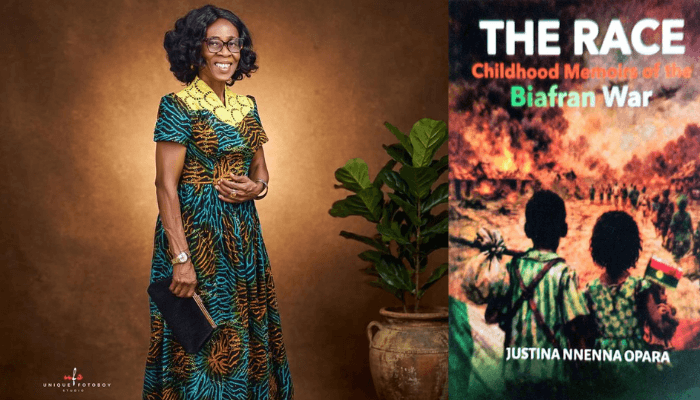
The Race: Childhood Memoirs of the Biafran War, authored by Justina Nnenna Opara, is a poignant account of childhood amid the turmoil of the Nigerian Civil War.
Rather than focusing on military strategies or political events, Opara offers a ground-level view of life under siege, capturing the daily struggles, small joys, and moral choices that defined civilian survival.
The memoir is written from the retrospective perspective of an adult reflecting on her girlhood in Owerri and surrounding villages. Her prose is calm and measured, avoiding melodrama while conveying the heavy weight of lived experience.
In one vivid moment, Opara recalls carrying a large metal trunk filled with food during the chaotic “Last Race” of January 1970 and feeling no weight at all, a single sentence that encapsulates the extraordinary psychological realities of war.
Opara’s narrative often shifts from the individual to the communal. The “I” frequently dissolves into “we,” situating her within family networks, village life, and the wider Biafran experience. This collective viewpoint underscores a central theme of the memoir: survival during war is not a solitary act, but a shared struggle.
Three core themes shape ‘The Race’. The first is resilience through routine. Despite bombings, scarcity, and fear, children played moonlight games, women traded small valuables in local markets, and communities organized informal competitions for basic prizes. These everyday acts of life are presented as a subtle form of resistance, asserting the human need for joy and normalcy even in extreme conditions.
The second theme is the moral economy of scarcity. War reshaped social hierarchies and ethical codes. Hunger became a defining factor in social status, and acts like theft were rendered morally complex. In one scene, Opara’s mother discovers thieves on the family farm and allows them to keep what they have taken. Scenes like this quietly reveal how social norms adapted under extraordinary pressure.
The third and perhaps most compelling theme is gendered vulnerability. Opara revisits the dangers faced by women and girls repeatedly: threats of forced labour or sexual exploitation, nightly retreats into the bush, and strategies of disguise at refugee camps. These passages offer an important contribution to the understanding of civilian experiences during the Biafran War, highlighting a dimension often overlooked in historical accounts.
Structurally, the fourteen chapters follow the rhythms of displacement and waiting. Time in the memoir is uneven, stretching and contracting with the experience of survival. The historical introduction contextualises the conflict’s origins in the 1966 coups and the Aburi Accord, but the book’s power lies in its preservation of everyday life.
Opara enriches the narrative with cultural fragments: war songs, folktales, chants, and even the Biafran national anthem. These elements give the memoir an archival quality, capturing sounds and rhythms that formal histories often omit.
The memoir is not without minor imperfections. Some chapters, like “Birth of Ure’s Baby” and “The Package and the Traditional Wedding,” are brief and read as snapshots rather than fully developed scenes. Certain emotional experiences are stated rather than fully rendered. Yet these qualities reflect a survivor’s economy, an effort to record events clearly and honestly, rather than polish them into literary artifice.
‘The Race’ fills a notable gap in literature on the Biafran War. While much scholarship focuses on politics, military strategy, and humanitarian images, Opara documents the civilian experience, especially of women and children. Her account also notes the role of international aid organisations, acknowledging both their contributions and limitations in addressing inequalities.
The memoir closes with a simple but resonant plea: that there should be no war again in Nigeria. It is a modest statement, yet it carries the weight of lived experience and moral witness. ‘The Race’ is a quiet but powerful testament to resilience, communal life, and the human cost of conflict. It deserves a broad readership, from historians and students of African literature to anyone seeking to understand the civilian realities behind headlines and historical summaries.

Join BusinessDay whatsapp Channel, to stay up to date
Open In Whatsapp