

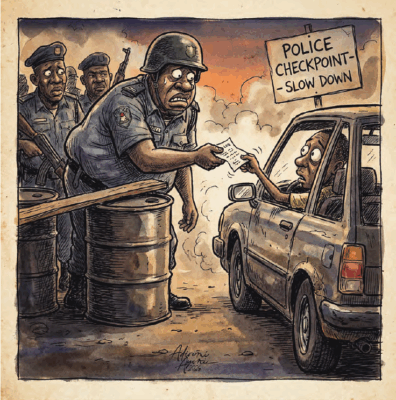
In a country grappling with serious security challenges, police checkpoints on Nigerian roads are expected to serve as deterrents against crime. However, what was designed as a security mechanism to safeguard lives and property has increasingly become a site of anxiety, coercion, and systemic abuse.
Across cities, towns and highways, motorists encounter police officers stationed at frequent intervals, often at locations where no checkpoints previously existed. What were once occasional, intelligence-driven stops have gradually evolved into a routine and sometimes unavoidable feature of daily movement, raising fundamental questions about their purpose and legitimacy.
New checkpoint locations appear frequently, sometimes overnight, marked by improvised barricades such as wooden planks, oil drums, or metal spikes, and at times simply by officers positioned in the middle of the road. In many instances, these checkpoints appear loosely organised, lacking clear authorisation, structured oversight, or a defined security objective. Rather than reinforcing public safety, they often project uncertainty and arbitrariness.
For many Nigerians, the sight of a police barricade signals anticipation of harassment or extortion. Motorists approach expecting to be asked for “something for the weekend” or similar informal payments. The problem deepens where officers appear to search for faults where none exist, questioning valid documents or raising issues unrelated to any identifiable security concern. In more troubling cases, there are allegations of evidence being planted to manufacture offences.
As stated in Section 214 of the Constitution of the Federal Republic of Nigeria 1999 and Section 4 of the Nigeria Police Act 2020, the primary function of the police is to maintain public order and safety, prevent and detect crime, protect lives and property, enforce laws, and facilitate free movement. Within this mandate, checkpoints can serve as important instruments of surveillance and crime prevention, particularly in the context of persistent security threats. However, their effectiveness depends on strategic deployment, proper authorisation, and disciplined execution. The increasing concentration of multiple checkpoints within short distances, often without clear justification, raises concerns about whether current practices reflect coordinated security operations or an over-extension of discretionary powers.
It is no longer news that the Foundation for Environmental Rights, Advocacy and Development (FENRAD) has raised concerns about widespread abuse, intimidation, and extortion at checkpoints, particularly across the South-East, estimating that illegal roadside collections may exceed ₦1.3 trillion annually. According to its reports, nearly 200 checkpoints operate within the region alone.
FENRAD further notes that these illegal collections significantly increase transportation costs for commercial drivers, traders, and small businesses, thereby worsening inflationary pressures on goods and deepening economic hardship for citizens already facing difficult conditions.
Numerous complaints from citizens detail patterns of abuse, including illegal demand for money, intimidation of motorists and passengers, arbitrary searches of private belongings and mobile phones, confiscation of documents, unlawful detention, and threats against those who resist extortion. These practices have become sufficiently widespread to suggest systemic, rather than isolated, misconduct.
Such actions violate fundamental constitutional rights, including the right to dignity (Section 34), personal liberty (Section 35), privacy (Section 37), and freedom of movement (Section 41). They also contradict provisions of the Nigeria Police Act 2020, which explicitly prohibits corruption, abuse of office, extortion, and unlawful searches. The persistence of these practices, despite clear legal prohibitions, points to a gap between formal regulation and actual enforcement.
Even within the institutional structure of the Nigeria Police Force, there have been directives aimed at curbing excesses. For instance, the former Inspector-General of Police, Kayode Egbetokun, issued a directive banning arbitrary arrests, the searching of citizens’ phones, and other unlawful practices at checkpoints, warning that officers found engaging in such acts would face disciplinary action. Checkpoints are expected to be authorised, supervised, and established strictly for genuine security purposes. However, the continued prevalence of abuses suggests weak compliance and limited internal accountability.
A central issue lies in the nature of roadside enforcement itself. The routine collection of cash by officers creates opportunities for abuse and undermines the legitimacy of law enforcement. A more structured system, where officers issue formal tickets for verified offences rather than engaging in on-the-spot monetary transactions, would significantly reduce discretionary abuse. The current overlap of functions, where police officers perform roles associated with road safety, vehicle inspection, and even financial enforcement, further blurs institutional boundaries and weakens operational clarity.
At the same time, citizen conduct cannot be entirely separated from this dynamic. A significant number of motorists comply with illegal payments because they are in violation of traffic regulations or lack complete documentation. This creates a mutually reinforcing system where both enforcement gaps and non-compliance sustain informal practices. Addressing checkpoint abuse therefore requires both institutional reform and greater adherence to lawful conduct by citizens.
In terms of reform, existing accountability mechanisms require strengthening. Internal disciplinary units must be more proactive and transparent, while independent reporting channels should be accessible to citizens for real-time complaints. Evidence-based enforcement, including the use of body cameras, CCTV, and digital reporting systems, can improve oversight and reduce direct confrontation. Where credible evidence is provided, disciplinary actions against erring officers should be swift and visible to restore public confidence.
The effectiveness of checkpoints must be measured against their intended purpose: enhancing security while respecting the rights and dignity of citizens. Only by returning to its statutory foundations can the police maintain legitimacy and rebuild trust. Without this realignment, checkpoints risk remaining symbols not of security, but of systemic dysfunction.

Join BusinessDay whatsapp Channel, to stay up to date
Open In Whatsapp


