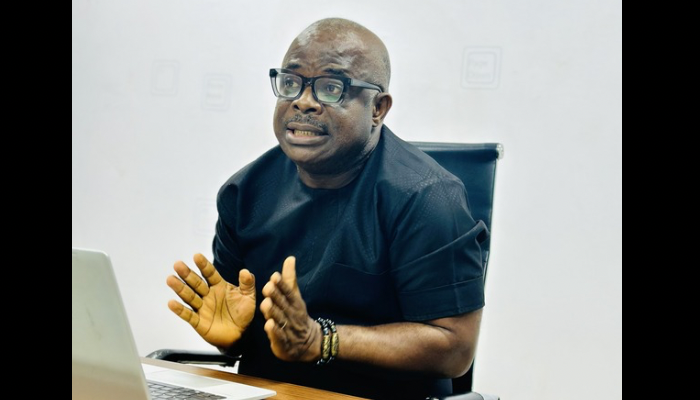
From his training and career journeys, it has been all about technology and innovations for Udo Ngele, who is currently the managing director of HumanManager, a subsidiary of SystemSpecs Group of Companies, where he previously managed the infrastructure platforms and services that power enterprise applications.
In this interview, Ngele, a topnotch system designer and an Oracle-certified professional, who is responsible for developing and implementing enterprise-wide information security programmes, shares with OBINNA EMELIKE why businesses are increasingly turning to HR automation, the place of HumanManager solution in the automation, why data and analytics matter to organizations, clears the air on technology taking humans place in future workplace, passion for technology, work experience, among others. Excerpts:
For those who are meeting you for the first time, who is Udo Ngele?
My name is Udo Ngele. I have been in technology since I started. I think shortly after leaving school, I got a Trainee Job with old KPMG and did a bit of Audit training. In January 2021, I had the privilege of joining SystemSpecs where I think, practically, all my life journey has been.
I started with HumanManager. They were deeply involved in human management. The company later dived into payments where I was doing a lot of work on Remita. From Remita I moved into becoming the chief information security officer (CISO) of the organization, who is more into cybersecurity rather than core development. I was the CISO of the organization for about four years before I got appointed on January 7th, last year to come back to my first love, which is HumanManager.
Why the interest in technology?
I studied Computer Science, and I wanted to be a developer. The first job I picked was just to pay bills, and that was why I lasted only six months. But SystemSpecs, being a top-notch system company, I had the opportunity to come. So, for me, it was more like a dream come true.
It was more like a fit between what I wanted to do and what they were doing. Human Resources happens to be what they were developing and I joined. Every other thing is a long story of getting to this journey. But for me, tech has been it for me.
It wasn’t my father who told me to go and read Computer Science. It was more like what I wanted. I felt it was something that is trending. It was something that caught my fancy, and that was why I got into tech.
What is fundamentally changing in how organisations manage people today?
What has changed is that managing people is no longer just an administrative function – it has become central to whether a business survives or not. We are operating in a time where talent is mobile, expectations are changing, and organisations are under pressure to remain efficient. In that environment, you cannot afford to manage people reactively.
Technology now gives organizations the ability to structure that process. But beyond the tools, it is really about visibility – understanding what is happening within your workforce and being able to respond in a timely and informed way.
At the end of the day, technology drives efficiency, but people still drive innovation. The real value is in bringing both together effectively.
Are organisations adopting HR technology at the pace required?
The interesting thing is that availability is no longer the issue – adoption is. There was a time when cost was the major barrier. Today, that has changed significantly, especially with cloud-based solutions. What now slows organizations down is the cultural shift required.
People are naturally resistant to change, and organizations reflect that. But the reality is that any serious organization today has to embrace that change.
So the real question is not whether solutions exist, it is whether organizations are ready to rethink how they operate.
How would you assess adoption across enterprises versus SMEs?
There is a noticeable difference. Enterprise organizations have largely embraced structured systems because they understand the risks of not doing so. But among SMEs, adoption is still relatively low, with many relying heavily on spreadsheets.
I had a real-life example recently – someone requested a payslip from 2016. If your records are managed manually, retrieving that becomes a challenge. But beyond that, it speaks to a bigger issue – lack of structured data.
When records are not properly managed, decision-making also becomes limited. Technology today is accessible and affordable. The gap we are seeing is more about mindset and prioritization than access.
What is driving adoption among enterprise organisations?
At that level, it comes down to continuity and risk management. Managing human capital is not something you approach casually if you want to grow. It requires structure and long-term thinking.
The current talent migration trend has made this even more obvious. Organisations are losing skilled people, and without a clear succession plan, that creates a gap.
In some industries, compliance is also a strong driver. You are required to have systems, backups, and proper documentation in place.
But beyond compliance, it is really about sustainability. Organisations that understand this are investing in systems that give them control and visibility.
Why are data and analytics becoming so critical in HR today?
Because without data, you are essentially guessing. A good HR system should tell you what is happening in your organization, not just store information.
For example, if employees are leaving, you should be able to understand why. Is it compensation? Is it management style? Is it culture? Without structured data, you cannot answer those questions accurately. I often say that organisations that do not have workforce data are operating blind. And in today’s environment, that is a risk no business can afford.
What new opportunities have technology created within the HR space?
One of the biggest advantages is that it allows organizations to focus on what really matters.
Instead of spending time on repetitive administrative tasks, you can automate those processes and focus on strategy and growth.
It also provides visibility. For instance, in a typical organization, leadership may not know exactly what everyone is doing at every point in time. But with the right tools, you can get a clear sense of productivity, engagement, and performance. Even something like remote work can now be evaluated based on actual data, not assumptions.
Technology simplifies complexity and enables better decisions.
What should organisations prioritize when selecting an HR solution?
They need to look beyond basic functionality and think about the full spectrum of human capital management. That includes performance, succession planning, culture, and analytics, not just payroll.
It is important to know the spectrum of HR while also acknowledging the need to monitor the performance of people. It is noteworthy also that with the current brain drain crisis, succession planning is critical. How is a business owner making sure that if people leave, others are taking responsibility?
One needs to be able to track, have analytics, and insights on what is happening in the organization. Whether or not one is present or absent, he is able to understand the behaviour of his workers. Tracking the culture that exists in the organization cannot be over-emphasized.
One of my former bosses used to say that people don’t leave organisations, they leave their bosses. The question then is – how do you measure that?
If you have two teams and one has a high exit rate, what is driving that? Without data and analytics, you cannot answer that question. An effective HR solution should help organizations see what is happening beneath the surface and act proactively. HumanManager does that efficiently.
With increasing automation, will technology replace human roles?
Technology will introduce efficiency, but humans are still required to drive those efficiencies – ensuring they are applied in the right places to create real value. Each has its own role, and both will continue to coexist.
For example, there was a time when writing code was the most critical skill in technology. Today, what is becoming more important is the ability to define requirements and think through problems. Tools can now support execution, but they still require direction. So, the responsibility is on individuals to evolve.
I often share a personal example. Early in my career, I made a conscious decision not to remain static. Whenever new technologies emerged, I invested time in learning them because I understood that the landscape would continue to change. That mindset is even more important today.
If you look at the conversations around AI, there is often a question: if AI begins to “think,” what will humans do? The reality is that there will always be space for human input – but we must continue to evolve to remain relevant.
Take software development as an example. Previously, developers – and the programmes they wrote – were considered the most valuable assets in a technology organization. Today, the emphasis is shifting. What is becoming more valuable is the ability to define clear requirements.
If you can clearly articulate what needs to be built, tools can now support the development process. This means product thinking – envisioning solutions and defining outcomes—is becoming more critical.
So, the focus is no longer just on writing code, but on understanding problems, designing solutions, and guiding execution.
This reinforces a broader point: we owe it to ourselves to continuously reinvent.
Earlier in my career, there was a common pattern – engineers who worked on older systems often transitioned into support roles when new technologies emerged, simply because they had not kept up. I made a deliberate decision from the start that I did not want to be in that position.
So, when new technologies were introduced, I committed extra time to learning them. The lesson here is simple – we must be intentional about growth and positioning ourselves for what is next.
Looking ahead, knowledge dynamics will become even more critical. One concern I have, particularly in Nigeria, is that while we often highlight the advantage of a youthful population, the real question is: how prepared and educated is that population for the future of work?
Continuous learning and upskilling will be essential. Technology is advancing rapidly, and individuals must be ready to adapt, reposition, and leverage new opportunities.
It is also important to recognize that every technological shift creates new opportunities. When organizations began moving to cloud, for instance, it created increased demand for cybersecurity.
Similarly, during the currency changes, the adoption of POS systems accelerated significantly. That shift did not eliminate jobs – it created new business opportunities and expanded the ecosystem.
The same applies across industries. Technology does not erase work; it transforms it.
Even in the media industry, there has been a clear evolution. There was a time when physical newspapers were the primary channel for distribution. Today, digital platforms have expanded reach significantly, often at a lower cost. This did not eliminate the media industry – it reshaped it.
So, the real issue is not whether technology and AI will replace jobs. The real risk lies with individuals who fail to adapt.
How should organisations respond to workforce disruption, particularly the ‘Japa’ trend?
The first step is to accept that it is happening. Rather than trying to stop it, organizations should focus on managing its impact.
In my view HumanManager can help you manage the impact of Japa but will not necessarily prevent it. One of the old modules we will be bringing back (in our next release) is succession planning. Organisation must have a succession plan, and we hope to help make it easy for the practitioner to put the process in place.
This is where structure becomes critical. If people leave, there must be continuity. There is also a need to rethink how work is structured. We are seeing a shift toward performance-based systems, where outcomes matter more than physical presence.
I remember when employment contracts were very rigid – people were expected to focus on just one role. Today, the reality is different. People are more flexible, and organizations need to adapt to that. The goal is to build systems that can absorb these changes without disrupting operations.
What is HumanManager, and what role does it play in this evolving landscape?
HumanManager is a human capital solution designed to help organizations manage the entire employee lifecycle – from onboarding to exit and beyond – within a structured system.
For an organisation it empowers the owner and manager to effectively manage their human capital by providing insight and analytics that help them make effective decisions. It also helps the organizations meet regulatory requirements for their employees.
It covers payroll, performance, leave, expenses, learning, and more. But beyond functionality, the real value is in the insights it provides.
It enables organisations to move from administrative processes to strategic workforce management. At its core, it is a solution built with the mindset that organizations need to drive and manage their most critical asset – people.
How has the solution evolved over time?
HumanManager has been in the market for a long time and has seen strong adoption, particularly among enterprise organizations.
This is the 30th year, at some point, over 70 percent of the major enterprises in Nigeria adopted HumanManager. As someone said in one of our product launches some years back, “any organisation that is not using HumanManager is not a serious organisation”.
Our solution is customizable, so it made it easy to adapt to the various industries, cutting across manufacturing, banks, oil and gas. We service Enterprise organizations, SME’s and MSME’s.
At a point, organisational focus shifted toward payments, which meant the product did not receive the level of investment required for its evolution. However, demand never went away. Clients continued to ask for it, which made it clear that the solution was still relevant.
That led to a strategic decision to create a dedicated subsidiary and refocus on building it properly.
With the creation of this subsidiary, we are effectively rebuilding HumanManager to reclaim its full strength. While progress has been made, we acknowledge that this is still a journey we restarted just three to four years ago.
Today, we are leveraging our years of experience and deep partnerships with organisations to reposition HumanManager for its rightful place. Our solution is robust, and we are progressively integrating AI to enhance its capabilities. By the end of the year, HumanManager will stand as the most comprehensive AI-driven human capital solution in the market
What are clients currently prioritizing?
Performance management and payroll remain the most sought-after features. There is also growing interest in self-service capabilities, which allow employees to handle their own processes. That is important for driving efficiency.
Overall, organizations are looking for solutions that reduce complexity while improving visibility and control.
In a competitive market, what differentiates HumanManager?
Competition is expected in any evolving space. Our approach has always been to build solutions that can compete globally while remaining relevant locally.
So, yes, the competition is there, but our focus remains on continuously evolving our product to meet changing requirements. Being in this space, we see these shifts in real time. We work closely with our clients to understand their pain points, and our ability to address those needs is what keeps us moving forward.
What is your outlook for the future of work?
The key driver for us has been our commitment to doing things right. Whenever we build a solution, the goal is to make it competitive on a global scale, while ensuring it fits seamlessly into our local environment.
The organisations that will succeed are those that understand their people and use data to guide decisions. Workforce intelligence will become a key differentiator.
At the same time, individuals must continue to evolve. The pace of change is increasing, and adaptability will be critical. Technology will continue to reshape the workplace, but it will also create new opportunities.
The real question is not whether change will happen – it is whether organisations and individuals are prepared for it.

Join BusinessDay whatsapp Channel, to stay up to date
Open In Whatsapp