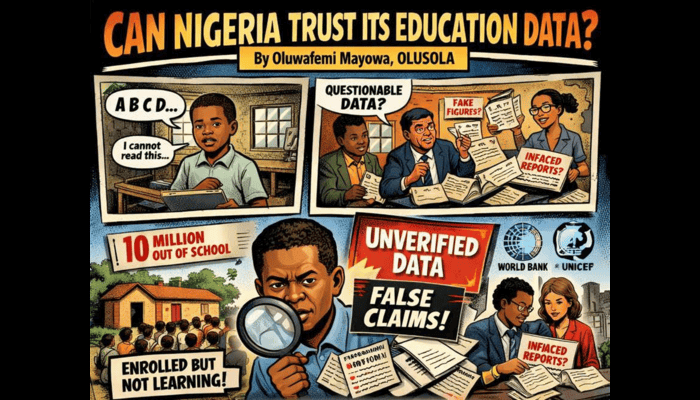
In a public primary school on the outskirts of Kano, a 10-year-old pupil confidently recites the alphabet but struggles to read a simple sentence. He has been in school for four years. On paper, he is “enrolled”. In reality, he is not learning.
This paradox lies at the heart of Nigeria’s education crisis and raises a fundamental question: can the data claiming progress in schools be trusted? Nigeria is home to one of the largest out-of-school populations in the world, with over 10 million children, according to recent estimates by UNICEF and the World Bank. Yet the deeper crisis is not simply access; it is credibility. Even among those attending school, learning outcomes remain alarmingly low. The World Bank’s learning poverty index suggests that a majority of Nigerian children cannot read and comprehend a simple text by age 10.
The problem is not a shortage of data; it is a shortage of reliable data. Enrolment numbers rise, classrooms are built, and teachers are posted on paper, yet the reality on the ground often tells a different story. How can progress be measured if the information itself is unreliable?
A lesson from the corporate world offers a striking parallel. In business, companies no longer rely solely on internal reports; ESG frameworks demand independent verification. Investors and stakeholders expect evidence that performance metrics are accurate and outcomes real. Education, by contrast, remains largely insulated from such scrutiny. Nigeria continues to report enrolment and infrastructure figures without systematically validating whether children are actually learning. That absence of independent assurance represents a fundamental barrier to meaningful reform.

The data credibility problem
Nigeria’s education system is awash in statistics but starved of reliable insights. Institutions such as the Universal Basic Education Commission (UBEC), the Federal Ministry of Education, and the National Education Management Information System (NEMIS) collect extensive data on enrolment, infrastructure, and teacher numbers. Yet these figures frequently fail to align with independent assessments of learning outcomes.
WAEC and NECO results consistently reveal gaps in student performance, while regional and international assessments point to weak literacy and numeracy skills. The disconnect is clear: inputs are measured, but outcomes are not verified. This is not simply a technical issue; it is a governance failure.
As ESG expert Sarah Esangbedo Ajose-Adeogun observes, “ESG is no longer a conversation about intent; it is about evidence, and evidence requires measurement.” The same principle applies to education. Without credible measurement, reform risks becoming rhetoric rather than results.
Independent assurance: A governance imperative
Independent assurance introduces a straightforward but powerful idea: data must be verified by a neutral third party. In education, such a system could transform how progress is measured. Learning outcomes would be validated through independently administered national assessments, teacher competencies periodically evaluated by external bodies, and UBEC-funded projects audited not merely for completion but for impact. State-level data could be cross-checked to ensure consistency and accuracy.
This is not an exercise in adding bureaucracy; it is about strengthening governance. Independent assurance aligns closely with the “G” in ESG, ensuring systems are transparent, accountable, and outcome-driven. It also reinforces the “S” dimension by focusing on real educational impact, what students actually learn. Without verification, Nigeria risks “edu-washing”, overstating progress while underlying challenges persist.
From measurement to meaningful action
One of the most powerful lessons from ESG practice is that measurement must drive decision-making. In Nigeria, linking verified data directly to policy could transform outcomes. Low literacy in a region would trigger targeted funding and teacher deployment. Weak teacher competencies would prompt tailored professional development. Lagging digital literacy metrics would justify focused ICT investments.
Here, assurance moves from compliance to impact. As Ajose-Adeogun emphasises, “You cannot manage what you do not measure.” But more importantly, you cannot improve what you do not verify.”
Learning from African peers
Nigeria is not starting from scratch. Other African countries have demonstrated the value of credible education data systems. Kenya’s Education Management Information System (EMIS) enables near real-time tracking of enrolment and performance, while Ghana leverages district-level data to guide targeted interventions in literacy and numeracy.
The lesson is not to replicate these models wholesale but to adapt them. Nigeria’s scale and diversity demand a hybrid approach, combining national standards with state-level flexibility, all underpinned by independent verification.
A practical pathway forward
Adopting independent assurance in education does not require overnight transformation. The process can begin by strengthening data foundations, improving the quality and consistency of information collected through NEMIS, UBEC, and state systems. Clear metrics should be established, focusing on enrolment, learning outcomes, teacher quality, and digital readiness.
Third-party verification should be integrated through partnerships with universities, research institutions, and credible independent bodies.
Technology will be a key enabler. Digital platforms, AI-driven analytics, and standardised assessment tools can make assurance more efficient and scalable, even in resource-constrained environments.
The trust factor
Ultimately, education reform is not merely policy; it is trust. Parents must trust that schools are delivering real value, employers must trust that graduates possess relevant skills, and governments must trust the data guiding their decisions. Independent assurance strengthens that trust.
It signals seriousness, demonstrates accountability, and transforms data from a reporting tool into a strategic asset that informs decision-making. Embedding verification in the education system gives stakeholders confidence that reforms are not only well-intentioned but also evidence-based and impactful.
Nigeria’s education system stands at a critical juncture. With ongoing reforms, increased funding, and growing attention to quality, the opportunity for meaningful transformation is real. Without credible and verified data, however, that opportunity risks being squandered.
ESG frameworks offer an instructive lesson: transparency alone is insufficient; what matters is verifiability. Progress is not defined by what is reported or promised; it is measured by what can be proven through evidence and accountable systems. Only by anchoring reforms in verifiable outcomes can Nigeria ensure its education system delivers lasting and demonstrable impact.
Oluwafemi Mayowa Olusola is the opinion page editor at BusinessDay. He writes provocative, data-driven essays on youth development, governance, and strategic partnerships in Nigeria, with a growing focus on climate resilience and ESG (Environmental, Social, and Governance) frameworks as critical lenses for national development. His work explores the intersections of education, economic policy, sustainability, and institutional reform, offering pragmatic insights into how Nigeria can drive inclusive growth and long-term transformation in a rapidly changing global landscape.
Join BusinessDay whatsapp Channel, to stay up to date
Open In Whatsapp