Nigeria’s economy expanded at its fastest pace in three years in 2025, supported by stronger output in agriculture and industry, as policymakers seek to entrench reforms in Africa’s most populous economy.
Gross domestic product grew 4.07 percent year-on-year in the fourth quarter of 2025, higher than the 3.76 percent recorded in the same period of 2024, according to data released by the National Bureau of Statistics (NBS). For the full year, growth stood at 3.87 percent, up from 3.38 percent in 2024.
The latest print marks Nigeria’s strongest annual performance since 2022 and extends the rebound from the pandemic-induced contraction of 6.96 percent in 2020. Growth recovered to 0.95 percent in 2021, accelerated to 4.32 percent in 2022, slowed to 3.04 percent in 2023, and has now strengthened for two consecutive years.
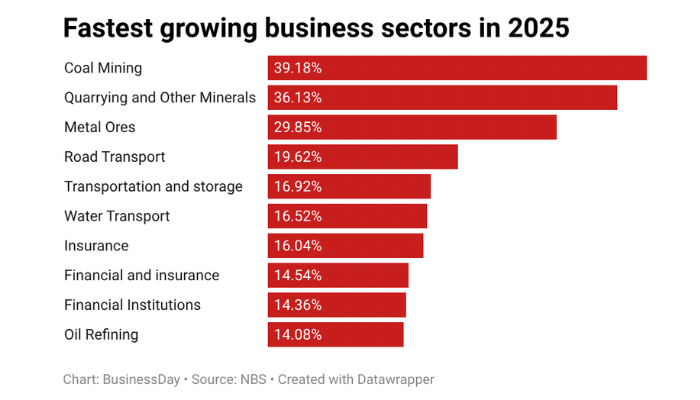
Drawing on data from the NBS for Q1, Q2, Q3, and Q4, BusinessDay examines the fastest-growing sectors in Nigeria’s economy in 2025.
Coal Mining
Coal mining emerged as the fastest-growing activity in 2025. The business activity recorded the strongest growth at 39.18 percent, a turnaround from a contraction of 4.2 percent in 2024. This was driven by increased interest in alternative energy sources for industrial use, including cement production, which has boosted coal demand.
Quarrying and other minerals
Quarrying and other minerals followed closely with a 36.13 percent expansion, rebounding from a steep decline of 26.77 percent a year earlier. The surge points to renewed activity in Nigeria’s solid minerals sector, as policy focus and investor interest begin to translate into output gains.
Read also: New 1% turnover tax exposes risks for Nigeria’s informal sector
Metal Ores
In 2025, the business of metal ores has grown by an average of 25 percent, which is a decrease from 75.3 percent reported in 2024, with the most growth coming in the fourth quarter when the sub-sector grew by 68.7 percent. This business sector was the fastest-growing business in 2024.
Metal ores involve the mining of iron ore, gold, as well as other solid minerals, and is a part of the activities sector. Lithium exploration linked to global electric vehicle supply chains continues to attract investors into Nigeria.
Road transport
Within the context of Nigeria’s GDP, transport services include storage and transportation activities such as logistics and freight services, as well as special mobility services such as chartered transport, ambulance, and medical transport services.
Road transport grew by 19.62 percent, up from 9.89 percent in 2024,
Transportation and storage
The broader transportation and storage segment expanded by 16.92 percent compared to 7.92 percent in the previous year.
The broader logistics ecosystem continued to expand, reflecting structural demand for supply chain services, such as warehousing hubs around Lagos and Ogun, which are growing to support importers and manufacturers.
Water transport
With an average growth rate of 16.09 percent, the water transport business was the fifth fastest-growing business activity last year. There was a surge in the second quarter of the year, as the business grew by 27 percent year-on-year.
So far, ferry services in Lagos are seeing increased patronage from commuters seeking faster travel options.
Insurance
In 2025, the insurance business in Nigeria is on an average growth rate of 16.04 percent. Growth in the insurance business, as well as financial institutions, drove the financial services sector to an average growth of 3.42 percent in 2024.
The growth in the insurance business is linked to returns on investment assets owned by insurance companies, as well as a spike in premiums received by these companies.
Financial and insurance sector
The broader financial and insurance sector expanded by 14.54 percent, up from 2.95 percent during the review period.
The sector benefited from improved margins and higher transaction volumes. Examples include digital savings and investment platforms that are attracting more retail users amid concerns about inflation.
Financial Institutions
Financial institutions include commercial banks, development finance institutions, asset management companies, microfinance banks, capital market operators, pension fund administrators, and Fintechs. These businesses were the major source of growth in the services sector this year.
Financial institutions posted a 14.36 percent growth rate, compared to 2.89 percent a year earlier, highlighting improved earnings conditions and increased financial intermediation.
Oil refining
Oil refining emerged as another turnaround story, growing by 14.08 percent in 2025 after contracting by 14.67 percent in 2024. The recovery signals improving domestic refining capacity and a gradual reduction in reliance on imported petroleum products.

Join BusinessDay whatsapp Channel, to stay up to date
Open In Whatsapp