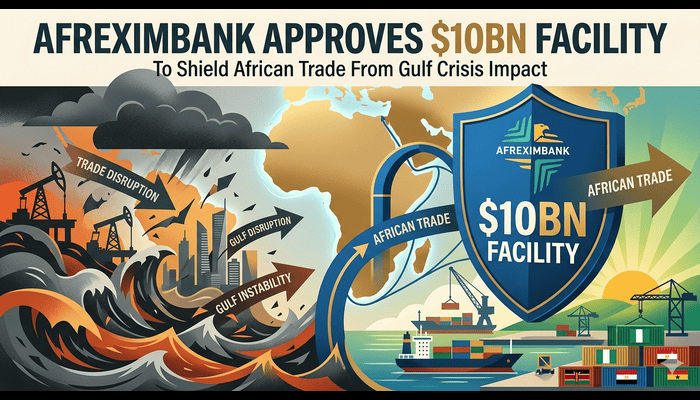
To counter severe economic shocks triggered by escalating conflict in the Middle East, the African Export-Import Bank (Afreximbank) board of directors has approved a $10bn Gulf Crisis Response Programme (GCRP). The initiative aims to insulate African and Caribbean economies, financial institutions, and corporations from the impact of the ongoing crisis.
The conflict, which escalated on February 28 2026, has sent shockwaves through the global economy, with African and Caribbean nations bearing the brunt of the impact.
Given the significance of the Gulf region as a primary source of oil, liquefied natural gas (LNG) and fertilisers—and the critical role of the Strait of Hormuz—the outbreak has triggered wider repercussions, adversely affecting Caricom economies.
These impacts specifically affect nations that rely heavily on fuel, fertiliser and food imports, alongside those exposed to Gulf shipping corridors. Additionally, the crisis has disrupted investment, tourism and remittance inflows.
Sustaining essential imports and liquidity
The GCRP is designed to sustain essential imports, including fuel, LNG, food, fertiliser and pharmaceuticals, by providing vital short-term foreign exchange and liquidity to support vulnerable member states. It further aims to empower African energy and minerals exporters to capitalise on elevated prices and rerouted trade flows by scaling productive capacity in strategic commodities through pre-export finance, working capital and inventory financing.
Read also: Middle East war drags Kenya’s business activity to eight-month low
Additionally, the programme provides short-term relief to African and Caribbean member states whose tourism and aviation industries have been adversely impacted. The GCRP also seeks to build medium- to long-term resilience by scaling productive capacities and accelerating the completion of critical energy, port and logistics infrastructure projects delayed by the conflict.
Afreximbank president and board chairman George Elombi, commenting on the facility launched on March 31 2026, said: “This crisis response programme is in tune with our DNA. We understand how our economies work and the pain points associated with these transitory crises. The programme will support African countries in adjusting smoothly to the crisis while strengthening their resilience to future shocks through interventions that transform the structure of their economies”.
The GCRP builds on timely emergency interventions introduced by Afreximbank in recent years, which have cushioned economies from shocks such as the 2015-16 commodity crisis, the Covid-19 pandemic of 2020-21 and the 2023-24 Ukraine crisis. For instance, the bank launched a $4bn Ukraine Crisis Adjustment Trade Financing Programme for Africa (Ukafpa) to help countries confront trade impacts. Under this programme, the bank disbursed $39bn, which helped many African nations bridge liquidity gaps or access essential goods.
Strengthening regional coordination
These historical interventions underscore Afreximbank’s ability to deploy robust and innovative risk-mitigation frameworks to help member states navigate global volatility. Through the GCRP, the bank has already begun taking proactive steps through partnerships with banks and corporations to secure fuel, energy supplies, fertilisers and food imports interrupted by the prolonged crisis.
Read also: Collateral damage: how the Middle East war is deepening Nigeria’s transport and food crises
Beyond financing, Afreximbank will spearhead a coordinated regional response in partnership with the UN Economic Commission for Africa (Uneca), the African Union Commission (AUC), the African Continental Free Trade Area (AfCFTA) secretariat and the Caricom secretariat.
This collaboration aims to strengthen regional coordination on energy security, trade resilience and supply chain diversification.

Join BusinessDay whatsapp Channel, to stay up to date
Open In Whatsapp