Nigeria’s brewing industry is witnessing a balance sheet shift as major players collectively raised about N1.2 trillion in fresh capital in the past two years, a move already translating into improved working capital positions and stronger short-term liquidity across the sector.
The capital injection, driven largely through rights issues, comes at a critical time when brewers have been grappling with rising input costs, foreign exchange volatility, and weakened consumer demand.
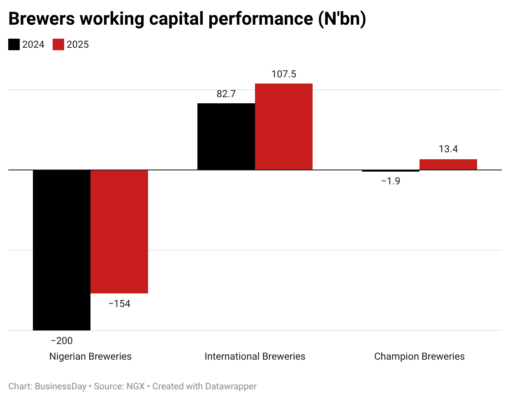
Data tracked by BusinessDay from the full-year financial statements revealed that out of the three listed brewers, International Breweries and Champion Breweries both reported an increase in positive working capital to N120.9 billion in 2025 from N80.9 billion reported in 2024.
A positive and growing working capital means companies are holding enough liquid assets to cover debts, pay suppliers, and fund day-to-day business activities without relying heavily on new borrowing.
However, Nigerian Breweries, the largest brewer, reported a negative working capital position of N154 billion from N200 billion reported in 2024.
When it is negative, the company’s current liabilities exceed its current assets, suggesting that the company lacks sufficient liquid assets to cover its short-term financial obligations. One way to navigate it is to turn to raise funds through debt or equity, financial analysts say.
“Working capital had been under severe strain due to FX losses and elevated finance costs. This fund raise provides immediate relief and improves operational flexibility,” said Tunde Adebayo, an independent capital markets analyst. “Management teams are prioritising cash flow efficiency to stay competitive and avoid costly external financing.”
Israel Odubola, a research analyst, linked the firms’ improved liquidity position to stronger macro fundamentals.
“The FX rate has stabilised a lot and even appreciated. Inflation has been decelerating for five months now. So bringing these together has enabled firms to meet their short-term obligations,” he added.
Read also: Nigeria’s biggest brewer tests local barley in push to cut $150m imports
In 2024, International Breweries raised N588 billion through a rights issue to settle a dollar-denominated loan and improve liquidity. Nigerian Breweries followed to raise N600 billion through a rights issue to reduce its debt burden and strengthen its balance sheet.
The Uyo-based beer maker, Champion Breweries, announced this year the opening of a N42 billion public offer of ordinary shares at N16 per share, following a N15.9 billion rights issue to existing shareholders in November. The capital raise is part of a two-stage programme to fund the acquisition of the Bullet energy drink brand portfolio and expand market reach.
The fresh funds are helping brewers reduce their reliance on expensive short-term borrowings, which had surged in recent years amid naira depreciation and inflationary pressures.
Data shows that the Nigerian economy is becoming stable, with the country’s real gross domestic product now at 3.87 percent in 2025, up from 3.38 percent in 2024.
The latest print marks Nigeria’s strongest annual performance since 2022 and extends the rebound from the pandemic-induced contraction of 6.96 percent in 2020. Growth recovered to 0.95 percent in 2021, accelerated to 4.32 percent in 2022, slowed to 3.04 percent in 2023, and has now strengthened for two consecutive years.
Similarly, the Consumer Price Index declined to 15.06 percent in February 2026 from 15.10 percent in January 2026.
For many businesses, this means that Africa’s most populous country is no longer under pressure compared to early 2023 and 2024
Debt profile improves
A key impact of the fundraising is the restructuring of debt portfolios. Brewers are now able to refinance high-cost, short-term obligations with longer-tenor instruments or equity, lowering finance costs and easing cash flow pressure.
Data reveals that Nigerian breweries reported N59.7 billion in loans and borrowings in 2025, which is the lowest the company has borrowed in the past four years.
CardinalStone Research analysts disclosed in a report that Nigerian breweries demonstrated a deliberate shift towards balance sheet optimisation in FY ’25, with total borrowings declining significantly to N59.7 billion from N209.1 billion in FY ’24, reflecting management’s commitment to reducing debt exposure.
“The reduction was largely supported by improved operating performance and disciplined cash flow management, which allowed the company to record a net repayment of N149.4 billion,” it said.
Read also: Champion Breweries lists N30bn bond on FMDQ Exchange platform
The report stated that for FY ’26, the company plans to keep new borrowings low and will mainly use money generated from its own operations to fund its activities.
“We expect improving operating performance and more stable working capital dynamics to support the cash position to N114.1 billion in FY ’26 (vs N61.1 billion in FY ’25). We also expect a debt to EBITDA ratio of 0.17x (vs. 0.21x in FY ’25),” CardinalStone disclosed.
For Champion breweries, the company took on substantial debt to fund the expansion of the Bullet brands. Non-current borrowings stood at N29.6 billion, while current borrowings were N29.4 billion, compared with no borrowings in the prior year.
While international breweries didn’t report any borrowings in the last two years, the company has shifted to other sources to raise funds.
This strategy is particularly important in an environment where interest rates remain elevated, despite the Central Bank of Nigeria (CBN) reduction of the Monetary Policy Rate (MPR) from 27.0 percent to 26.5 percent in February, aimed at fighting inflation.
FX exposure remains
Despite the positive shift in working capital, brewers remain exposed to foreign exchange risks due to their dependence on imported raw materials such as barley, malt, and packaging inputs.
The foreign exchange position of the brewers, although still negative at N18 billion, represents a significant decline from the N322 billion reported in 2024, indicating that pressure on the naira has reduced.
A review of the Nigerian breweries’ full-year financials shows that the company was the only brewer that reported an FX gain in 2025. In an earlier notice during the capital raise, the company disclosed that one of the reasons for raising funds was to reduce its foreign exchange exposure.
“ This reduction was driven by improved foreign exchange (FX) stability and lower FX exposure following the successful 2024 Rights Issue, which strengthened the balance sheet and eliminated foreign currency liabilities. Notably, the company recorded FX gains of N752 million in FY 2025, compared with an FX loss of N157.55 billion in FY 2024,” analysts at Csl StockBroker said.
However, International Breweries reduced its negative FX positions by 92 percent, while Champion Breweries reported N5.4 billion during the period.
The Nigerian naira recorded its best annual performance in over a decade in 2025, appreciating by more than seven percent against the United States dollar.
Data from the apex bank showed the naira has gained N50.05, or 3.4 percent, in the past three months at the Nigerian Foreign Exchange Market (NFEM).
While improved liquidity allows for better FX planning and forward purchases, analysts caution that sustained naira volatility could still weigh on margins.
Join BusinessDay whatsapp Channel, to stay up to date
Open In Whatsapp