May & Baker Nigeria Plc has projected revenue of N42.3 billion for the 2026 financial year, even as it warns that rising raw material costs and structural challenges in the pharmaceutical sector could undermine industry stability.
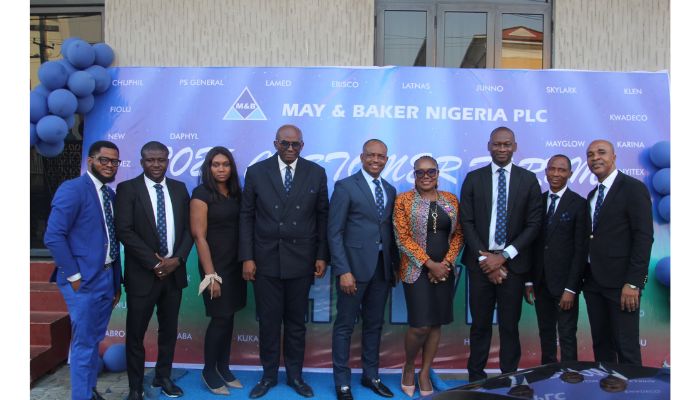
The projection was disclosed at the company’s customers’ forum themed “Working Closely To Thrive” held in Ikeja, where management engaged distributors and outlined strategies for sustaining growth amid economic pressures.
Patrick Ajah, the company’s managing director, said the firm recorded a 32 percent revenue increase in 2025, reaching N33.9 billion, driven largely by increased market penetration, foreign exchange stability, and internal operational resilience.
Read more:May & Baker revenue surges to N11.9 billion, highest in four years
He, however, noted that recent global developments, particularly tensions in the Middle East, are already impacting production costs.
According to him, the price of paracetamol raw materials has surged sharply within weeks.
“Before now, per kilogram, we were paying $2.90. As I speak, suppliers are quoting $6.50. After negotiations, it dropped to $5.90,” Ajah said.
He warned that such volatility, despite occurring outside Nigeria, has direct consequences on local manufacturers due to heavy reliance on imported active pharmaceutical ingredients (APIs).
Ajah called on the federal government to prioritise local API production, stressing that current financing conditions are prohibitive.
“Loans at interest rates as high as 33 percent make it nearly impossible for manufacturers to break even. If anyone is going into API production, government support is critical, zero duty and single-digit financing of not more than 2.5 to five percent,” he said.
He added that API investments typically require a minimum of three years before yielding returns, with additional time needed to achieve profitability.
The company also emphasised the role of distributors in its growth trajectory, noting that performance across its network directly reflects overall business expansion.
Read also: Traders kick against plans to bring in Chinese retailers into Ariaria International Market
Ajah said top-performing distributors, largely concentrated in Lagos and Onitsha, continue to drive volume growth, while the company is increasing investments in northern Nigeria to deepen market reach.
“Our distributors are central to our success. If they are not growing, we cannot grow. Last year, we achieved 32 percent growth, which means many of them delivered double-digit expansion,” he said.
As part of efforts to strengthen partnerships, May & Baker disbursed over N300 million in incentives to distributors in 2025 and plans to increase it in 2026.
The forum, he noted, also serves as a feedback mechanism, enabling the company to refine its distribution strategy based on real-time market insights.
Ajah further highlighted challenges in logistics and security, noting that poor road infrastructure and insecurity have limited access to certain markets, affecting distribution efficiency.
“In some locations, we have had to withdraw supply routes because of insecurity. These are real constraints on operations,” he said.
On pricing, Ajah said the company has deliberately held back increases despite cost pressures, citing concerns about affordability for consumers.
“Most of the people who rely on our products are not high-income earners. We are cautious about pricing because access to basic medication like paracetamol is critical,” he said.
He added that recent foreign exchange stability and the federal government’s zero tariff policy on pharmaceutical inputs have provided some relief, helping companies manage costs without passing the burden fully to consumers.
Also speaking, Chiagozie Maduneme, head of sales, expressed confidence in achieving the company’s 2026 revenue target despite prevailing macroeconomic challenges.
He said growth would continue to be driven by expanded distribution, increased promotional activities, and sustained engagement with key market stakeholders.
Beyond immediate business concerns, Ajah stressed the need for long-term industry planning, warning that Nigeria’s dependence on imported pharmaceutical inputs leaves the sector vulnerable to global shocks.
“As a country, we need to plan. Politics should not interfere with healthcare delivery or access to essential medicines,” he said.
He added that while some local investments in API production have begun, progress remains slow due to high capital requirements and limited government support.
The company also disclosed plans to deepen market penetration through expanded advertising campaigns across television and radio platforms, including local language content targeted at northern audiences.
Ajah noted that the strategy is aimed at boosting demand, supporting distributor profitability, and reducing price undercutting across markets.
Read also: GSK, May & Baker show strong cash flows in first quarter results
He also revealed plans to introduce succession planning support for distributors, many of whom operate informal structures without long-term business continuity frameworks.
“We want our distributors to build sustainable businesses. Succession planning is critical to ensuring continuity and stability across the value chain,” he said.

Join BusinessDay whatsapp Channel, to stay up to date
Open In Whatsapp