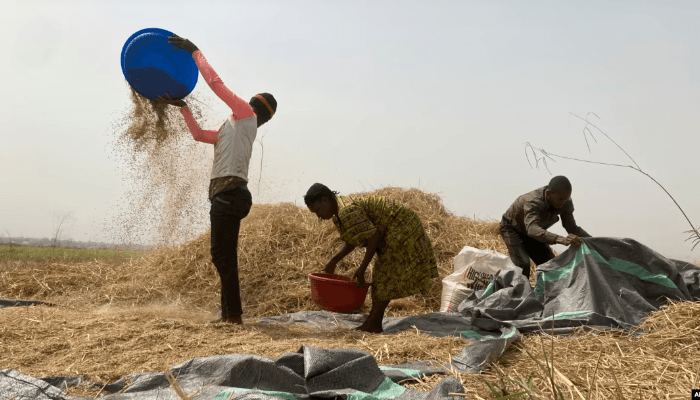
For many years, China Peters, a Benue State farmer, cultivated yams and cassava on a large acre of land that provided his family with a livelihood.
After several planting seasons enjoying peace and calm in his community, calamity struck when attacks over land ownership and insurgency made him and other farmers abandon their farms, forcing them to seek refuge in Internally Displaced Persons (IDPs) camps.
“I now live in an IDP camp with other farmers from my village and other villages,” he said in an interview with BusinessDay.
Read also: Germany bets on Nigeria’s food factories as import bill hits trillions
Across Nigeria, similar land-related conflicts are forcing farmers off their fields, disrupting supply chains and threatening food production.
About 54 violent incidents have erupted amid rising land clashes between locals in the South-South, North-West, South-East, North-East, North-Central, and South-West, a new report by SBM Intelligence found.
The report titled, ‘The Price of a parcel: An analysis of land disputes and their impact on food security in Nigeria’ is billed for official release on March 31, 2026.
The SBM noted that between 2019 and early 2026, about 112 people, including farmers, have died as a result of growing land dispute incidents. This growing trend also poses a risk to traders and the overall food supply chain, the SBM survey found.
Abiodun Olorundero, managing partner at Prasinos Farms, told BusinessDay that land conflicts in the South-West often stem from a desire to reclaim lands already sold to a farmer by ‘omonile’, a Yoruba term used to describe indigenous community land owners.
“Because land appreciates with time, we see that people who sell the land to farmers come back to reclaim the land to resell to real estate buyers. They do this because it will fetch them more money,” said Olorundero.
According to him, even after the farmers present land ownership documents, they are still forced to either delay planting until a consensus is made or they are threatened to leave the land altogether.
“Many of the affected farmers are smallholders, which means that their output contribution to food production is limited,” Olorundero told BusinessDay.
The SBM survey showed that around 72.7 percent of traders across states in the country have direct experience of the impacts of land conflict, ranging from 54.5 percent in the North-East to a high of 92.3 percent in the South-West, posing a serious risk to food security and the safety of players in the food supply chain.
“Land ownership is at the heart of most of the clashes in Benue State, even if it isn’t often discussed,” a source said. “Many of the conflicts we hear about stem directly from land disputes.
Read also: NEPC guards against food poisoning, checkmates aflatoxin in food exports
Impacts on food security
After several strategic interventions by the Nigerian government to combat inflation, food inflation dropped to 12.12 percent in February on a year-on-year basis, down from 26.98 percent in 2025, according to data from the National Bureau of Statistics.
Yet experts warn that farmers’ inability to cultivate on lands where they have legal rights could result in declining food production and ultimately spike food prices.
“When farmers abandon farms, it means food circulation will be impacted, and this will affect food prices for consumers,” the agribusinessman said.
Weak policies and laws
According to Nigeria’s 1978 Land Use Act, users hold land under statutory or customary rights, commonly proven by a Certificate of Occupancy, which acts as evidence of the right to occupy for a specific period.
This law should protect a landowner against threats from people reclaiming lands where they do not possess ownership. However, weak adherence to the law often leaves ownership to a battle of survival of the fittest, regardless of the original owner’s documents.
“People who rent or buy land the legal way no longer have access to it. The government has said land dispute cases should not be reported to the police. So who do we report to?” Olorundero said.
Logistic hurdle
Food supply chains, including logistics, are delayed as a result of farmers’ inability to meet production quotas and unrest in communities where clashes are raging. This makes it difficult for transporters to load and supply food.
An Abuja commodities transporter who craved anonymity told BusinessDay that in the face of clashes, it costs more to transport goods because of the risk involved.
“When there are issues of insecurity or fights in communities where I go to pick up, I charge more from the clients because the risk involved in that trip is high. I need some form of insurance,” he said.
Read also: Stakeholders call for reforms as land conflicts force farmers off fields, impact food security
The consumer costs
As more farmers abandon their fields and supply chains come under strain, the impact could show up in markets where higher transport costs and reduced supply are factors in food prices rising beyond the reach of cash-strapped Nigerians.
“When transporters increase their cost of carrying goods for us, we are also going to transfer that extra cost to the consumers. That is the way it works,” Iya Amope, a Lagos trader, said.

Join BusinessDay whatsapp Channel, to stay up to date
Open In Whatsapp