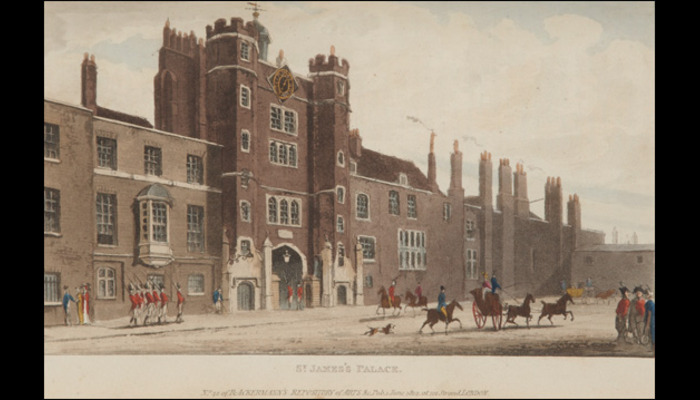
The Court of St James’s derives its name from St James’s Palace, which is the most senior royal residence in the United Kingdom, and which retains its pride of place in diplomatic activities even though Buckingham Palace nearby has been the metropolitan residence of British monarchs since the enthronement of Queen Victoria in 1837.
Queen Victoria was at home in Buckingham Palace and at court at St James Palace when an epochal drama was enacted several thousands of miles away in Lagos. The event is known in history as ‘The Reduction (some people call it the ‘Destruction’) of Lagos’.
Lagos at the time was known for slave trade. Anti-slavery sentiment was strong in the UK, and the British Navy was operating on the high seas to put a stop to the inhuman trade. Many of the first slaves to be freed settled in Sierra Leone. Some chose to come back to Lagos. They were known among the indigenes as ‘Saros’. The Saros were fearful that, in the prevalent climate of Lagos, they might be re-enslaved and sold off to European rogue slavers. This was because Oba Kosoko of Lagos was an avid slave trader, despite the opprobrium aroused in some quarters by his actions.
A group of people went to meet Queen Victoria at St James’s Court to plead for action against slave trade in Lagos. They included Bishop Ajayi Crowther and other missionaries.
It was decided that Oba Kosoko would be deposed, and that Oba Akitoye, who had himself been deposed by Kosoko earlier, and who was amenable to ending the slave trade, would be brought back to Iga Idunganran.
On the 25th of November 1851, Commander Forbes of the Royal Navy, with 306 officers and men aboard the HMS Bloodhound attacked Lagos. Kosoko’s warlord Oshodi Tapa stood ready to repulse them with cannon and five thousand muskets on the Lagos shore. After a fierce battle the British were forced to retreat.
They came back ‘in full force’ one month later. They routed Oshodi’s warriors in an epic battle of firepower that Lagosians would call ‘Ogun Agidingbi’ – in reference, and reverence, to the loud boom of British guns.
Oba Kosoko fled with his supporters to Epe on 28th December 1851. Thousands died among Oshodi Tapa’s soldiers, and among the devastated population of Lagos.
On the British side, fifteen men died and seventy-five were wounded. One of the British wounded was Captain James Pinson Labulo Davies, an officer of Her Majesty’s Navy, who was a ‘Saro’, and who would later become a wealthy cocoa trader and philanthropist in Lagos. He would marry Sarah Forbes Bonetta, the beautiful and brilliant former slave girl that Queen Victoria had adopted as her goddaughter. Their daughter Victoria – named after the Queen, would marry Dr John K. Randle, an eminent Lagos physician.
Akitoye was installed as Oba of Lagos, and the Treaty of Lagos was signed on 1st January 1852, abolishing slave trade.
Of course, Queen Victoria was in the business of Empire, not Philanthropy. Less than ten years later, Oba Dosunmi, Akitoye’s successor, under the threat of military bombardment, was corralled by Queen Victoria’s officers into signing the Lagos Treaty of Cession, ceding Lagos as a colony to Britain.
Historical developments since then are well known. The merging of Lagos with the Southern Protectorate, and the amalgamation of the Southern Protectorate with the Northern Protectorate to form ‘Nigeria’ in a ‘wedding’ of the favoured Northern ‘gentleman’ to the Southern ‘lady of means.’ Elections, Independence. Civil War.
British interest in Nigeria has always been a given, and very seldom for altruistic reasons. The two nations have forged strong economic and social relations. There are one quarter of a million ethnic Nigerians living in the UK. Some have British citizenship. Many have achieved prominent positions in HealthCare, Commerce, and Creative Arts. Even in politics, people of Nigerian ethnicity sit on both sides of the parliamentary aisle. Kemi Badenoch, feisty leader of the Conservative Party, battles with identity confusion, seeking to ‘disappear totally’ into British values and their way of life.
Members of the Royal Family visited Nigeria as the history of Nigeria and the United Kingdom progressed. Charles’ mother Elizabeth visited twice.
Three past Nigerian leaders have been received on State Visits to the United Kingdom – the ultimate acknowledgment of esteem and fraternal relations between the nations. General Yakubu Gowon visited, as did President Shehu Shagari. General Ibrahim Babangida the Military President had his turn in May 1989.
On Wednesday and Thursday 18th and 19th of March 2026, it was the turn of the incumbent President of Nigeria, Asiwaju Bola Ahmed Tinubu, accompanied by his wife, Oluremi, to be received with pomp and pageantry by King Charles and Queen Camilla. No effort was spared. The flag of Nigeria flew alongside the Union Jack all the way down the Mall.
In the work aspect, cooperation agreements were signed between officials of the two governments. The huge accompanying coterie of private sector players had a field day networking and making deals with British counterparts. There was talk of making the Commonwealth more relevant and active as an economic and trading block, as a countervailing initiative to increasing American isolationism.
Nigeria was in the eye of the world, and it was for good this time. At the State Banquet, King Charles remarked, in pigin, only partially in jest ‘Nigeria no dey carry last’.
Nigerians were still having a hard time in their daily lives, but the indices of an economic turnaround, intentionally, if imperfectly, executed, were there to be seen.
The relentlessly adversarial commentariat in social media and some local newspapers were turning contortions to tar the State Visit with a dark brush of villainy or snag it in the well-known mire of Nigerian politics.
President Tinubu’s State Visit has since come and gone, and the unending saga of Nigeria and the Court of St James’s has moved to the next phase.

Join BusinessDay whatsapp Channel, to stay up to date
Open In Whatsapp