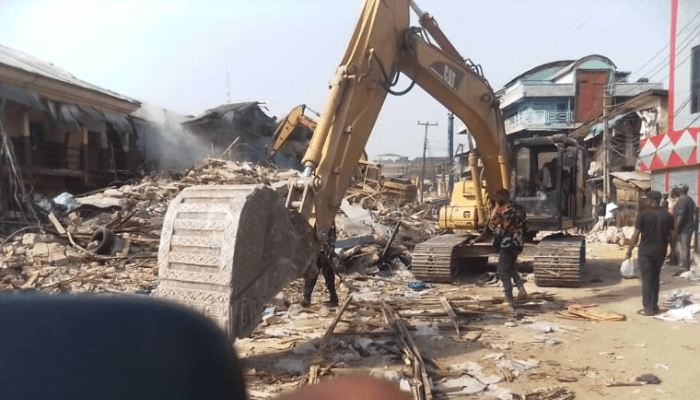
…Demolition, market upgrade long overdue – Govt

For Azubuike Onyia, a textile trader at the famous Onitsha Main Market in Anambra State, the dream of independence has turned into a nightmare of debris and dust. The 26-year-old had only recently gained his freedom after five years of apprenticeship, investing his entire N2 million settlement into a shop that now lies in ruins. He represents a growing class of traders whose livelihoods were levelled by the state government’s recent demolition exercise.

The end of February 2026 brought a bitter conclusion for many in the commercial hub. In the early hours of March 1, earth-moving equipment deployed by the state government rammed into shops across Park 1, Park 2, and Park 3, as well as sections along Bright Street and the popular Gwomgworo area. Traders who had hoped to resume business after the Christmas season instead found their investments crushed under the weight of bulldozers.

The human toll of the exercise is worrisome. Onyia, who used funds from his elderly parents to establish himself, has been forced to transition from a shop owner to a hawker.

“I have lost all my livelihood, now moving from a shop owner to hawking and to becoming jobless after the Governor Chukwuma Soludo’s bulldozers destroyed my shop, on which I spent over N2 million, given to me after my freedom. Part of the money is from my old parents to establish,” he said.

Onyia told BusinessDay that it is too hard to survive the present hard conditions, saying he finds it difficult to go back to apprenticeship to start all over again.

“You won’t believe that I just spent barely a month and a half before the shop demolition. I have resorted to hawking wares to eke out a living.

“My solace now is that I have already paid for a room apartment in Onitsha suburb, where I took shelter before this incident,” he further lamented.

Others, like Charles Iloh, suffered physical collapses upon seeing their shops destroyed before they could evacuate their wares.

“I rushed to evacuate my wares at 2 am. When I got close to my shop, it was already demolished with the wares inside. I collapsed. On regaining consciousness, I managed to leave without a pin from my shop,” Iloh recounted.

The chaos also invited exploitation, with Ifeanyi Anagor recounting how security operatives allegedly sold off the iron structures of demolished shops even as owners pleaded for mercy.

“In my presence, the iron structure of my shop was sold by a vigilante operative despite my plea to him. He asked me why I did not comply with the order that we should remove our wares within 14 days,” he lamented.

“We have turned from shop owners to hawkers. Since the demolition was carried out, we struggle to get here before 5 am daily, and scramble for a standing space where we hang on with our goods.

Another victim, Kingsley Obum, said that most of them have resorted to waking up before 4am daily and rushing to the market before 5am so they can get a standing space to trade, but government agents have sacked them from the demolished spot and sealed off the whole place.

The affected traders were earlier given 14 days’ notice of the impending demolition on Feb. 1, 2026, which was later extended till Feb. 28, 2026. Some of the traders thought that the government might have backed out of the plan. The belief was further strengthened after a reported court order restrained action and ordered maintenance of status quo till the next court sitting on March 16, 2026.

The state government, however, maintains that the demolition was a necessary step toward progress. Anthony Nwora, chairman of the Onitsha North Local Government Area, stated that the action was geared toward ridding the market of illegal structures and restoring its original master plan. Leaders of the market associations, including Humphrey Anuma, President General of Anambra State Markets Amalgamated Traders Association (ASMATA) and Chijioke Okpalugo, chairman of Onitsha Main Market, defended the move as a cleansing of the rot perpetrated by previous administrations. Anuma noted that several shops had been cleverly erected over drainage channels by developers who recouped their money and left unsuspecting traders to face the eventual consequences.

“Go and check the demolished places, you see even drainage channels that were covered and shops erected on them. Even the developer who built those shops then knew that a day like this would come. That’s why he cleverly sold all the shops after building and recouped his investments immediately.

“My pain is that most of the people occupying the structures now, before this demolition, didn’t know the situation before they committed money into the property” Anuna said.

Also, the Onitsha Chamber of Commerce, Industry, Mines and Agriculture (ONICCIMA) commended what it described as the visionary initiative of Governor Soludo to remodel and modernise the Onitsha Main Market

Chinedu Nwonu, president of the Chamber, in a statement, said the market was long overdue for the transformation, which he said was aimed at restoring the market’s prestige through the provision of essential modern facilities, including adequate vehicular parking, proper fire-fighting equipment, security posts, CCTV surveillance, improved ventilation, etc, all designed for convenience and enhanced shopping experience.

Nwonu said the Chamber recognises the fact that the current fragmented state of the market, resulting from years of unauthorised encroachments, has undermined its functionality and sustainability. It also took note of the implications of the present government’s actions in the market.

Join BusinessDay whatsapp Channel, to stay up to date

Open In Whatsapp